 N3 · easy
Simplified retelling · JLPT N3
浦島太郎 Urashima Tarō in easy Japanese (N3)
This is our own simplified retelling of Urashima Tarō and the Palace Under the Sea, written for N3 learners and checked word by word against the N3 vocabulary list. A few story words and grammar patterns go beyond N3; the notes below give each one's level. It keeps the characters, events and ending of the original. When it feels easy, move on to the original text.
The story in brief
The young fisherman Urashima Tarō saves a turtle from some cruel children, and a few days later the grateful turtle carries him to the Dragon Palace under the sea. After three happy years with Princess Otohime he grows homesick and returns with a jewelled box he has promised never to open. Back home, he finds three hundred years have passed. Forgetting his promise, he opens the box hoping to learn something, and it turns him into an old man.
AI translation · independently checked
むかしむかし、ある海の近くの村に、うらしまたろうという若いりょうしが住んでいました。Long, long ago, in a village near the sea, there lived a young fisherman called Urashima Tarō.
うらしまは毎日海へ出て、魚をつって、両親と生活していました。Every day Urashima went out to sea, caught fish, and lived with his parents.
ある日、うらしまが魚つりから帰る途中、子供たちが五、六人集まっていました。One day, as Urashima was on his way home from fishing, five or six children had gathered together.
見ると、小さいかめをつかまえて、ぼうでたたいたり、石を投げたりして、いじめています。When he looked, he saw that they had caught a little turtle and were tormenting it, beating it with sticks and throwing stones at it.
「そんなかわいそうなことをしてはいけないよ」とうらしまは言いましたが、子供たちは聞きません。"You mustn't do such a cruel thing," said Urashima, but the children would not listen.
かめを足でけったり、すなの中に入れたりしました。They did things like kicking the turtle and pushing it into the sand.
「じゃあ、お金をあげるから、そのかめを売ってくれないか」"All right, then. I'll give you some money, so won't you sell me that turtle?"
うらしまがそう言うと、子供たちは喜んでお金をもらって、帰って行きました。When Urashima said this, the children happily took the money and went off home.
うらしまはかめの首をやさしくなでて、「もう大丈夫だよ。さあ、お帰り」と言って、海にかめを放してやりました。Urashima gently stroked the turtle's neck. "You're safe now. Go on, off you go home," he said, and he let the turtle go into the sea.
かめはうれしそうに、水の中へ深くしずんで行きました。The turtle looked happy as it sank deep down into the water.
二、三日あと、うらしまが船に乗って、遠くの海で魚をつっていると、後ろから「うらしまさん、うらしまさん」と呼ぶ声がしました。Two or three days later, Urashima was out in his boat fishing far out at sea when a voice called from behind him: "Urashima, Urashima!"
ふりかえると、人はだれもいません。He turned around, but there was nobody there.
船のそばに、一ぴきのかめがいました。Beside the boat there was a single turtle.
「私はこの前助けていただいたかめです。今日はお礼に来ました。うらしまさん、りゅうぐうを見たことがありますか」"I am the turtle whose life you kindly saved the other day. I have come today to thank you. Master Urashima, have you ever seen the Dragon Palace?"
「話には聞いたが、まだ見たことはないよ。でも、海のそこまでは泳いで行けないよ」"I've heard stories about it, but I've never seen it. Still, I can't swim all the way to the bottom of the sea."
「大丈夫です。私の背中に乗ってください」"There is no need to worry. Please climb onto my back."
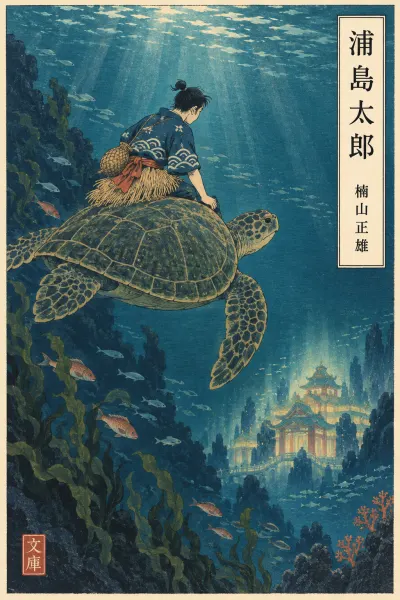
うらしまがかめの背中に乗ると、かめはどんどん泳いで行きました。When Urashima got onto the turtle's back, the turtle swam steadily on and on.
なみの音がだんだん遠くなって、青い水のそこへ、夢のように運ばれて行きました。The sound of the waves grew fainter and fainter, and he was carried down to the bottom of the blue water as if in a dream.
すると急に明るくなって、白いすなの道の向こうに、立派なもんが見えました。Then all at once it grew bright, and beyond a road of white sand he could see a magnificent gate.
そのおくには、金や銀の建物が光っていました。Farther inside, buildings of gold and silver were shining.
かめはうらしまをもんの中へあんないしました。The turtle led Urashima in through the gate.
たくさんの魚がめずらしそうにうらしまを見ています。A great many fish were gazing at Urashima with curiosity.
そこへ、おとひめさまが、おおぜいの女の人たちと一緒に迎えに来ました。Just then Princess Otohime came out to welcome him, together with a large number of ladies.
「うらしまさん、よく来てくださいました。かめの命を助けてくださって、本当にありがとうございます。どうぞゆっくり楽しんでください」"Master Urashima, how good of you to come. Thank you most sincerely for saving the turtle's life. Please stay as long as you like and enjoy yourself."
おとひめさまはていねいにあいさつしました。Princess Otohime greeted him most courteously.
それから、魚たちがめずらしい料理をたくさん運んできて、にぎやかなパーティーが始まりました。After that, the fish brought in plenty of rare and wonderful dishes, and a lively feast began.
女の人たちは歌を歌ったり、おどりをおどったりしました。The ladies sang songs and danced dances.
うらしまは夢を見ているような気持ちでした。Urashima felt as if he were dreaming.
そのあと、おとひめさまは四つの部屋を見せてくれました。Afterwards, Princess Otohime showed him four rooms.
東がわの部屋は春の景色で、さくらの花が咲いて、小鳥が鳴いていました。The room on the east side held a spring scene, where cherry blossoms were in bloom and little birds were singing.
南がわの部屋は夏の景色で、いけに赤と白の花が咲いていました。The room on the south side held a summer scene, where red and white flowers were blooming on a pond.
西がわの部屋は秋の景色で、赤いもみじのはやしがありました。The room on the west side held an autumn scene, with a grove of red maple trees.
北がわの部屋は冬の景色で、山が雪で真っ白でした。The room on the north side held a winter scene, where the mountains were pure white with snow.
うらしまはおどろいて、何もかも忘れてしまいました。Urashima was so amazed that he forgot everything else.
毎日楽しいことが続いて、三年がすぎました。One happy day followed another, and three years went by.
三年目の春、うらしまはふるさとの夢を見るようになりました。In the spring of the third year, Urashima began to dream of his home village.
「お父さんとお母さんは、今どうしているだろう」"I wonder how my father and mother are doing now."
そう思うと、早く家に帰りたくなりました。When he thought of this, he wanted to hurry home.
歌を聞いても、おどりを見ても、楽しくありません。Even when he listened to the songs or watched the dancing, he took no pleasure in it.
おとひめさまは心配して、「気分が悪いのですか」と聞きました。Princess Otohime grew worried and asked, "Are you feeling unwell?"
「いいえ。実は、家に帰りたくなったのです」"No. The truth is, I have come to want to go home."
おとひめさまは悲しそうな顔をしましたが、「それでは、しかたがありません」と言って、きれいなほうせきでかざった箱を持って来ました。Princess Otohime looked sad, but she said, "Then it cannot be helped," and she brought out a box decorated with beautiful jewels.
「これはたまてばこです。中には人間のいちばん大事なものが入っています。またここへ戻りたいなら、決してこの箱を開けてはいけません」"This is the jewelled box. Inside it is the thing most precious to a human being. If you wish ever to return here, you must never, ever open this box."
「はい、決して開けません」"Yes. I will never open it."
うらしまは箱を持って、もんを出ました。Urashima took the box and went out through the gate.
かめが待っていました。The turtle was waiting for him.
うらしまはかめの背中に乗って、すぐにもとのはまに着きました。Urashima climbed onto the turtle's back and soon arrived at the same beach he had left.
かめは「では、お元気で」と言って、海の中へ帰って行きました。"Well then, fare you well," said the turtle, and it went back into the sea.
うらしまはまわりを見ました。Urashima looked around him.
景色は夢で見たふるさとと同じです。The scenery was the same as the home he had seen in his dreams.
でも、会う人はみんな知らない顔ばかりでした。But everyone he met had a face he did not know.
自分の家があった所へ行くと、草がたくさんはえていて、家は何もありませんでした。When he went to the place where his house had stood, it was overgrown with weeds, and nothing at all was left of the house.
そこへ、つえをついたおばあさんが来ました。Just then an old woman came along, leaning on a stick.
「すみません。うらしまたろうの家はどこでしょう」"Excuse me. Where might Urashima Tarō's house be?"
「うらしまたろう? 聞いたことがありませんね」"Urashima Tarō? Never heard of him."
「そんなはずはありません。たしかにこの辺に住んでいたのです」"That can't be right. He definitely lived around here."
おばあさんはしばらく考えてから言いました。The old woman thought for a while and then spoke.
「ああ、その人なら、三百年も前の人ですよ。昔、船でつりに出たまま、帰って来なかったそうです。りゅうぐうへ行ったのだろうという話ですよ」"Oh, if you mean him, he's someone from a good three hundred years ago. They say that long ago he went out fishing in his boat and never came back. The story goes that he must have gone to the Dragon Palace."
うらしまはびっくりしました。Urashima was astonished.
りゅうぐうの三年は、人間の三百年だったのです。Three years in the Dragon Palace had been three hundred years in the human world.
家がないのも、両親がいないのも当たり前です。No wonder his house was gone and his parents were no longer there.
うらしまは急に悲しく、さびしくなりました。All at once Urashima felt sad and lonely.
りゅうぐうへ戻りたくなりましたが、かめはもう来ません。He longed to go back to the Dragon Palace, but the turtle would not come any more.
その時、うらしまは持っていたたまてばこに気がつきました。It was then that Urashima noticed the jewelled box he was holding.
「そうだ。この箱を開けたら、何か分かるかもしれない」"I know! If I open this box, maybe I'll find out something."
うらしまは、おとひめさまとの約束を忘れて、箱を開けてしまいました。Forgetting his promise to Princess Otohime, Urashima opened the box.
すると中から、むらさき色の煙が出て、うらしまの顔にかかって、すっと消えました。At once a purple smoke rose out of it, drifted over Urashima's face, and quietly vanished.
箱の中には何も残っていませんでした。Nothing at all was left inside the box.
水にうつった自分の顔を見ると、顔はしわだらけで、髪もひげも真っ白でした。When he looked at his face reflected in the water, it was covered in wrinkles, and his hair and beard were snow white.
うらしまは、おじいさんになっていたのです。Urashima had become an old man.
「人間のいちばん大事なものとは、じゅみょうのことだったのか」"So the thing most precious to a human being was a person's span of life."
うらしまは残念そうに言いました。Urashima said it sadly, full of regret.
春の海は遠くまで静かに広がっていて、どこからか船の歌が聞こえてきました。The spring sea stretched calmly far into the distance, and from somewhere came the sound of a boatman's song.
うらしまは、ぼんやりと昔のことを思い出していました。Urashima was absently remembering days long past.
Vocabulary
| Word | Meaning | JLPT |
|---|---|---|
| りょうしりょうし | fishermandictionary form: 漁師漁 means 'fishing' and 師 means 'master of a trade'. | N2 |
| いじめていますいじめる | to bully; to tormentdictionary form: いじめるUsed for picking on someone weaker, whether a person or an animal. | N4 |
| かわいそうかわいそう | pitiable; poor (thing); かわいそうなこと: a cruel thing to do (to a poor creature)A な-adjective. かわいそうなこと here means 'a cruel thing to do'. | N3 |
| 放してはなす | to let go; to release (an animal)dictionary form: 放すDo not confuse it with 話す (to speak) or 離す (to separate). | N3 |
| お礼おれい | thanks; a return of a favourお礼に来る means 'to come in order to thank someone'. | N4 |
| りゅうぐうりゅうぐう | the Dragon Palace (the Sea God's palace under the sea)dictionary form: 竜宮A key place in Japanese folktales. It is usually written 竜宮 or 竜宮城. | — |
| 迎えむかえる | to welcome; to meet (a guest)dictionary form: 迎える迎えに来る means 'to come to meet or collect someone'. | N4 |
| 景色けしき | scenery; viewThis is an irregular reading of the kanji. | N4 |
| ふるさとふるさと | one's home village; hometownOften written 故郷. The word is warm and nostalgic. | — |
| たまてばこたまてばこ | a jewelled box; a treasure casketdictionary form: 玉手箱The famous box from this tale. It is used today for something full of surprises. | — |
| 決してけっして | never (with a negative)It is always followed by a negative form, such as 決して開けてはいけません. | N4 |
| 当たり前あたりまえ | natural; only to be expectedIt can mean 'no wonder' or 'of course'. | N2 |
| 約束やくそく | promise約束を忘れる means 'to forget a promise'. | N4 |
| じゅみょうじゅみょう | lifespan; span of lifedictionary form: 寿命It is also used for how long a machine or battery lasts. | N2 |
Grammar
〜たり〜たりする N4 doing things like A and B
This pattern lists typical actions as examples, without giving a complete list or an order. Here it shows the different ways the children hurt the turtle.
ぼうでたたいたり、石を投げたりして、いじめています
they were tormenting it, beating it with sticks and throwing stones at it
〜ていただく N3 to have someone (kindly) do something for you
This is the humble form of 〜てもらう. The turtle uses it to show deep respect and thanks to Urashima for saving it.
私はこの前助けていただいたかめです。
I am the turtle whose life you kindly saved the other day.
〜ようになる N4 to come to do; to start doing
〜ようになる means 'to come to do' or 'to start doing'. It attaches to the dictionary form (or ない form) and expresses a change in state or habit. Urashima was not homesick before, but now he has started to dream of home.
うらしまはふるさとの夢を見るようになりました。
Urashima began to dream of his home village.
〜たまま N3 while still in the state of ~; having done ~ and nothing changed
It shows that the state after an action continued. He went out fishing and stayed in that state, never coming back.
船でつりに出たまま、帰って来なかったそうです。
They say he went out fishing in his boat and never came back.
〜そうだ (hearsay) N4 I hear that ~; they say that ~
After a plain form, そうだ reports information heard from others. It is different from the look-based 〜そう in うれしそう. The old woman is passing on an old rumour.
帰って来なかったそうです
they say he never came back
〜だらけ N3 covered with ~; full of ~
It is attached to a noun and means something is covered with it, usually something unpleasant. しわだらけ means 'all wrinkles'.
顔はしわだらけで、髪もひげも真っ白でした。
his face was covered in wrinkles, and his hair and beard were snow white.