Part 1 of 4 · JLPT N2
浦島太郎 Urashima Tarō, part 1: A Rescued Turtle Repays a Kindness
In this part
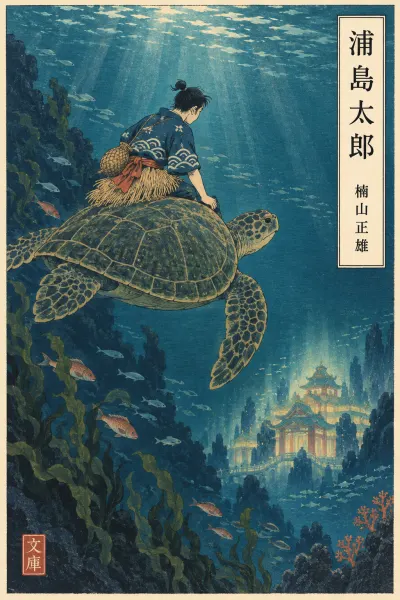
Urashima Tarō, a fisherman who supports his parents, saves a small turtle from some children by buying it from them and setting it free. A few days later the turtle appears beside his boat to thank him and offers to take him to the Dragon Palace at the bottom of the sea. Carried on its back into the deep blue water, Urashima arrives before a magnificent gate with glittering roofs of gold and silver.
AI translation · independently checked
一1
むかし、むかし、丹後の国水の江の浦に、浦島太郎というりょうしがありました。Long, long ago, on the shore of Mizunoe in the province of Tango, there lived a fisherman called Urashima Tarō.
浦島太郎は、毎日つりざおをかついでは海へ出かけて、たいや、かつおなどのおさかなをつって、おとうさんおかあさんをやしなっていました。Every day Urashima Tarō would shoulder his fishing rod and set off for the sea, where he caught sea bream, bonito and other fish, and in this way he supported his father and mother.
ある日、浦島はいつものとおり海へ出て、一日おさかなをつって、帰ってきました。One day Urashima went out to sea as usual, fished all day long, and was on his way home.
途中、子どもが五、六人往来にあつまって、がやがやいっていました。Along the way, five or six children had gathered in the road and were making a great racket.
何かとおもって浦島がのぞいてみると、小さいかめの子を一ぴきつかまえて、棒でつついたり、石でたたいたり、さんざんにいじめているのです。Wondering what was going on, Urashima peeped in and saw that they had caught a little baby turtle and were poking it with sticks and hitting it with stones, tormenting it terribly.
浦島は見かねて、Urashima could not bear to watch, and
「まあ、そんなかわいそうなことをするものではない。いい子だから」"Now, now, you mustn't do such a cruel thing. Be good children, won't you?"
と、とめましたが、子どもたちはきき入れようともしないで、he said, trying to stop them; but the children would not even listen, and
「なんだい。なんだい、かまうもんかい」"So what? So what? Who cares!"
といいながら、またかめの子を、あおむけにひっくりかえして、足でけったり、砂のなかにうずめたりしました。they said, and once again they flipped the little turtle onto its back, kicked it, and buried it in the sand.
浦島はますますかわいそうにおもって、Feeling sorrier for it than ever, Urashima
「じゃあ、おじさんがおあしをあげるから、そのかめの子を売っておくれ」"Well then, I'll give you some money, so sell me that little turtle."
といいますと、こどもたちは、said, and the children
「うんうん、おあしをくれるならやってもいい」"Yeah, yeah, if you'll give us money, you can have it."
といって、手を出しました。said, and held out their hands.
そこで浦島はおあしをやってかめの子をもらいうけました。So Urashima gave them the money and took the little turtle off their hands.
子どもたちは、The children
「おじさん、ありがとう。また買っておくれよ」"Thanks, mister! Buy another one from us sometime!"
と、わいわいいいながら、行ってしまいました。shouted noisily as they ran off.
そのあとで浦島は、こうらからそっと出したかめの首をやさしくなでてやって、After they had gone, Urashima gently stroked the turtle's head, which it had timidly poked out of its shell, and
「やれやれ、あぶないところだった。さあもうお帰りお帰り」"Well, well, that was a narrow escape. Now then, off home you go, off home."
といって、わざわざ、かめを海ばたまで持って行ってはなしてやりました。he said, and he took the trouble to carry the turtle all the way to the water's edge and let it go.
かめはさもうれしそうに、首や手足をうごかして、やがて、ぶくぶくあわをたてながら、水のなかにふかくしずんで行ってしまいました。Looking ever so happy, the turtle moved its head and limbs about, and before long, sending up bubbles, it sank deep down into the water and was gone.
それから二、三日たって、浦島はまた舟にのって海へつりに出かけました。Two or three days later, Urashima got into his boat once more and went out to sea to fish.
遠い沖のほうまでもこぎ出して、一生けんめいおさかなをつっていますと、ふとうしろのほうでHe had rowed far out into the open sea and was fishing with all his might when suddenly, from somewhere behind him,
「浦島さん、浦島さん」"Mr. Urashima! Mr. Urashima!"
とよぶ声がしました。came a voice calling his name.
おやとおもってふりかえってみますと、だれも人のかげは見えません。Surprised, he turned around to look, but there was no sign of anyone at all.
その代り、いつのまにか、一ぴきのかめが、舟のそばにきていました。Instead, a turtle had somehow come up beside the boat without his noticing.
浦島がふしぎそうな顔をしていると、As Urashima stared at it with a puzzled look,
「わたくしは、先日助けていただいたかめでございます。きょうはちょっとそのお礼にまいりました」"I am the turtle whom you so kindly rescued the other day. I have come today to offer you my thanks."
かめがこういったので、浦島はびっくりしました。When the turtle said this, Urashima was astonished.
「まあ、そうかい。わざわざ礼なんぞいいにくるにはおよばないのに」"Well, is that so? There was no need to come all this way just to thank me."
「でも、ほんとうにありがとうございました。ときに、浦島さん、あなたはりゅう宮をごらんになったことがありますか」"Even so, thank you ever so much. By the way, Mr. Urashima, have you ever seen the Dragon Palace?"
「いや、話にはきいているが、まだ見たことはないよ」"No, I've heard tell of it, but I've never seen it."
「ではほんのお礼のしるしに、わたくしがりゅう宮を見せて上げたいとおもいますがいかがでしょう」"Then, as a small token of my thanks, I should like to show you the Dragon Palace. What would you say to that?"
「へえ、それはおもしろいね。ぜひ行ってみたいが、それはなんでも海の底にあるということではないか。どうして行くつもりだね。わたしにはとてもそこまでおよいでは行けないよ」"Why, that sounds like fun. I'd love to go, but isn't it said to be somewhere at the bottom of the sea? How do you mean to get there? I could never swim all that way."
「なに、わけはございません。わたくしの背中におのりください」"Oh, it is no trouble at all. Pray climb upon my back."
かめはこういって、背中を出しました。So saying, the turtle offered him its back.
浦島は半分きみわるくおもいながら、いわれるままに、かめの背中にのりました。Feeling half uneasy about it, Urashima did as he was told and climbed onto the turtle's back.
かめはすぐに白い波を切って、ずんずんおよいで行きました。At once the turtle cut through the white waves and swam steadily onward.
ざあざあいう波の音がだんだん遠くなって、青い青い水の底へ、ただもう夢のようにはこばれて行きますと、ふと、そこらがかっとあかるくなって、白玉のようにきれいな砂の道がつづいて、むこうにりっぱな門が見えました。The roar of the waves grew fainter and fainter, and as he was carried down into the deep, deep blue water, just as if in a dream, suddenly everything around him blazed with light; a path of sand as lovely as white pearls stretched away before him, and beyond it he could see a magnificent gate.
その奥にきらきら光って、目のくらむような金銀のいらかが、たかくそびえていました。Behind it, roofs tiled in gold and silver, glittering so brightly they dazzled the eyes, towered high into the air.
Vocabulary
| Word | Meaning | JLPT |
|---|---|---|
| りょうしりょうし | fishermandictionary form: 漁師Written in hiragana here for young readers; the kanji is 漁師. | N2 |
| つりざおつりざお | fishing roddictionary form: 釣り竿つり (fishing) + さお (pole), with rendaku さ→ざ. | — |
| やしなってやしなう | to support, to provide for (a family)dictionary form: 養うAlso means to raise or nourish. | N1 |
| 往来おうらい | road, streetLiterally 'coming and going'; a somewhat old-fashioned word for a public road. | — |
| いじめているいじめる | to torment, to bully, to be cruel todictionary form: いじめる | N4 |
| 見かねてみかねる | to be unable to stand by and watchdictionary form: 見かねるUsed when something is so painful to see that you feel you must step in. | — |
| おあしおあし | money, coinsdictionary form: お足Old-fashioned, gentle word for money, said to come from the way money 'walks' from hand to hand. | — |
| もらいうけましたもらいうける | to receive (something) from someone; to take over or obtain something by asking for itdictionary form: 貰い受ける | — |
| こうらこうら | shell (of a turtle or crab)dictionary form: 甲羅 | — |
| 沖おき | the open sea, offshore | N3 |
| りゅう宮りゅうぐう | the Dragon Palacedictionary form: 竜宮The palace of the Dragon King at the bottom of the sea in Japanese legend. | — |
| きみわるくきみわるい | uneasy, creepy, eeriedictionary form: 気味悪いHere it describes Urashima's uneasy feeling rather than something frightening. | — |
| いらかいらか | roof tiles; a tiled roofdictionary form: 甍Literary word, often used for the grand roofs of palaces and temples. | — |
| そびえてそびえる | to tower, to rise highdictionary form: そびえる | N1 |
Grammar
〜ては N3 repeated or habitual action
Te-form + は describes an action that is done again and again, each time followed by the next action. Here it shows Urashima's daily routine: shoulder the rod, then head out to sea.
毎日つりざおをかついでは海へ出かけて
every day he would shoulder his fishing rod and set off for the sea
〜たり〜たり N4 doing things like A and B
Lists representative actions out of a larger set. The children do various cruel things, of which poking and hitting are examples.
棒でつついたり、石でたたいたり
poking it with sticks and hitting it with stones
〜ものではない N3 one should not…
Dictionary form + ものではない gives moral advice about what people generally should not do. It sounds like an adult gently scolding children.
そんなかわいそうなことをするものではない
you mustn't do such a cruel thing
〜ようともしない N2 won't even try to…
Volitional form + ともしない stresses that someone refuses even to make an attempt. The children don't even try to listen.
子どもたちはきき入れようともしないで
the children would not even listen
〜にはおよばない N2 there is no need to…
Dictionary form + には及ばない politely says an action is unnecessary. Urashima modestly tells the turtle it needn't have come to thank him.
わざわざ礼なんぞいいにくるにはおよばないのに
there was no need to come all this way just to thank me
〜ままに N3 just as…, following…
Verb (passive or plain form) + ままに: doing something just as one is told or led, without resisting. Urashima simply does as the turtle says (いわれるままに).
いわれるままに、かめの背中にのりました
he did as he was told and climbed onto the turtle's back