Upper intermediate · JLPT N2
浦島太郎Urashima Tarō — Urashima Tarō and the Palace Under the Sea
- JLPT N2
- 5,542 characters
- 4 parts
- about 46 minutes
- 3 easier versions
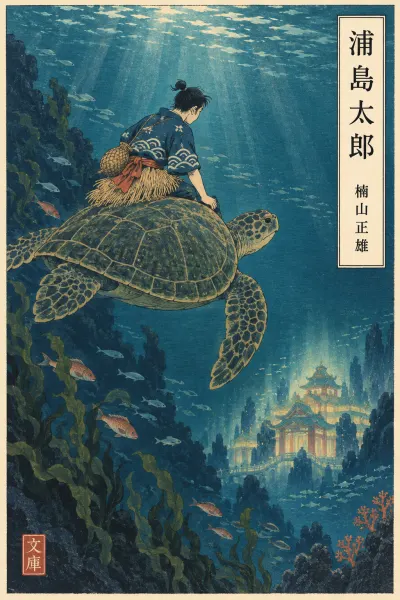
This is Kusuyama Masao's retelling of Urashima Tarō, one of Japan's best-known folktales. A kind young fisherman from the shore of Mizunoe in Tango Province rescues a turtle from a group of village children. The grateful turtle later carries him to the Dragon Palace at the bottom of the sea, where Princess Otohime welcomes him with feasts and wonders. Life there is so pleasant that he loses track of time, until he begins to long for home. The narrator speaks in a gentle, unhurried storyteller's voice, using polite です/ます style throughout. For a learner this steady narration is a comfortable anchor. The challenge lies in the dialogue. The turtle and the princess speak in very formal keigo, while the children talk roughly and the old woman speaks casually. The story is therefore a compact tour of Japanese registers, from the most courteous to the most colloquial. It also introduces vocabulary tied to Japanese folklore, such as 竜宮 and 玉手箱, which you will meet again in other tales and in everyday cultural references.
Contents
Easier versions
This story is also retold in simpler Japanese. Reading an easier version first makes the original much more approachable.
Before you read
- The narration is consistently in polite past tense (〜ました, 〜でした). Once you are used to this rhythm, focus your effort on the dialogue, which carries most of the harder grammar.
- Learn the humble and honorific keigo used by the turtle and Princess Otohime before you start: ございます (polite 'is/there is'), まいりました (humble 'came/went'), and おぼしめす (honorific 'to think/feel'). Recognizing these will make their long, courteous speeches much easier to follow.
- Watch how speech style signals the speaker. The children use rough, casual forms, Urashima speaks in plain but kindly adult male speech, and the old woman is casual. Noticing the register often tells you who is talking even when no name is given.
- Learn a few key words first, since they recur and carry the plot: 亀 (かめ, turtle), 竜宮 (りゅうぐう, the Dragon Palace), 乙姫 (おとひめ, the princess), 玉手箱 (たまてばこ, the jewelled box), and 浜 (はま, beach/shore).
- Keep the place names in mind: 丹後 (たんご) is the old province and 水の江 (みずのえ) is Urashima's home shore. The return to that same shore in the final part is where the story's time shift becomes clear.
Words to know
The most useful words from the notes across the story.
| Word | Meaning | JLPT |
|---|---|---|
| かすんだかすむ | to be hazy, mistydictionary form: 霞むSpring haze (霞 かすみ) is a classic image of spring in Japanese poetry. | N1 |
| りゅう宮りゅうぐう | the Dragon Palacedictionary form: 竜宮The palace of the Dragon King at the bottom of the sea in Japanese legend. | — |
| 腰元こしもと | lady-in-waiting, maid of honourAn old word for women who attend a noblewoman. | — |
| 玉手箱たまてばこ | jewelled box; the precious box in this taleNow also used figuratively for something full of surprises. | — |
| いじめているいじめる | to torment, to bully, to be cruel todictionary form: いじめる | N4 |
| 沖おき | the open sea, offshore | N3 |
| りょうしりょうし | fishermandictionary form: 漁師Written in hiragana here for young readers; the kanji is 漁師. | N2 |
| 四季しき | the four seasons | N2 |
| 月日つきひ | time, the months and daysRead つきひ for 'time passing'; がっぴ is a date on a form. | N2 |
| ひとりごとひとりごと | talking to oneselfdictionary form: 独り言Usually written 独り言; ひとりごとを言う = to mutter to oneself. | N2 |
| 方角ほうがく | direction, bearingMore concrete than 方向; often used for compass directions and locations. | N2 |
| こいしくてこいしい | longed for, misseddictionary form: 恋しいUsed for missing places and people, not only romantic love. | N2 |
| うっかりうっかり | carelessly, absent-mindedlyDescribes doing something by mistake through inattention. | N2 |
| 寿命じゅみょう | lifespanAlso used for the working life of machines and batteries. | N2 |
| やしなってやしなう | to support, to provide for (a family)dictionary form: 養うAlso means to raise or nourish. | N1 |
Plot summary
Show the full summary (contains spoilers)
Urashima Tarō, a young fisherman of Mizunoe in Tango, sees village children tormenting a turtle on the beach. He buys the turtle's freedom and lets it go into the sea. Later the turtle returns to thank him and carries him on its back to the Dragon Palace beneath the waves. There Princess Otohime entertains him with feasts and marvels, and he stays happily for what seems a short time. Eventually he grows homesick and asks to leave. The princess gives him a jewelled box, the tamatebako, and warns him never to open it. Back on his own shore, nothing is familiar. An old woman tells him that a man named Urashima vanished at sea some three hundred years ago. In despair, Urashima opens the box. White smoke rises out of it, and he instantly becomes a white-haired old man.
About the author
Kusuyama Masao (1884–1950) was a Japanese writer, editor and translator who did much to shape children's literature in modern Japan. He studied at Waseda University and was also active in theatre, working as a critic and translator of Western drama. He is best remembered for his retellings of Japanese folk tales and legends for young readers. His retellings are written in clear, rhythmic Japanese meant to be read aloud.