 N5 · easy
Simplified retelling · JLPT N5
浦島太郎 Urashima Tarō in easy Japanese (N5)
This is our own simplified retelling of Urashima Tarō and the Palace Under the Sea, written for N5 learners and checked word by word against the N5 vocabulary list. A few story words and grammar patterns go beyond N5; the notes below give each one's level. It keeps the characters, events and ending of the original. When it feels easy, move on to the N4 version or the original text.
The story in brief
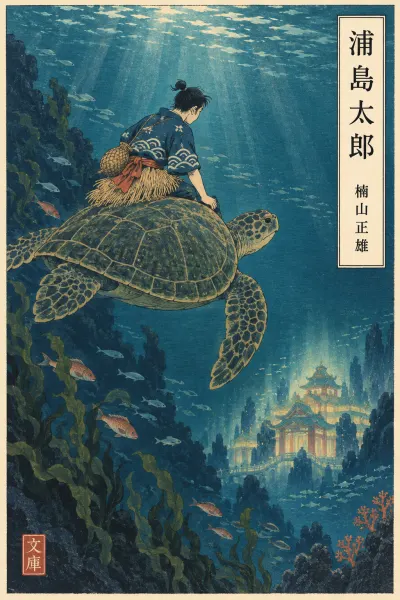
Urashima, a young fisherman, saves a small turtle from some cruel children. The turtle carries him to the Dragon Palace under the sea, where Princess Otohime welcomes him. After three happy years he goes home with a box he must not open. He finds that three hundred years have passed, opens the box, and becomes an old man.
AI translation · independently checked
うみのちかくの小さなむらに、うらしまというわかい男がいました。In a small village near the sea, there lived a young man named Urashima.
うらしまは毎日ふねでうみに出て、さかなをとりました。Every day Urashima went out to sea in his boat and caught fish.
お父さんとお母さんといっしょにすんでいました。He lived together with his father and mother.
あるゆうがた、うらしまはいえにかえるみちで、子どもを五、六人見ました。One evening, on his way home, Urashima saw five or six children.
子どもたちは小さなかめをいじめていました。The children were tormenting a little turtle.
「いじめないでください。」"Please don't be cruel to it."
うらしまはいいました。Urashima said.
でも、子どもたちは聞きません。But the children would not listen.
「じゃあ、お金をあげます。そのかめをうってください。」"All right, then, I'll give you some money. Please sell me that turtle."
子どもたちはお金をとって、どこかへ行きました。The children took the money and went off somewhere.
うらしまはかめをもって、うみへ行きました。Urashima carried the turtle down to the sea.
「もう大じょうぶですよ。」"You're safe now."
かめは水の中へ入って行きました。The turtle went off into the water.
すこしあとで、うらしまはまたふねでうみに出ました。A little while later, Urashima went out to sea in his boat again.
すると、後ろから「うらしまさん」とよぶこえがしました。Then, from behind him, a voice called, "Mr Urashima."
見ましたが、人はいません。He looked, but there was no one there.
ふねのそばに、一ぴきのかめがいました。Beside the boat there was a turtle.
「この間のかめです。どうも。りゅうぐうをしっていますか。」"I am the turtle from the other day. My thanks to you. Do you know of the Dragon Palace?"
「名前だけしっています。」"I only know the name."
「では、いっしょに行きましょう。わたしの上にのってください。」"Then let us go there together. Please climb onto my back."
うらしまはかめの上にのりました。Urashima climbed onto the turtle's back.
かめはあおい水の中を長い間およぎました。The turtle swam through the blue water for a long time.
そして、大きくてきれいなもんの前につきました。And then they arrived in front of a large, beautiful gate.
そこがりゅうぐうでした。That was the Dragon Palace.
りゅうぐうでは、きれいなおとひめさまがまっていました。At the Dragon Palace, the beautiful Princess Otohime was waiting.
「うらしまさん、よく来ましたね。かめをたすけて、どうも。どうぞ、ゆっくり休んでください。」"Mr Urashima, you are most welcome. Thank you for saving the turtle. Please, rest here as long as you like."
さかなたちがおいしい食べものをもって来ました。The fish brought delicious food.
にぎやかなパーティーがはじまりました。A merry party began.
女の人たちはうたをうたいました。The women sang songs.
それから、おとひめさまは四つのドアをあけて、見せました。After that, Princess Otohime opened four doors and showed him what lay behind them.
東はるで、はながたくさんさいていました。To the east it was spring, and many flowers were blooming.
南はなつで、いけにはながさいていました。To the south it was summer, and flowers were blooming on the pond.
西はあきで、山の木があかくなっていました。To the west it was autumn, and the trees on the hills had turned red.
北はふゆで、白いゆきがふっていました。To the north it was winter, and white snow was falling.
うらしまは毎日たのしくあそびました。Every day Urashima played and enjoyed himself.
そして、三年がたちました。And so three years went by.
うらしまは、いえにかえりたくなりました。Urashima began to want to go home.
「お父さんとお母さんは、げんきかな。」"I wonder if my father and mother are well."
おとひめさまに話すと、おとひめさまはげんきがなくなりました。When he told Princess Otohime, she grew very sad.
そして、きれいなはこをもって来ました。Then she brought a beautiful box.
「これはたまてばこです。人のいちばんたいせつなものが入っています。またりゅうぐうへ来たいなら、あけないでください。」"This is a jewelled box. Inside it is what matters most to a person. If you wish to come to the Dragon Palace again, please do not open it."
「はい、あけません。」"Yes, I won't open it."
うらしまはかめの上にのって、むらのちかくのうみにかえりました。Urashima climbed onto the turtle's back and returned to the sea near his village.
かめは「さようなら」といって、うみへ入って行きました。The turtle said "Farewell" and went back into the sea.
でも、むらの人はみんなしらない人でした。But everyone in the village was a stranger.
いえもありません。His house was gone, too.
お父さんもお母さんもいません。His father and mother were not there either.
そこへ、おばあさんが一人来ました。Just then, an old woman came by on her own.
「すみません。うらしまのいえは、どこですか。」"Excuse me. Where is Urashima's house?"
「うらしま?それは三百年前の人ですよ。ふねでうみに出て、かえりませんでした。」"Urashima? That's someone from three hundred years ago. He went out to sea in his boat and never came back."
おばあさんは行きました。The old woman went on her way.
うらしまはわかりました。Urashima understood.
りゅうぐうの三年は、ここの三百年でした。Three years in the Dragon Palace had been three hundred years here.
うらしまはとてもかなしくなりました。Urashima became very sad.
うみを見ましたが、かめはもう来ません。He looked at the sea, but the turtle did not come anymore.
うらしまは、たまてばこを見ました。Urashima looked at the jewelled box.
「これをあけたら、何かわかるでしょうか。」"If I open this, will I understand something?"
うらしまはおとひめさまの話をわすれて、はこをあけました。Urashima forgot the princess's words and opened the box.
すると、中から白いけむりが出ました。Then white smoke came out from inside.
けむりはすぐにきえました。The smoke soon disappeared.
はこの中には、何もありません。There was nothing inside the box.
うらしまは、白いあたまのおじいさんになっていました。Urashima had become an old man with white hair.
「たいせつなものは、わたしのわかい時間だったのか。」"So the most precious thing was my young years."
はるのうみは、とおくまでしずかでした。The spring sea was calm as far as the eye could see.
どこかで、だれかがうたをうたっていました。Somewhere, someone was singing a song.
うらしまは長い間、うみを見ていました。For a long time, Urashima stood looking at the sea.
Vocabulary
| Word | Meaning | JLPT |
|---|---|---|
| かめかめ | turtledictionary form: 亀In Japan the turtle is a symbol of long life. | — |
| いじめていじめる | to bully, to be cruel todictionary form: いじめるUsed for people and for animals. | N4 |
| うってうる | to selldictionary form: 売るThe opposite is 買う (かう), to buy. | N5 |
| りゅうぐうりゅうぐう | the Dragon Palacedictionary form: 竜宮A palace at the bottom of the sea in Japanese folktales. Kanji: 竜 (dragon) + 宮 (palace). | — |
| およぎましたおよぐ | to swimdictionary form: 泳ぐ | N5 |
| つきましたつく | to arrivedictionary form: 着くThe place you arrive at takes に: 〜につく. | N5 |
| たすけてたすける | to save, to helpdictionary form: 助ける | N3 |
| さいてさく | to bloom (of flowers)dictionary form: 咲く | N5 |
| たちましたたつ | (of time) to passdictionary form: 経つUsed with time words, as in 三年がたつ, "three years pass". | N3 |
| たまてばこたまてばこ | jewelled box (the princess's gift)dictionary form: 玉手箱箱 (はこ) becomes ばこ inside the compound word. | — |
| たいせつなたいせつ | important, preciousdictionary form: 大切A な-adjective. | N5 |
| わすれてわすれる | to forgetdictionary form: 忘れる | N5 |
| けむりけむり | smokedictionary form: 煙 | N3 |
| きえましたきえる | to disappear, to vanishdictionary form: 消える | N5 |
Grammar
〜ないでください N5 please don't …
Add ないでください to the ない-form of a verb to ask someone politely not to do something. Here いじめない becomes いじめないでください.
「いじめないでください。」
"Please don't be cruel to it."
〜ていました N5 was …ing (an ongoing action or state in the past)
The て-form plus いました describes something that was going on at that moment in the past. It sets the scene that Urashima saw.
子どもたちは小さなかめをいじめていました。
The children were tormenting a little turtle.
〜たくなる N4 to start wanting to …
たい ("want to") behaves like an い-adjective, so its い changes to く before なる. かえりたくなりました means his wish to go home grew over time.
うらしまは、いえにかえりたくなりました。
Urashima began to want to go home.
い-adjective + くなる N5 to become …
Change the final い of an い-adjective to く and add なる to show a change of state. かなしい becomes かなしくなりました, "became sad".
うらしまはとてもかなしくなりました。
Urashima became very sad.
〜たら N4 if / when …
Add ら to the past tense of a verb to state a condition. あけたら means "if I open it", and the result follows.
「これをあけたら、何かわかるでしょうか。」
"If I open this, will I understand something?"