 N4 · easy
Simplified retelling · JLPT N4
浦島太郎 Urashima Tarō in easy Japanese (N4)
This is our own simplified retelling of Urashima Tarō and the Palace Under the Sea, written for N4 learners and checked word by word against the N4 vocabulary list. A few story words and grammar patterns go beyond N4; the notes below give each one's level. It keeps the characters, events and ending of the original. When it feels easy, move on to the N3 version or the original text.
The story in brief
Urashima Tarō, a young fisherman, saves a turtle from some village children, and the turtle carries him to the Dragon Palace under the sea. After three happy years with Princess Otohime he grows homesick, and she gives him a jewelled box he must never open. Back home he finds that three hundred years have passed; he opens the box, a purple smoke rises, and he becomes an old man.
AI translation · independently checked
むかし、海の近くの小さなむらに、うらしまたろうというわかいりょうしが住んでいました。Long ago, in a small village near the sea, there lived a young fisherman named Urashima Tarō.
たろうは毎日海へ行って、魚をつりました。Every day Tarō went down to the sea and caught fish.
そして、お父さんとお母さんのために働いていました。And he worked for the sake of his father and mother.
ある日、たろうが家に帰る時、道に子どもたちが五、六人集まっていました。One day, as Tarō was on his way home, he found five or six children gathered in the road.
見ると、子どもたちは小さいかめをいじめていました。When he looked, he saw that the children were tormenting a small turtle.
ぼうでたたいたり、足でふんだりしていました。They were hitting it with sticks and stamping on it with their feet.
「かわいそうだから、やめなさい。」とたろうは言いました。"Stop that, the poor thing!" said Tarō.
でも、子どもたちはやめませんでした。But the children did not stop.
そこで、たろうは「じゃあ、お金をあげるから、そのかめを売ってください。」と言いました。So Tarō said, "All right then, I'll give you some money, so please sell me that turtle."
子どもたちはお金をもらって、かめをわたしました。The children took the money and handed over the turtle.
たろうはかめを海まで持って行きました。Tarō carried the turtle all the way down to the sea.
「もうだいじょうぶだよ。さあ、お帰り。」かめはうれしそうに、海の中へ帰って行きました。"You're safe now. Off you go, back home." The turtle looked happy as it swam away into the sea.
二、三日後、たろうはまたふねで海に出ました。Two or three days later, Tarō went out to sea in his boat again.
魚をつっていると、後ろから「うらしまさん。」とよぶこえがしました。While he was fishing, he heard a voice behind him calling, "Mr Urashima!"
見ると、あのかめがふねのそばにいました。He looked, and there was the same turtle beside his boat.
「この前は、たすけてくださって、ありがとうございました。おれいに、りゅうぐうへつれて行ってあげたいです。わたしのせなかにのってください。」"You were so kind as to save me the other day, and I am most grateful. As a token of thanks, I should like to take you to the Dragon Palace. Pray, climb upon my back."
たろうはかめのせなかにのりました。Tarō climbed onto the turtle's back.
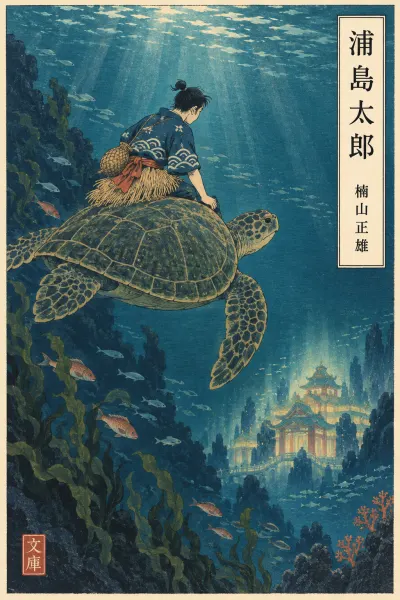
かめは海の中をどんどんおよいで行きました。The turtle swam on and on, deeper into the sea.
青い水の中をゆめのようにすすんで行くと、白いきれいな道と、りっぱなもんが見えました。As they moved through the blue water as if in a dream, a beautiful white road and a splendid gate came into view.
中から、うつくしいおとひめさまが出て来ました。Out from inside came the lovely Princess Otohime.
「かめをたすけてくださって、ありがとうございました。どうぞ、ゆっくりあそんで行ってください。」と、ていねいにあいさつしました。"Thank you so kindly for saving the turtle. Please stay, and take your ease here as long as you like," she said, greeting him courteously.
たくさんの魚が、めずらしいごちそうを運んで来ました。A great many fish carried in rare and wonderful dishes.
女の人たちは、歌を歌ったり、おどったりしました。Ladies sang songs and danced.
食事の後で、おとひめさまは四つのとを開けて見せました。After the meal, Princess Otohime opened four doors to show him what lay beyond.
東のとの中は春で、花がきれいにさいていました。Behind the eastern door it was spring, and flowers were blooming beautifully.
南は夏で、いけに花がさいて、木の上でむしがないていました。In the south it was summer; flowers bloomed on the pond, and insects were singing up in the trees.
西は秋で、赤い葉のはやしが見えました。In the west it was autumn, and he could see a wood full of red leaves.
北は冬で、山に白いゆきがふっていました。In the north it was winter, and white snow was falling on the mountains.
たろうはとてもおどろいて、何もかもわすれてしまいました。Tarō was so amazed that he forgot about everything else.
毎日が楽しくて、三年がすぐにすぎました。Every day was so much fun that three years passed in no time.
ある春、たろうはむらのゆめを見るようになりました。One spring, Tarō began to dream of his village.
「お父さんとお母さんは、今どうしているだろう。」そう思うと、早く家に帰りたくなりました。"I wonder how Father and Mother are doing now." When he thought this, he began to want to hurry home.
歌を聞いても、おどりを見ても、楽しくなくなりました。Whether he listened to the songs or watched the dancing, he no longer enjoyed himself.
おとひめさまはしんぱいして、「きぶんが悪いのですか。」と聞きました。Princess Otohime was worried and asked, "Are you feeling unwell?"
「いいえ。家に帰りたくなったのです。」とたろうは答えました。"No. It's just that I've come to want to go home," Tarō answered.
おとひめさまはとてもざんねんそうでした。Princess Otohime looked very disappointed.
そして、きれいなはこを持って来て言いました。Then she brought a beautiful box and said:
「これはたまてばこです。中には、人のいちばん大切なものが入っています。おわかれのプレゼントです。でも、またここへ帰りたいなら、けっしてこのはこを開けてはいけませんよ。」"This is a jewelled box. Inside it is the thing that is most precious to a person. It is my parting gift to you. But if you wish ever to return here, you must never, ever open this box."
「わかりました。けっして開けません。」たろうはまたかめのせなかにのって、むらの海に帰りました。"I understand. I will never open it." Tarō climbed onto the turtle's back once more and returned to the sea by his village.
かめは「お元気で。」と言って、海の中へ帰って行きました。The turtle said, "Fare you well," and went back into the sea.
むらの海は、ゆめで見た海と同じでした。The sea by the village was just the same as the sea he had seen in his dreams.
でも、会う人は知らない人ばかりでした。But everyone he met was a stranger.
たろうは家があった所へ急ぎました。Tarō hurried to the place where his house had been.
でも、そこにはくさがたくさんあるだけで、家はありませんでした。But there was nothing there except a lot of grass; his house was gone.
そこへ、年をとったおばあさんが来ました。Just then, an old woman came along.
「うらしまたろうの家はどこですか。」と聞くと、おばあさんは少し考えて言いました。When he asked, "Where is Urashima Tarō's house?", the old woman thought for a moment and said:
「ああ、うらしまたろうは三百年も前の人ですよ。ある日、つりに出て、帰って来なかったそうです。子どものころ、そう聞きました。」"Oh, Urashima Tarō lived a good three hundred years ago. They say one day he went out fishing and never came back. That's what I was told when I was a child."
たろうはびっくりしました。Tarō was stunned.
りゅうぐうの三年は、人の世界の三百年だったのです。Three years in the Dragon Palace had been three hundred years in the world of people.
家もないし、お父さんもお母さんももういません。His house was gone, and his father and mother were no longer alive.
たろうはとてもかなしくなりました。Tarō grew very sad.
りゅうぐうへ帰りたくなりましたが、かめはもう来ませんでした。He wanted to go back to the Dragon Palace, but the turtle never came again.
その時、たろうは手に持っているたまてばこに気がつきました。At that moment, Tarō noticed the jewelled box he was holding in his hand.
「このはこを開けたら、何かわかるかもしれない。」たろうはおとひめさまのことばをわすれて、はこを開けてしまいました。"If I open this box, maybe I'll understand something." Forgetting the princess's words, Tarō opened the box.
すると、中からむらさき色のけむりが出て来て、たろうのかおにかかりました。At once, a purple smoke came drifting out and settled over Tarō's face.
けむりはすぐにきえました。The smoke soon vanished.
はこの中には、何ものこっていませんでした。Nothing at all was left inside the box.
水にうつったじぶんを見ると、かみもひげも真っ白で、かおにはしわがたくさんありました。When he looked at his reflection in the water, his hair and beard were pure white, and his face was covered in wrinkles.
たろうは、おじいさんになっていたのです。Tarō had become an old man.
「そうか。人のいちばん大切なものは、生きる時間だったのか。」とたろうはざんねんそうに言いました。"I see. So the most precious thing a person has was the time they have to live," Tarō said sadly.
春の海は、遠くまで広がっていました。The spring sea stretched far away into the distance.
どこからか、ふねの歌が聞こえてきました。From somewhere came the sound of a boatman's song.
たろうは、ぼんやりとむかしのことを思い出していました。Tarō sat lost in thought, remembering days long gone.
Vocabulary
| Word | Meaning | JLPT |
|---|---|---|
| りょうしりょうし | fishermandictionary form: 漁師Written with 漁 (fishing) + 師 (master of a trade). | N2 |
| いじめていじめる | to bully, to tormentdictionary form: いじめるUsed for people or animals that are weaker than you. | N4 |
| かわいそうかわいそう | poor thing; pitifulA な-adjective. Not related to かわいい (cute) in meaning. | N3 |
| たすけてたすける | to save, to rescue, to helpdictionary form: 助ける | N3 |
| おれいおれい | thanks; something given in thanksdictionary form: お礼おれいに = as thanks, as a reward. | N4 |
| りゅうぐうりゅうぐう | the Dragon Palacedictionary form: 竜宮The palace of the sea dragon king at the bottom of the sea in Japanese folktales. | — |
| めずらしいめずらしい | rare, unusualdictionary form: 珍しい | N4 |
| ごちそうごちそう | a feast; delicious fooddictionary form: ご馳走Also in ごちそうさまでした, said after a meal. | N4 |
| ざんねんざんねん | sorry, disappointed, a pitydictionary form: 残念 | N4 |
| たまてばこたまてばこ | jewelled box; treasure casket (the magic box given to Urashima)dictionary form: 玉手箱A beautiful lacquered box; はこ becomes ばこ (rendaku) in the compound. | — |
| けっしてけっして | never (with a negative)dictionary form: 決してAlways used with a negative form: けっして〜ない / 〜てはいけない. | N4 |
| けむりけむり | smokedictionary form: 煙 | N3 |
| しわしわ | wrinkle | N1 |
| ぼんやりぼんやり | absent-mindedly, lost in thoughtAlso means 'dimly, vaguely' when describing something you see. | N3 |
Grammar
〜たり〜たりする N4 doing things like A and B
Put two or more verbs in the た-form + り and finish with する. It gives examples of actions without listing everything.
ぼうでたたいたり、足でふんだりしていました。
They were hitting it with sticks and stamping on it with their feet.
〜てくださる / 〜てあげる N4 someone kindly does something for me / I do something for someone
たすけてくださって is a polite way to say 'you helped me'. つれて行ってあげたい means 'I want to take you (as a favour)'. These verbs show who does the favour for whom.
たすけてくださって、ありがとうございました。
You were so kind as to save me, and I am most grateful.
〜てしまう N4 to do completely; to do something by accident or with regret
Here it shows that Tarō completely forgot everything, and later (sentence with the box) that he opened the box even though he should not have.
たろうはおとひめさまのことばをわすれて、はこを開けてしまいました。
Forgetting the princess's words, Tarō opened the box.
〜ようになる N4 to come to do; to start doing (a change)
Dictionary form + ようになる shows a gradual change in habits or ability. Tarō did not dream of home before, but now he does.
たろうはむらのゆめを見るようになりました。
Tarō began to dream of his village.
〜てはいけない N5 must not do
て-form + はいけない forbids an action. With けっして it becomes very strong: 'you must never'.
けっしてこのはこを開けてはいけませんよ。
You must never, ever open this box.
〜そうだ (hearsay) N4 I hear that; they say that
Plain form + そうだ reports something the speaker heard from others. Compare うれしそうに, where そう after a stem means 'looks like'.
つりに出て、帰って来なかったそうです。
They say he went out fishing and never came back.