 N5 · easy
Simplified retelling · JLPT N5
やまなし Yamanashi in easy Japanese (N5)
This is our own simplified retelling of The Wild Pear in the Stream, written for N5 learners and checked word by word against the N5 vocabulary list. A few story words and grammar patterns go beyond N5; the notes below give each one's level. It keeps the characters, events and ending of the original. When it feels easy, move on to the N4 version or the original text.
The story in brief
Two little crab brothers talk at the bottom of a stream in spring. A kingfisher dives in and carries off a fish, and their father comforts them. In winter the brothers argue about whose bubbles are bigger, and a wild pear falls into the water; the father says that in two days it will sink down and turn into delicious wine.
AI translation · independently checked
はるの話です。This is a story of spring.
川の中で、かにの子どもが二ひき話していました。In the stream, two little crab children were talking.
にいさんとおとうとです。They were an older brother and a younger brother.
「クラムボンはわらったよ。」"Kuramubon laughed."
「クラムボンはわらったよ。」"Kuramubon laughed."
上を、小さいあわがたくさん行きます。Above them, lots of little bubbles went drifting by.
二ひきも、あわを出しました。The two of them blew bubbles too.
小さいさかなが一ぴき、あたまの上を行きました。A little fish swam past over their heads.
「クラムボンはしんだよ。」"Kuramubon died."
「なぜしんだの。」"Why did it die?"
「わからない。」"I don't know."
すると、川の中がとてもあかるくなりました。Just then, the water in the stream grew very bright.
さかなは、また上のほうへ行きました。The fish swam upward again.
「さかなは何をしているの。」"What's the fish doing?"
「何かをとっているんだよ。」"It's catching something, that's what."
その後です。It was after that.
上から、あおくて大きい物が入って来ました。Something big and blue came plunging in from above.
さきはくろくて、ほそいです。Its tip was black and thin.
さかなは上へ行って、もういませんでした。The fish went upward, and then it was gone.
二ひきは、何もいえませんでした。The two brothers could not say a word.
お父さんのかにが来ました。Their father crab came along.
「どうした。」"What's the matter?"
「お父さん、しらない物が来たよ。あおくて、さきがくろいの。」"Dad, something strange came! It was blue, and its tip was black."
「それはとりだ。かわせみだよ。わたしたちはだいじょうぶだ。」"That was a bird. A kingfisher. We're safe."
「さかなはどこへ行ったの。」"Where did the fish go?"
「こわいところへ行ったよ。」"It went to a scary place."
「こわいよ、お父さん。」"I'm scared, Dad."
「だいじょうぶだ。ほら、白いはなが来たよ。きれいだろう。」"It's all right. Look, here come white flowers. Aren't they pretty?"
白いはながたくさん、水の上をゆっくり来ました。Many white flowers came floating slowly over the water.
ふゆの話です。This is a story of winter.
子どもたちは大きくなりました。The children had grown bigger.
よるです。It is night.
つきがあかるくて、水はとてもきれいです。The moon is bright, and the water is very beautiful.
二ひきはねないで、外に出ました。The two brothers didn't go to sleep; they went outside instead.
そして、あわを出していました。And they were blowing bubbles.
「わたしのあわのほうが大きいね。」"My bubbles are bigger, aren't they?"
「ちがうよ。同じだよ。」"No they're not. They're the same."
「じゃあ、いっしょに出そう。」"Then let's blow them together."
お父さんのかにが来ました。Their father crab came along.
「おそいよ。もうねなさい。」"It's late. Go to sleep now."
「お父さん、どっちのあわが大きいの。」"Dad, whose bubbles are bigger?"
「にいさんのほうだろう。」"Your big brother's, I'd say."
おとうとは、なきそうになりました。The little brother was about to cry.
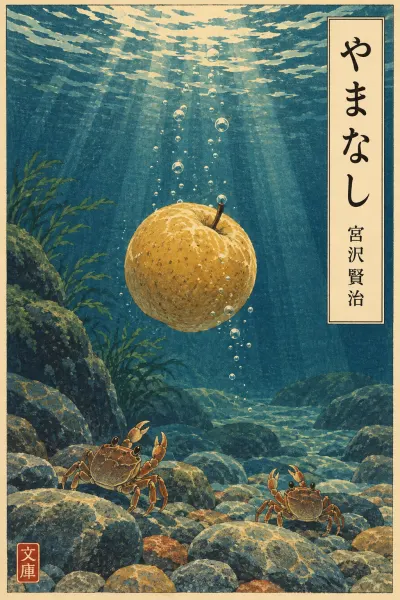
すると、上からくろくてまるい物が入って来ました。Just then, something black and round came dropping in from above.
下まで来て、また上へ行きました。It sank all the way to the bottom, then rose up again.
「かわせみだ。」子どもたちがいいました。"A kingfisher!" cried the children.
お父さんはよく見て、いいました。Their father took a good look and said,
「ちがう。あれはやまなしだ。いいにおいだね。いっしょに行こう。」"No. That's a wild pear. Smells nice, doesn't it? Let's follow it."
水の中は、やまなしのいいにおいでいっぱいでした。The water was full of the sweet smell of the wild pear.
三びきは、やまなしのうしろを歩きました。The three crabs walked along behind the wild pear.
やまなしは、木にかかってとまりました。The wild pear caught on a branch and stopped.
「食べたいね、お父さん。」"I want to eat it, Dad."
「まて、まて。あと二日まつと、やまなしは下へ来る。そして、おいしいおさけになるよ。さあ、いえにかえろう。」"Wait, wait. In two more days it'll sink down here. And it'll turn into delicious wine. Now, let's go home."
三びきは、いえにかえりました。The three crabs went home.
上では、水があおくきれいでした。Up above, the water was blue and beautiful.
これで、話はおわりです。And so the story ends.
Vocabulary
| Word | Meaning | JLPT |
|---|---|---|
| かにかに | crabdictionary form: 蟹Usually written in kana in children's texts; the kanji is 蟹. | — |
| あわあわ | bubble; foamdictionary form: 泡あわを出す = to blow bubbles. | N3 |
| わらったわらう | to laugh; to smiledictionary form: わらうKanji: 笑う. | N4 |
| しんだしぬ | to diedictionary form: しぬKanji: 死ぬ. The only verb ending in ぬ; past tense is しんだ. | N5 |
| あかるくあかるい | bright; lightdictionary form: あかるいKanji: 明るい. Opposite: くらい (dark). | N5 |
| ほそいほそい | thin; narrowKanji: 細い. Used for long thin things like a beak. | N5 |
| かわせみかわせみ | kingfisherA small blue bird with a long, pointed beak that dives into water to catch fish. | — |
| こわいこわい | scary; (I'm) scaredKanji: 怖い. Can describe the thing (a scary place) or your feeling (I'm scared). | N4 |
| つきつき | the moondictionary form: 月The same kanji 月 is read がつ in month names like 一月. | N4 |
| やまなしやまなし | wild pear; mountain peardictionary form: 山梨山 (mountain) + 梨 (pear). The title word of the story. | — |
| においにおい | smell; scentいいにおい = a nice smell. | N4 |
| まつまつ | to waitKanji: 待つ. まて is the plain command form: 'Wait!' | N3 |
| おさけさけ | alcohol; sake; wine (here: the ripe pear will ferment into a kind of fruit wine)dictionary form: さけKanji: 酒. お is the polite prefix. | N3 |
Grammar
〜ていました N5 was/were doing (an ongoing action in the past)
The て-form + いました shows an action that was going on at that time. 話す becomes 話して + いました: 'were talking'.
川の中で、かにの子どもが二ひき話していました。
In the stream, two little crab children were talking.
〜くなる N5 to become (adjective)
For い-adjectives, change the final い to く and add なる to say something changes. あかるい becomes あかるくなりました: 'became bright'.
すると、川の中がとてもあかるくなりました。
Just then, the water in the stream grew very bright.
〜ないで N4 without doing; instead of doing
The ない-form + で connects two actions: the first one did not happen, and the second one did. ねないで means 'without going to sleep'.
二ひきはねないで、外に出ました。
The two brothers didn't go to sleep; they went outside instead.
〜そうになる N4 to be about to (do something); to almost (do something)
The ます-stem + そうになる means something almost happens. なく (to cry) becomes なきそうになりました: 'was about to cry'.
おとうとは、なきそうになりました。
The little brother was about to cry.
Volitional 〜う/〜よう N4 let's (do something)
This is the casual form of 〜ましょう. 行く becomes 行こう and かえる becomes かえろう: 'let's go', 'let's go home'.
いっしょに行こう。
Let's follow it.
〜と (conditional) N4 when/if (something happens), then (a natural result follows)
Dictionary form + と shows that one thing naturally leads to another. Here, waiting two days leads to the pear sinking down.
あと二日まつと、やまなしは下へ来る。
In two more days it'll sink down here.