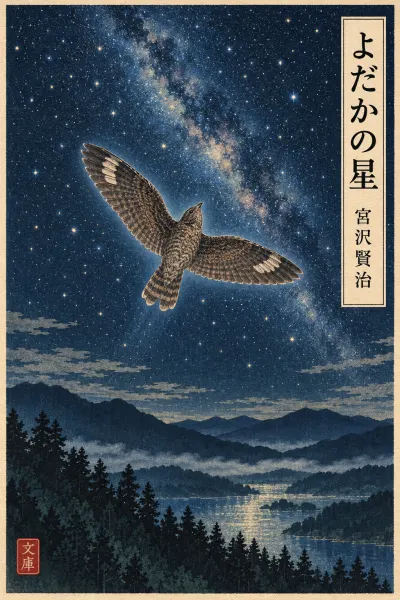
 N3 · easy
Simplified retelling · JLPT N3
よだかの星 Yodaka no Hoshi in easy Japanese (N3)
This is our own simplified retelling of How the Nighthawk Became a Star, written for N3 learners and checked word by word against the N3 vocabulary list. A few story words and grammar patterns go beyond N3; the notes below give each one's level. It keeps the characters, events and ending of the original. When it feels easy, move on to the original text.
The story in brief
The nighthawk is an ugly bird whom everyone dislikes. The hawk threatens to kill him unless he changes his name to Ichizō, and he is troubled that he kills insects every night. After saying goodbye to his brother, he asks the sun, who kindly tells him to ask the stars instead. The stars all turn him away, but he flies straight up until his strength is gone and becomes a star that still burns today.
AI translation · independently checked
よだかは、とてもみにくい鳥です。The nighthawk was a very ugly bird.
体には、きたない色の点がたくさんあります。His body was covered in spots of a dirty colour.
口はとても大きくて、耳の近くまであります。His mouth was very large and stretched almost to his ears.
足もよわくて、上手に歩けません。His legs were weak too, and he could not walk well.
ほかの鳥たちは、よだかを見ただけで、いやな気持ちになりました。The other birds felt disgusted just from looking at the nighthawk.
小さな鳥たちは、よだかに会うと、いつもいやなことを言いました。Whenever the little birds met the nighthawk, they always said nasty things.
「また来たよ。本当にへんな鳥だね。」"He's here again. What a strange bird he really is."
でも、よだかは本当はたかのなかまではありません。But in truth, the nighthawk was no relative of the hawk.
美しいかわせみと、ほうせきのようなはちすずめのお兄さんでした。He was the elder brother of the beautiful kingfisher and of the jewel-like hummingbird.
よだかには、するどいくちばしも、強い足もありません。The nighthawk had neither a sharp beak nor strong feet.
だから、どんなによわい鳥でも、よだかをこわがる理由はありませんでした。So even the weakest bird had no reason to be afraid of him.
よだかのはねは強くて、飛ぶ時はたかのように見えました。His wings were strong, and when he flew he looked like a hawk.
声も、少したかに似ていました。His voice was also a little like a hawk's.
それで「たか」という名前がついたのです。That was how he came to have the word "hawk" in his name.
たかは、それがとてもきらいでした。The hawk hated this very much.
ある夕方、たかがよだかの家に来ました。One evening the hawk came to the nighthawk's home.
「おい、よだか。名前はいつ変えるんだ。おれは青い空をどこまでも飛べる。お前は、くもりの日か夜だけ出て来る鳥だ。」"Hey, nighthawk. When are you going to change your name? I can fly as far as I like across the blue sky. You're a bird that only comes out on cloudy days or at night."
「たかさん、それは無理です。この名前は、神さまにもらったものです。」"Mr Hawk, I can't do that. God gave me this name."
「いや、お前の名前は、おれと夜から借りた名前だ。返せ。今日から『いちぞう』という名前にしろ。首に『いちぞう』と書いた紙をかけて、みんなの家にあいさつに回るんだ。」"No. Your name is borrowed from me and from the night. Give it back. From today, call yourself Ichizō. Hang a sign around your neck that says 'Ichizō', and go round to everyone's house to greet them."
「そんなことは、とてもできません。」"I could never do such a thing."
「あさっての朝、おれは鳥の家を全部回って聞く。一つの家でもお前が来ていなかったら、お前を殺すぞ。」"The morning after tomorrow I'll go round every bird's house and ask. If you haven't been to even one house, I'll kill you."
たかはそう言って、帰って行きました。With that, the hawk went home.
よだかは目を閉じて考えました。The nighthawk closed his eyes and thought.
(どうしてぼくは、みんなにいやがられるのだろう。前に、小さな鳥の子供がすから落ちた時、ぼくはすに連れて帰ってあげた。でも、親の鳥は、どろぼうから守るように子供をぼくからはなして、ぼくを笑った。そして今度は、いちぞうという名前だなんて。)(Why does everyone dislike me so much? Once, when a little baby bird fell out of its nest, I took it back to the nest. But its parent pulled the baby away from me as if guarding it from a thief, and laughed at me. And now they want to call me Ichizō!)
暗くなると、よだかは空へ飛び出しました。When it grew dark, the nighthawk flew out into the sky.
遠くの山では、火が赤くもえていました。On the distant mountains, fires were burning red.
よだかが口を大きく開けて飛ぶと、小さなむしがたくさん口に入りました。As the nighthawk flew with his mouth wide open, lots of small insects went into it.
かぶとむしが一ぴき、よだかののどに入って、苦しそうに動きました。One beetle got into his throat and struggled painfully.
よだかはそれを飲みましたが、その時、急に心が痛くなりました。The nighthawk swallowed it, but at that moment his heart suddenly began to ache.
よだかは大きな声でなきながら、空を回りました。Crying out loudly, the nighthawk circled round and round the sky.
(ああ、ぼくは毎晩、たくさんのむしを殺している。そして、そのぼくが今度はたかに殺される。なんてつらいことだろう。もう、むしを食べるのはやめよう。遠い遠い空の向こうへ行ってしまおう。)(Oh, every night I kill so many insects. And now I am going to be killed by the hawk. How painful this is. I'll stop eating insects. I'll go away, far, far beyond the sky.)
よだかは、弟のかわせみの所へ飛んで行きました。The nighthawk flew to his younger brother, the kingfisher.
「お兄さん、どうしたのですか。」"Brother, what's wrong?"
「ぼくは遠い所へ行くんだ。その前に、お前に会いに来たよ。」"I'm going somewhere far away. I came to see you before I go."
「行ってはいけません。はちすずめも遠くにいるのに、ぼくは一人になってしまいます。」"You mustn't go. The hummingbird is far away too, so I'll be all alone."
「もう決めたんだ。お前も、魚を取るのは、本当に必要な時だけにしておくれ。はちすずめにも、よろしく。元気でね。」"I've already decided. And please catch fish only when you really need to. Give my regards to the hummingbird. Take care."
よだかはなきながら、家に帰りました。Crying, the nighthawk went home.
夏の夜はみじかくて、もう朝になりかけていました。The summer night was short, and morning was already beginning to come.
よだかは、すの中をきれいにかたづけて、また飛び出しました。The nighthawk tidied the inside of his nest and flew out again.
お日さまが、東から上って来ました。The sun came up in the east.
よだかはまぶしいのをがまんして、お日さまの方へ飛びました。Putting up with the dazzling light, the nighthawk flew toward the sun.
「お日さま、私をあなたの所へ連れて行ってください。やけて死んでもかまいません。」"Sun, please take me to where you are. I don't mind if I burn to death."
お日さまは、だんだん遠くなりながら言いました。As it moved farther and farther away, the sun spoke.
「お前はよだかだね。つらかっただろう。でも、お前は夜の鳥だ。今夜、ほしに頼んでみなさい。」"You're the nighthawk, aren't you? It must have been hard for you. But you are a bird of the night. Tonight, try asking the stars."
よだかは力をなくして、草の上に落ちてしまいました。His strength gone, the nighthawk fell down onto the grass.
まるで夢を見ているようでした。It was just as if he were dreaming.
目を開けると、もう夜でした。When he opened his eyes, it was already night.
空には、たくさんのほしが光っていました。Many stars were shining in the sky.
よだかは空へ上って行きました。The nighthawk rose up into the sky.
よだかは、西の青白いほしに頼みました。He asked the pale blue-white star in the west.
でも、ほしは歌を歌っていて、よだかを見もしませんでした。But the star was singing a song and did not even look at him.
次に、南の青いほしに頼みました。Next, he asked the blue star in the south.
「ばかなことを言うな。お前はただの鳥だ。お前のはねでは、何おく年かかっても、ここまで来られるものか。」"Don't talk nonsense. You're only a bird. With wings like yours, you could never get up here, not even in hundreds of millions of years."
次に、北の青いほしに頼みました。Next, he asked the blue star in the north.
「そんなことを考えてはいけない。少し頭を休めなさい。冷たい水の中にでも入って来なさい。」"You mustn't think such things. Give your head a little rest. Go and jump into some cold water or something."
最後に、東の白いほしに頼みました。Last of all, he asked the white star in the east.
「いやいや、とても無理だ。ほしになれるのは、特別な者だけだ。それに、お金もたくさんいるのだ。」"No, no, that's quite impossible. Only special beings can become stars. Besides, it takes a lot of money."
よだかは、もう力をなくして、はねを閉じて、下へ落ちて行きました。With no strength left, the nighthawk folded his wings and fell downward.
でも、足が土につく少し前、よだかは急に空へ上って行きました。But just before his feet touched the ground, he suddenly rose up into the sky.
そして、たかのように高い声でなきました。Then he cried out in a high voice, like a hawk.
ねむっていたほかの鳥たちは、みんな目を覚まして、ふるえながらほしの空を見ました。The other birds, who had been asleep, all woke up and looked at the starry sky, trembling.
よだかは、どこまでもまっすぐ空へ上って行きました。The nighthawk went on rising straight up into the sky, on and on.
山の火は、もうとても小さく見えます。The fires on the mountains now looked very small.
とても寒くて、息は白くこおりました。It was very cold, and his breath froze white.
空気がうすいので、はねを何度も動かさなければなりませんでした。The air was thin, so he had to beat his wings again and again.
それでも、ほしは少しも近くなりません。Even so, the stars did not come any closer at all.
よだかのはねは、もう動かなくなりました。The nighthawk's wings would no longer move.
よだかは、なみだの出た目で、もう一度空を見ました。With tears in his eyes, the nighthawk looked at the sky once more.
これが、よだかの最後でした。That was the nighthawk's end.
よだかは、上っているのか、落ちているのかも、分かりませんでした。The nighthawk could not tell whether he was rising or falling.
でも、心はとても静かでした。But his heart was very calm.
ちのついたくちばしは、少し笑っているようでした。His bloodstained beak seemed to be smiling a little.
しばらくして、よだかは目を開けました。After a while, the nighthawk opened his eyes.
自分の体が、青く美しい光になって、静かにもえているのが見えました。He saw that his own body had become a beautiful blue light and was quietly burning.
よだかは、ほかのほしの間にいました。The nighthawk was among the other stars.
よだかのほしは、いつまでもいつまでももえつづけました。The nighthawk's star burned on and on, for ever and ever.
今でも、まだもえています。It is still burning even now.
Vocabulary
| Word | Meaning | JLPT |
|---|---|---|
| よだかよだか | nighthawk (nightjar), a bird that hunts insects at duskThe name contains たか ('hawk'), and this is why the hawk is angry. Written 夜鷹 in kanji, literally 'night hawk'. | — |
| みにくいみにくい | uglydictionary form: 醜いDo not confuse it with 見にくい ('hard to see'), which sounds the same. | N2 |
| なかまなかま | companion; member of the same group or kind (here: one of the hawk's kind/family)dictionary form: 仲間Usually means 'friend' or 'companion'. Here it means a bird of the same family. | N3 |
| するどいするどい | sharpdictionary form: 鋭いUsed for claws, knives and beaks, and also for a sharp mind or a sharp look. | N3 |
| 無理むり | impossible; unreasonableそれは無理です is a common, fairly direct way to refuse. | N4 |
| いやがられるいやがる | to dislike, to not want (shown by behaviour)dictionary form: 嫌がるPassive here: 'to be disliked by others'. 〜がる describes someone else's feelings as seen from outside. | N2 |
| もえてもえる | to burndictionary form: 燃えるA key word in the story: first the field fires burn, and at the end the nighthawk himself burns as a star. | N3 |
| かたづけてかたづける | to tidy up, to put in orderdictionary form: 片付けるHe cleans his nest because he does not plan to come back. | N4 |
| まぶしいまぶしい | dazzling, too bright to look atdictionary form: 眩しい | N2 |
| がまんがまん | enduring, putting up with somethingdictionary form: 我慢〜をがまんする = to bear something unpleasant. The pattern 〜のをがまんする turns a whole phrase into the thing that is endured. | N3 |
| 頼みましたたのむ | to ask (someone to do something), to requestdictionary form: 頼む | N5 |
| 目を覚ましてめをさます | to wake updictionary form: 目を覚ますThe intransitive form is 目が覚める ('to wake up / be woken'). | — |
| こおりましたこおる | to freezedictionary form: 凍る | N3 |
Grammar
Noun + のように N4 like ~, as if ~
のように compares something to a noun. たかのように見えました means the nighthawk looked like a hawk when he flew. The same pattern appears in たかのように高い声 ('in a voice as high as a hawk's').
飛ぶ時はたかのように見えました。
When he flew, he looked like a hawk.
Passive 〜られる / 〜れる N4 to be done to (by someone)
The passive puts the nighthawk in the position of the one who suffers the action, and the doer is marked with に. Here he realises that he kills insects and will now be killed himself.
そのぼくが今度はたかに殺される。
And now I am going to be killed by the hawk.
〜てしまおう N4 let me just ~ / I'll go ahead and ~ (for good)
〜てしまう shows that an action is complete or cannot be undone, and 〜おう is the volitional form ('I will / let's'). Together they show a firm decision to leave and never return.
遠い遠い空の向こうへ行ってしまおう。
I'll go away, far, far beyond the sky.
Verb stem + かける N3 to be about to ~, to have just started ~
Verb stem + かける means an action or change has begun but is not finished. 朝になりかけていました means the night was already starting to turn into morning.
もう朝になりかけていました。
Morning was already beginning to come.
〜ものか N2 as if ~! / there's no way ~
〜ものか is a strong rhetorical question that means the opposite of what it says. The star is not asking a question: it declares that the nighthawk could never reach it. It sounds rough and scornful.
何おく年かかっても、ここまで来られるものか。
You could never get up here, not even in hundreds of millions of years.
Verb stem + つづける N4 to keep on ~, to continue ~
つづける attaches to a verb stem to show that an action goes on without stopping. Together with いつまでもいつまでも it shows that the star burns forever.
よだかのほしは、いつまでもいつまでももえつづけました。
The nighthawk's star burned on and on, for ever and ever.