Upper intermediate · JLPT N2
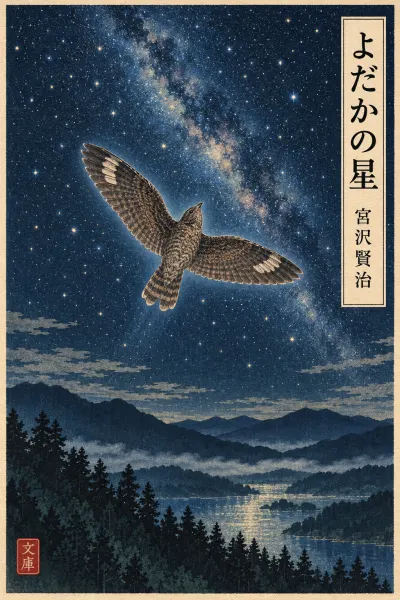
よだかの星Yodaka no Hoshi — How the Nighthawk Became a Star
- JLPT N2
- 5,159 characters
- 4 parts
- about 43 minutes
- 3 easier versions
よだかの星 is a short fable by Miyazawa Kenji about a small, plain bird that everyone else looks down on. The nighthawk is mocked for its appearance, and the hawk even resents that the name よだか contains the word たか ('hawk'). The hawk demands that the nighthawk give up its name, and this sets the bird on a night-long search for somewhere it can belong. The narration uses a gentle, polite です/ます storyteller's voice, and the dialogue is plain and direct. The hawk's rough threats contrast sharply with the nighthawk's quiet courtesy. The story moves from fields and woods to the burning fires of the countryside and finally to the constellations, and it is full of vivid sky imagery. For learners, it offers a clear fable structure, repeated scenes that reinforce vocabulary, and a range of speech styles in a short text. The main challenges are its older spellings (云う, 呉れ, 居る), old counters and units, and some lyrical passages near the end. These sections reward slow reading. The story also raises serious questions about pride, guilt and the cost of living, which give it real weight behind its simple surface.
Contents
Easier versions
This story is also retold in simpler Japanese. Reading an easier version first makes the original much more approachable.
Before you read
- Learn the older spellings before you start: 云う = 言う, 呉れる = くれる, 居る = いる. The counter 一疋 (いっぴき) is used for animals. 一間 and 一尺 are old units of length, roughly 1.8 m and 30 cm.
- Notice how speech styles mark character. The narration is polite です/ます, but the hawk uses おれ, お前 and 貴様 with blunt commands. The nighthawk speaks politely to others but uses 僕 in its private thoughts. Tracking who says what becomes easy once you listen for these markers.
- The name joke drives the plot. よだか contains たか ('hawk'), and the hawk wants the nighthawk to take the plain human name 市蔵 (いちぞう) instead. Keep this in mind when the hawk lists its conditions.
- The star scenes in the last part follow a repeated pattern: the nighthawk calls out a plea, then a constellation answers. Once you understand the first exchange, use the repetition to predict the grammar of the others. Look up the constellation names (オリオン, 大犬座, 大熊星, 鷲の星, カシオピア座) in advance.
- Words worth learning first: 鷹 (たか), 羽 (はね), 虫 (むし), 星 (ほし), 空 (そら), 飛ぶ, 燃える, 天の川 (あまのがわ). They recur throughout and carry the story's key images.
Words to know
The most useful words from the notes across the story.
| Word | Meaning | JLPT |
|---|---|---|
| みにくいみにくい | uglydictionary form: 醜いThe name よだか (night + hawk) contains たか 'hawk', which is the basis of the hawk's complaint. | N2 |
| よだかよだか | nighthawk (nightjar)dictionary form: 夜鷹A night bird that catches insects in its wide mouth. The name contains たか ('hawk'), which is why the hawk objects to it. The text writes it both as よだか and 夜だか. | — |
| 工合ぐあい | state of affairs, the way things weredictionary form: 具合Old spelling of 具合. | N4 |
| 無理むり | unreasonable; impossible; forcedIn s.23 無理に means 'forcibly, against one's will'. | N4 |
| 呉れくれる | to do (something) for me; here, as 〜てくれ, 'please do'dictionary form: 呉れるOlder kanji spelling; today usually written in kana. 〜てくれ is a plain, masculine request. | N4 |
| 灼けてやける | to burn, be scorcheddictionary form: 灼けるLiterary kanji for 焼ける, suggesting intense, scorching heat. | N4 |
| ふだふだ | tag, placard, labeldictionary form: 札 | N3 |
| がっかりがっかり | disappointed, dejectedUsually used as がっかりする. | N3 |
| いやがられるいやがる | to dislike, to show dislike of (here passive: to be disliked)dictionary form: 嫌がるがる is added to feeling adjectives to describe someone else's feelings: いや → いやがる. | N2 |
| 餓えてうえる | to starvedictionary form: 餓えるAlso written 飢える. | N2 |
| こらえてこらえる | to bear, endure, hold backdictionary form: こらえるAlso written 堪える. Often used for pain, tears or laughter. | N2 |
| かえってかえって | on the contrary, insteaddictionary form: 却ってMarks a result opposite to what was expected. | N2 |
| 余計なよけい | unnecessary, uncalled-fordictionary form: 余計余計なこと 'needless things; things that are none of your business'. | N2 |
| めぐりましためぐる | to go around, to circledictionary form: 巡る | N2 |
| 身分みぶん | social rank, status | N2 |
Plot summary
Show the full summary (contains spoilers)
The nighthawk is an ugly bird, and the other birds despise it. The hawk objects that its name contains たか. He orders the nighthawk to change its name to Ichizō and announce this to every bird, or be killed. That night, while catching insects, the nighthawk realizes that it also takes lives in order to live. Now it faces death itself, so it decides to leave the world. It says goodbye to its brother the kingfisher and asks him not to catch more fish than he needs. It flies toward the sun, which tells it to ask the stars. At night it begs the constellations to take it. Orion ignores it, Canis Major mocks it, the Great Bear tells it to cool its head, and the Eagle Star says stardom needs rank and money. Exhausted, the nighthawk flies straight upward until it becomes a burning blue star beside Cassiopeia. It is still burning today.
About the author
Miyazawa Kenji was a poet and writer of children's stories from Hanamaki in Iwate Prefecture. He studied agricultural science in Morioka and later taught at an agricultural school. He devoted much of his life to helping local farmers improve their methods and their cultural lives. He was a devout Buddhist, and his faith, love of nature and interest in science run through his writing. His fame came after his death, with works such as 銀河鉄道の夜, 風の又三郎 and the poem 雨ニモマケズ.