 N5 · easy
Simplified retelling · JLPT N5
よだかの星 Yodaka no Hoshi in easy Japanese (N5)
This is our own simplified retelling of How the Nighthawk Became a Star, written for N5 learners and checked word by word against the N5 vocabulary list. A few story words and grammar patterns go beyond N5; the notes below give each one's level. It keeps the characters, events and ending of the original. When it feels easy, move on to the N4 version or the original text.
The story in brief
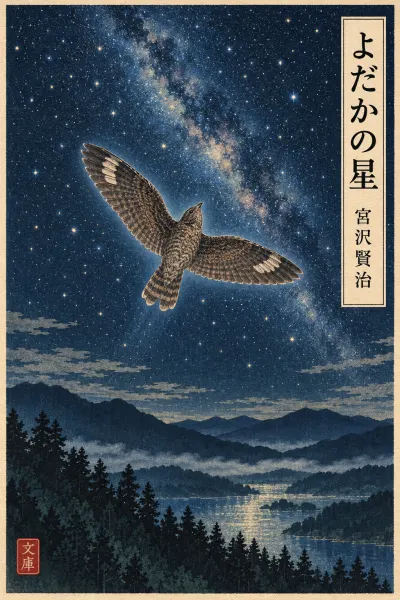
The nighthawk is a small, unattractive bird that the other birds dislike, and the hawk orders it to change its name to Ichizō or be eaten. Crying over eating insects and being eaten in turn, the nighthawk says goodbye to its brother the kingfisher and asks the sun and then the stars to take it in, but they refuse. At last it flies higher and higher into the cold sky until it becomes a beautiful blue light, and its star still burns in the night sky.
AI translation · independently checked
よだかは小さなとりです。The nighthawk was a small bird.
でも、きれいなとりではありません。But it was not a pretty bird.
くちが大きくて、あしがよわいです。Its mouth was big, and its legs were weak.
ほかのとりは、みんなよだかがきらいでした。All the other birds disliked the nighthawk.
「また来たね。いやだね。」と、わるいことばをいいました。"Here it comes again. How awful," they said, using unkind words.
よだかは、きれいなかわせみのにいさんです。The nighthawk was the elder brother of the beautiful kingfisher.
でも、よだかはつよく、はやくとびます。But the nighthawk flew strongly and fast.
こえも高いです。Its voice was high-pitched, too.
それで、名前に「たか」があります。That was why its name had "taka," hawk, in it.
たかは、それがいやでした。The hawk didn't like that.
あるゆうがた、たかがよだかのいえに来ました。One evening, the hawk came to the nighthawk's home.
「名前をいちぞうにかえてください。かみに名前を書いて、みんなのいえへ行ってください。あさってのあさまでに、してください。しないとりは、わたしが食べますよ。」「それはできません。」たかは大きなこえで「いいえ、できます。」といって、かえりました。"Change your name to Ichizō. Write the name on a piece of paper and go to everyone's home. Do it by the morning of the day after tomorrow. I will eat any bird that doesn't." "I can't do that." "Oh yes, you can," said the hawk in a loud voice, and it went home.
よる、よだかはそらをとびました。That night, the nighthawk flew through the sky.
くちを大きくあけて、むしをたくさん食べました。It opened its mouth wide and ate a lot of insects.
よだかはなきました。The nighthawk cried.
「わたしはまいばん、むしを食べます。今、たかがわたしを食べます。もうむしは食べません。とおいそらのむこうへ行きます。」"Every night I eat insects. And now the hawk is going to eat me. I won't eat insects anymore. I will go far away, beyond the distant sky."
よだかは、おとうとのかわせみのところへ行きました。The nighthawk went to see its younger brother, the kingfisher.
「わたしはとおいところへ行きます。もうあいません。」「にいさん、行かないでください。」「さかなをたくさんとらないでください。げんきでね。」"I am going somewhere far away. We won't meet again." "Brother, please don't go." "Please don't catch too many fish. Take care of yourself."
あさ、よだかはたいようのほうへとびました。In the morning, the nighthawk flew toward the sun.
「たいようさん、あなたのところへ行きたいです。わたしはもえてしにます。それでいいです。」たいようはいいました。"Sun, I want to go to where you are. I will burn up and die. That is all right with me." The sun said,
「あなたはひるのとりではありませんね。よる、ほしにたのんでください。」"You are not a bird of the daytime, are you? Tonight, ask the stars."
よだかは西のほしにたのみました。The nighthawk asked the star in the west.
「わたしも、あなたのところへ行きたいです。」ほしは何もこたえませんでした。"I want to go to where you are, too." The star did not answer at all.
南のほしは「とりには、できません。」といいました。The star in the south said, "A bird can't do that."
北のほしは「つめたい水に入ってください。」といいました。The star in the north said, "Go and get into some cold water."
東のほしは「お金がたくさんいりますよ。」といいました。The star in the east said, "You'll need a lot of money, you know."
よだかは下へおりました。The nighthawk dropped down low.
でも、また高くとびました。But then it flew up high again.
そして、大きなこえでなきました。And it cried out in a loud voice.
たかとおなじこえでした。It was the same voice as the hawk's.
ほかのとりは、みんなおきました。All the other birds woke up.
よだかは上へ上へとびました。The nighthawk flew up and up.
とてもさむいです。It was very cold.
もう上か下か、わかりません。It could no longer tell up from down.
でも、よだかはもういやではありませんでした。But the nighthawk was not unhappy anymore.
それから、よだかはあおいきれいなひかりになっていました。And then the nighthawk had become a beautiful blue light.
よだかのほしは、今もよるのそらでもえています。The nighthawk's star is still burning in the night sky today.
Vocabulary
| Word | Meaning | JLPT |
|---|---|---|
| よだかよだか | nighthawk (a bird that flies and hunts insects at night)The name contains たか, 'hawk'. That is why the real hawk is angry and wants it to change its name. | — |
| きらいきらい | disliked; hated (na-adjective 嫌い; Xがきらい = to dislike X)A な-adjective. The pattern is 'Aは Bが きらい': A dislikes B. The opposite is すき. | N5 |
| かわせみかわせみ | kingfisherA small, bright blue bird that catches fish in rivers. | — |
| いやいや | unpleasant; to hate (something)A な-adjective for things you do not want or cannot stand. 「いやだね」 means 'How awful.' | N5 |
| ゆうがたゆうがた | evening; late afternoonKanji: 夕方. | N5 |
| かえてかえる | to changedictionary form: かえるKanji: 変える. Do not confuse it with かえる (帰る), 'to go home', which comes in かえりました later in the same sentence. | N5 |
| あさってあさって | the day after tomorrow | N5 |
| もえてもえる | to burndictionary form: もえるKanji: 燃える. | N3 |
| たのんでたのむ | to ask (for a favour); to requestdictionary form: たのむThe person you ask is marked with に, as in ほしにたのむ, 'ask the stars'. | N5 |
| こたえませんでしたこたえる | to answerdictionary form: こたえる何もこたえませんでした: 'did not answer anything at all'. | N5 |
| つめたいつめたい | cold (to the touch)Use つめたい for water or objects and さむい for the weather or air, as in sentence 33. | N5 |
| おりましたおりる | to go down; to come downdictionary form: おりるKanji: 下りる / 降りる. | N5 |
| ひかりひかり | lightKanji: 光. | N4 |
Grammar
い-adjective 〜くて N5 and (linking adjectives)
To join an い-adjective to the next phrase, change the final い to くて. Here 大きい becomes 大きくて, which links 'big mouth' and 'weak legs'.
くちが大きくて、あしがよわいです。
Its mouth was big, and its legs were weak.
〜てください N5 please do ~
The て-form of a verb plus ください makes a polite request. The hawk uses it, but here it is really giving orders.
名前をいちぞうにかえてください。
Change your name to Ichizō.
〜までに N4 by (a deadline)
までに marks the time limit by which something must be done. まで alone means 'until'.
あさってのあさまでに、してください。
Do it by the morning of the day after tomorrow.
〜ないでください N5 please don't ~
The ない-form of a verb plus でください asks someone not to do something.
にいさん、行かないでください。
Brother, please don't go.
〜たいです N5 want to ~
Take the ます-stem of a verb (行き) and add たい to say what the speaker wants to do. です makes it polite.
たいようさん、あなたのところへ行きたいです。
Sun, I want to go to where you are.
noun + に なる N5 to become ~
A noun plus に なる means 'become'. Here the form になっていました shows the result: by then, the nighthawk had already become a light.
よだかはあおいきれいなひかりになっていました。
The nighthawk had become a beautiful blue light.