Intermediate · JLPT N3
ざしき童子のはなしZashikibokko no Hanashi — Tales of the Parlour Child
- JLPT N3
- 1,814 characters
- 1 part
- about 15 minutes
- 2 easier versions
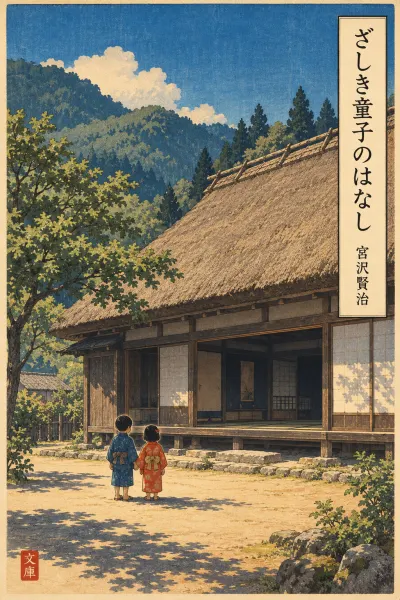
This is a short sketch by Miyazawa Kenji about the zashiki-warashi, or 'parlour child', a spirit that folk belief places in old country houses. It is not one continuous story. A gentle narrator from 'our part of the country' strings together several small tales. In one, a broom is heard sweeping in an empty house. In another, an extra child quietly appears among ten children playing in a ring. In a third, children gathered at a main house agree not to play with a boy still recovering from measles, and then find something in one of the rooms. A final tale comes from a ferryman on the Kitakami River. The tone is calm and slightly eerie rather than frightening, and the spirit is glimpsed but never explained. For learners, the text is short, at about 1,800 characters. The narration uses simple polite -masu/-desu forms and soft onomatopoeia such as ざわっざわっ and ぐるぐる. The harder parts are the ferryman's plain rural speech with おら, a few older forms like 〜たらば and 〜ておりました, and background details such as the old lunar calendar.
Contents
Easier versions
This story is also retold in simpler Japanese. Reading an easier version first makes the original much more approachable.
Before you read
- Learn the refrain こんなのがざしき童子です ('That's the kind of thing a parlour child is') before you start. It recurs in the text as the narrator's summing-up line. Note that ざしき童子 is read ざしきぼっこ here, not ざしきわらし.
- Watch for the change of voice. The narrator speaks in polite -masu/-desu Japanese, but the ferryman's account uses plain forms and おら, a rural, masculine word for 'I'. Read his section expecting shorter, blunter sentences.
- Review these patterns from the notes in advance: 〜てみる ('try doing'), 〜てたまらない ('unbearably / can't help …'), 〜ないふり(を)する ('pretend not to …') and 〜たばかりのはず ('should have only just …').
- Two older-sounding forms recur. 〜ておりました is a humble, polite version of 〜ていました. 〜たらば is an older form of the conditional 〜たら ('if / when …').
- Memorise the proper nouns: 北上川 (きたかみがわ), 朗妙寺 (ろうみょうじ), 笹田 (ささだ), 更木 (さらき), 斎藤 (さいとう). In the final tale, 笹田 and 斎藤 are household names, so read them as 'the Sasada family' and 'the Saitō family' rather than as individual characters.
Words to know
The most useful words from the notes across the story.
| Word | Meaning | JLPT |
|---|---|---|
| 見舞いみまい | visit to a sick person; get-well giftIn the later sentence, 見舞いに means as a get-well present. | N3 |
| あきたあきる | to get tired of, to have had enough ofdictionary form: 飽きる | N3 |
| 箒ほうき | broom | N2 |
| ざしき童子ざしきぼっこ | parlour child; a child spirit said to live in old housesdictionary form: 座敷童子Tōhoku folklore. The standard reading is ざしきわらし. A house with one prospers, and the house falls when it leaves. 座敷 means a tatami room. | — |
| ひっそりひっそり | silent, still, desertedClose to しんと in the earlier sentence; it describes a place where nothing stirs. | — |
| 箕み | winnowing basketA flat basket shaken to separate grain from chaff. 箕にかける means to winnow. | — |
| お振舞ふるまい | a treat; a party where guests are given fooddictionary form: 振舞Related to 振る舞う, to entertain or treat guests. | — |
| 本家ほんけ | main family, head householdPaired with 分家 (branch family) in the same sentence. | — |
| はしかはしか | measlesKanji 麻疹. Used with にかかる, to catch an illness. | — |
| ひどいめにあったひどいめにあう | to have a terrible time, to sufferdictionary form: ひどい目にあう目 here means an experience. | — |
| 渡し守わたしもり | ferryman渡し is a ferry crossing, and 守 means keeper. | — |
| おらおら | I, me (rural, rough)A dialect first-person pronoun of northern and eastern Japan. | — |
| 袴はかま | hakamaFormal pleated trousers or skirt worn over a kimono. With a crested kimono (紋付) and a sword, it marks formal samurai-style dress. | — |
| おちぶれておちぶれる | to fall into ruin, to come down in the worlddictionary form: 落ちぶれる | — |
| めきめきめきめき | rapidly, remarkably (of improvement or growth) | — |
Plot summary
Show the full summary (contains spoilers)
A narrator describes the parlour child, a spirit of old country houses, through a series of short tales. In one, children hear a broom sweeping in an empty house. In another, ten children playing in a ring mysteriously become eleven. At a gathering at a main house, the children of the branch families agree not to play with a boy who is recovering from measles. Then they find a parlour child in one of the rooms. It looks like that boy but thin and pale, and it cries. Finally, a ferryman tells how he rowed a strange, well-dressed child across the Kitakami River. The child said he was leaving the Sasada household to go to the Saitōs in Saraki. Afterwards the Sasadas fell into ruin, while the Saitōs prospered.
About the author
Miyazawa Kenji was a poet and writer of children's stories from Hanamaki in Iwate Prefecture. He studied agricultural science in Morioka and later taught at an agricultural school. He devoted much of his life to helping local farmers improve their methods and their cultural lives. He was a devout Buddhist, and his faith, love of nature and interest in science run through his writing. His fame came after his death, with works such as 銀河鉄道の夜, 風の又三郎 and the poem 雨ニモマケズ.