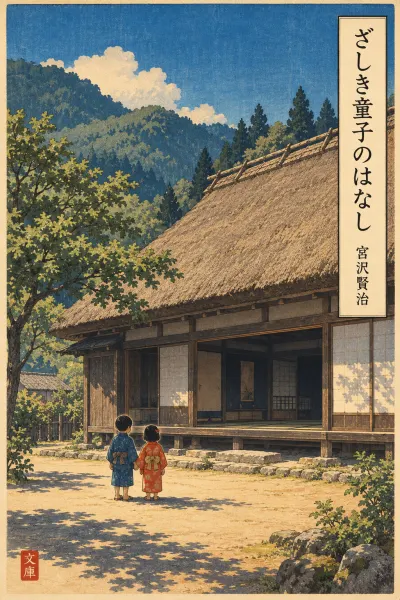
 N4 · easy
Simplified retelling · JLPT N4
ざしき童子のはなし Zashikibokko no Hanashi in easy Japanese (N4)
This is our own simplified retelling of Tales of the Parlour Child, written for N4 learners and checked word by word against the N4 vocabulary list. A few story words and grammar patterns go beyond N4; the notes below give each one's level. It keeps the characters, events and ending of the original. When it feels easy, move on to the original text.
The story in brief
The narrator tells several short stories about the parlour child, a spirit child who lives in old houses. It sweeps in empty rooms, appears as an extra child in a game, and shows up looking like a boy who had been ill, whom the other children had promised not to play with. A ferryman then describes carrying a mysterious boy across the Kitakami River one night. The boy said he was leaving the Sasada house for the Saitō house. Afterwards the Sasada family ran out of money, while at the Saitō house the sick recovered and the family grew more and more prosperous and respectable.
AI translation · independently checked
わたしたちの村の、ざしきわらしの話です。This is about the parlour child of our village.
よく晴れた昼間でした。It was a bright, sunny day.
大人はみんな山へ仕事に行きました。All the grown-ups had gone up to the mountains to work.
子ども二人が、にわであそんでいました。Two children were playing in the garden.
大きな家にはだれもいません。There was nobody in the big house.
とてもしずかでした。It was very quiet.
すると、家のどこかのへやから、ほうきでそうじをする音が聞こえました。Then, from some room somewhere in the house, came the sound of someone sweeping with a broom.
二人は手をとりあって、しずかに見に行きました。The two of them took each other's hands and went quietly to look.
でも、どのへやにもだれもいませんでした。But there was no one in any of the rooms.
かたなの箱があるだけでした。There was only a box for a sword.
また、ほうきの音が聞こえます。Then they hear the sound of the broom again.
とおくの鳥のこえでしょうか。Could it be a bird calling far away?
北上川の水の音でしょうか。Could it be the sound of the water in the Kitakami River?
二人はいろいろ考えながら、何も話さないで聞いていました。The two of them thought of all sorts of things as they listened without saying a word.
でも、どれでもないようでした。But it didn't seem to be any of those.
もう一度へやを見ましたが、やはりだれもいません。They looked in the rooms once more, but still there was no one.
日のひかりが、へやの中にあたたかく入っているだけでした。There was only the sunlight coming warmly into the rooms.
こんなのがざしきわらしです。That's the kind of thing a parlour child is.
ある家に、ちょうど十人の子どもがよばれて来ました。Once, exactly ten children were invited to a certain house.
子どもたちは手をとって丸くなりました。The children held hands and made a circle.
そして、へやの中をまわってあそんでいました。And they played, going round and round the room.
すると、いつのまにか十一人になっていました。Then, before anyone noticed, there were eleven of them.
知らないかおは一人もいません。There wasn't a single face they didn't know.
同じかおも一人もいません。And not a single face was the same as another.
でも、なんかい見ても十一人います。But no matter how many times they looked, there were eleven.
大人が来て、「ふえた一人がざしきわらしだよ」と話しました。A grown-up came and said, "The extra one is the parlour child."
子どもたちは、みんな「じぶんはざしきわらしではない」と思いました。Every one of the children thought, "I'm not the parlour child."
そして、目を大きく開けて、まじめにすわっていました。And they sat up very properly, with their eyes wide open.
こんなのがざしきわらしです。That's the kind of thing a parlour child is.
ある大きな家では、毎年八月にお祭りをして、家族の子どもたちをよびました。At one big house, every year in August they held a festival and invited all the children of the family.
ある年、その中の一人の男の子が、はしかになってねていました。One year, one of the boys had caught measles and was lying in bed.
「お祭りに行きたい。お祭りに行きたい」と、その子は毎日なきました。"I want to go to the festival. I want to go to the festival," the boy cried, day after day.
おばあさんがお見舞いに来ました。His grandmother came to see how he was.
その子のあたまに手を置いて、「お祭りを後にするから、早く元気になりなさい」と話しました。She put her hand on his head and said, "We'll hold the festival later, so hurry up and get well."
その子は九月に元気になりました。The boy got well in September.
そして、みんながよばれました。And everyone was invited.
でも、ほかの子どもたちはおもしろくありませんでした。But the other children weren't happy about it.
お祭りが遅くなりました。The festival had been put off.
それに、おもちゃのうさぎも、お見舞いにあげなければなりませんでした。On top of that, they had had to give him their toy rabbits as get-well presents.
「あの子のために、いやなことがあった。今日あの子が来ても、けっしてあそばないよ」と、みんなはやくそくしました。"Bad things happened because of him. Even if he comes today, we won't play with him, not ever," they all promised.
みんながへやであそんでいると、一人が「あ、来たよ」とよびました。While they were all playing in the room, one of them called out, "Oh, he's here!"
みんなはとなりの小さなへやに走って入りました。They all ran into the small room next door.
すると、そのへやの真ん中に、あの子がすわっていました。And there, sitting in the middle of that room, was the boy.
まだ門のところにいるはずの子です。The very boy who should still have been at the gate.
その子はとてもやせて、かおが青くなっていました。He was very thin, and his face had gone pale.
新しいくまのおもちゃを持って、なきそうなかおですわっていました。He was holding a new toy bear and sitting there, looking as if he was about to cry.
「ざしきわらしだ」一人がにげだしました。"It's the parlour child!" One of them ran off.
みんなもにげました。Everyone else ran too.
ざしきわらしはなきました。The parlour child cried.
こんなのがざしきわらしです。That's the kind of thing a parlour child is.
また、北上川で、ふねで人を運ぶ仕事をしている男が、ある日わたしに話してくれました。And one day a man who works on the Kitakami River, carrying people across by boat, told me this.
「八月十七日のばんでした。わたしはおさけを飲んで、早くねました。すると、川のむこうからよぶこえがしました。外へ出ると、月が空の高いところにありました。"It was the night of the seventeenth of August. I'd had some sake and turned in early. Then I heard somebody calling from across the river. I went outside, and the moon was high up in the sky.
わたしは急いでふねを出しました。I hurried and pushed the boat out.
むこうに着くと、きれいな男の子が一人で立っていました。When I got to the other side, there was a good-looking boy standing all by himself.
りっぱな着物を着て、かたなを持っていました。He was dressed in fine clothes, and he had a sword with him.
『わたりますか』と聞くと、『たのみます』と答えました。'You crossing?' I asked, and he answered, 'Yes, please.'
ふねが川の真ん中に来たころ、わたしはその子をよく見ました。About the time the boat reached the middle of the river, I took a good look at the boy.
その子はまじめに、空を見ながらすわっていました。He was sitting there all serious, looking up at the sky.
『どこから来て、どこへ行くのですか』と聞くと、その子はかわいいこえで答えました。'Where've you come from, and where are you headed?' I asked, and he answered in a sweet little voice.
『ささだの家に長くいたけど、もうつまらなくなったから、ほかへ行くよ』'I was at the Sasada house a long time, but I've got tired of it, so I'm going somewhere else.'
『どうしてですか』と聞くと、その子は何も答えないで、わらっていました。'Why's that?' I asked, but he didn't answer, just smiled.
『どこへ行きますか』とまた聞くと、『さらきのさいとうの家へ行くよ』と答えました。'Where are you going?' I asked again, and he answered, 'I'm going to the Saitō house in Saraki.'
むこうに着くと、その子はもういませんでした。When we got to the other side, the boy wasn't there anymore.
わたしは家の入口にすわっていました。I was sitting in the doorway of my house.
ゆめだったのか、わかりません。I can't tell whether it was a dream.
でも、きっとほんとうです。But I'm sure it really happened.
それから、ささだの家はお金がなくなりました。After that, the Sasada family lost all their money.
さいとうの家は、病気の人が元気になりました。At the Saitō house, the folks who'd been sick got well.
むすこも大学を出ました。Their son made it through university, too.
そして、どんどんりっぱになりました」And they just kept doing better and better."
こんなのがざしきわらしです。That's the kind of thing a parlour child is.
Vocabulary
| Word | Meaning | JLPT |
|---|---|---|
| ざしきわらしざしきわらし | parlour child; a spirit child that lives in an old housedictionary form: 座敷童子Folk belief from northeastern Japan: a house with one prospers, and a house it leaves falls into ruin. In local dialect it is also called ざしきぼっこ. | — |
| 昼間ひるま | daytime; the middle of the day | N4 |
| 聞こえましたきこえる | to be heard; can be hearddictionary form: 聞こえるThe sound comes to you by itself. Compare 聞く, 'to listen'. | N4 |
| とりあってとりあう | to take (each other's hands)dictionary form: 取り合う〜あう added to a verb means 'to do to each other'. | — |
| やはりやはり | still; just as before; as expectedCasual form: やっぱり. | N4 |
| ふえたふえる | to increase; to become moredictionary form: 増えるThe opposite is 減る (へる). | N4 |
| まじめにまじめ | seriously; properly, earnestlydictionary form: 真面目 | N4 |
| はしかはしか | measlesdictionary form: 麻疹 | — |
| お見舞いおみまい | a visit to a sick person; a get-well giftIt means the visit in sentence 33 and the gift in sentence 39. | N4 |
| けっしてけっして | never; not at alldictionary form: 決してAlways used with a negative verb, as in けっしてあそばない. | N4 |
| やせてやせる | to become thindictionary form: 痩せるThin people are described with やせている, not やせる. | N4 |
| にげだしましたにげだす | to run away; to start running offdictionary form: 逃げ出す〜だす added to a verb means 'to suddenly start doing'. | N1 |
| つまらなくつまらない | boring; dulldictionary form: つまらない | N5 |
| どんどんどんどん | steadily; more and more, quickly | N4 |
Grammar
〜ないで N4 without doing ~
Add ないで to the negative stem of a verb to show that one action happens without another. Here the children listen without speaking.
何も話さないで聞いていました
they listened without saying a word
いつのまにか N3 before you know it; without anyone noticing
This phrase shows that something changed while nobody was paying attention. It is often followed by 〜ていた or 〜ている, which describe the new state.
いつのまにか十一人になっていました
before anyone noticed, there were eleven of them
疑問詞 + 〜ても N4 no matter how (many times) ~
A question word together with the て-form + も means 'no matter how much…'. The result stays the same each time. Here, however often they look, they still count eleven.
なんかい見ても十一人います
no matter how many times they looked, there were eleven
〜なければなりません N4 must ~; have to ~
Take the negative form of a verb, change ない to なければ, and add なりません. Here it is in the past tense: the children had no choice and had to give their toys.
おもちゃのうさぎも、お見舞いにあげなければなりませんでした
they had had to give him their toy rabbits as get-well presents
〜はず N4 should be; is expected to be
はず shows what the speaker firmly expects is true. Here it describes the boy, who should still be at the gate. That is why his sudden appearance in the room is so strange.
まだ門のところにいるはずの子です
The very boy who should still have been at the gate.
Verb stem + そうな N4 looking as if about to ~
The verb stem + そう means something looks likely to happen. The form そうな describes a noun. なきそうなかお is 'a face that looks about to cry'.
なきそうなかおですわっていました
sitting there, looking as if he was about to cry