Part 1 of 1 · JLPT N3
あじさい Ajisai, part 1: A Pause in the Early-Summer Rain
In this part
A widow and a man close to her sit in the altar room beside her sick little daughter. She says she feels guilty about their closeness, and he silently debates whether to confess that he once wished her drowned husband dead. When the sun briefly breaks through the rain, the child wakes crying out for her father and stares fixedly at an empty corner of the room.
AI translation · independently checked
――あの人があんなふうにして不意に死んだのでなかったら、仮にまあ長い患のあとででもなくなったのであったら、きっと、あなたと私とのことを、たとえばいいとか決していけないとか、何かしらともかくもはっきりと言い置いたろう……わたしはどうもそんな気がするのです。"—If he had not died so suddenly, the way he did—if, let us say, he had passed away after a long illness instead—I am sure he would have left some word about you and me, something clear one way or the other, that it was all right, perhaps, or that it must never be… That is the feeling I can't seem to shake.
でも、あなたがあれから七年も経つのにどうして今日までひとりでいらっしゃるか、またわたしがどうして時々お説教を聴きに出かけたりするような気持になったか、そのわけをあの人は、口に出しては言わなかったけれどちゃんと知ってはいたのですものね。And yet, why you have stayed alone until today, even though seven years have passed since then, and why I came to feel like going out now and then to hear the sermons—he never put the reason into words, but he knew it perfectly well, didn't he?
それならばこそ、私を一そうやさしくもしたのでしょう。That must be exactly why he was all the kinder to me.
そのことを思うとわたしは、それだけにまたどうしていいか心が迷うの。When I think of that, my heart is all the more lost, and I don't know what I ought to do.
そうしてわたしとあなたとがこんな話をしていることも、またこんなことを思って見ることも気が引けてならないのですわ……And so even our talking together like this, even my letting myself think such things, makes me feel so terribly ashamed…"
そう、今のさっき目に涙を溜めながら女の言った言葉を、男は、自分の心のなかで繰返して見た。Yes—the man went over again in his heart the words the woman had spoken only a moment ago, her eyes brimming with tears.
そうして、女がどういうわけでそんなことを言うかという心持が男にもわかるように思えた。And it seemed to him that he, too, understood the feeling that made her say such things.
それにつけてもあの時から言おうか言うまいかと思いまどうている事を、今も、女に打開けようかどうかと考えたりする。All the same, the thing he had been torn over ever since that time, whether to say it or not, he now found himself wondering once more whether to confess to her.
それは、――全く、私はあののち幾度あの男が死んでさえくれたら。It was this: "—In all honesty, how many times since then have I… 'if only that man would die…'
……と思った事があるか知れないのです。…I cannot tell you how many times I thought it.
あなたの夫があんなふうにして溺れ死んだその瞬間にも、私はもしかすると遠くで何も知らずにではあったが、それを思いつめていなかったとは言えないのです。Even at the very moment your husband drowned like that, I cannot say that I was not, perhaps, brooding on it, though I was far away and knew nothing of what was happening.
実際、それほど度々私はそのことを思ったのだから。For in truth, that is how often I thought of it."
男が言おうか言うまいかとしている言葉というのはそれだけのことである。That, and nothing more, was what the man was trying to decide whether to say.
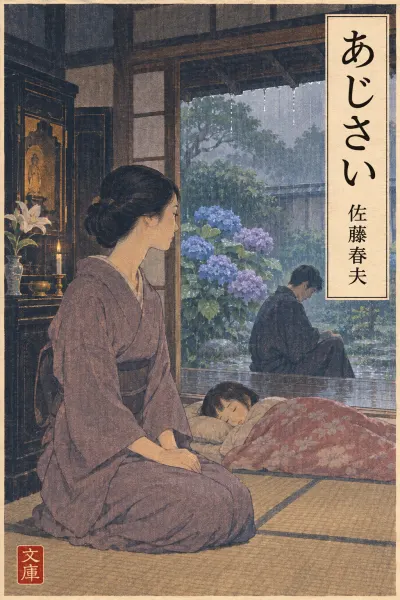
六畳の仏壇の間に、蒼白くやつれた病児――六つになる女の子の枕元から少し距れたところに女は坐っている。In the six-mat room that holds the Buddhist altar, the woman sits a little way from the pillow of a sick child, pale and worn thin—a little girl of six.
さっきから極く低い音で三味線を弄びながら、目を畳の上に見据えている。For some time now she has been toying with a shamisen, plucking it very softly, her eyes fixed on the tatami.
その同じあたりの畳の上を見入って男も、今言ったようなことを考えつづけていたが、そんな神経質な考え方を突放そうとして、目を上げて女の横顔を凝と見た。Gazing at the same patch of tatami, the man too had gone on thinking the thoughts just described, but, trying to thrust away such an overwrought way of thinking, he raised his eyes and looked steadily at the woman's profile.
肘枕をしている男の目には女の顔が少し紅を帯びて来たように思えた。To the man, lying with his head propped on his elbow, it seemed that a faint flush had come into her face.
その時、部屋のなかが少し明くなったと思うと、障子の腰にうすれ日が射した。Just then the room grew a little brighter, and pale sunlight fell on the lower panel of the paper screen.
「あら、日が当って来たわ。」"Oh, the sun's come out."
ひとり言のように女は言って、身を浮かせながら障子を引いた。The woman said it as if to herself, and, half rising, slid the screen open.
雲に断え間があってさみだれの晴れ間である。There was a break in the clouds; it was a lull in the early-summer rains.
女は空を見上げてから、意味もなく男の方を見返った。The woman looked up at the sky, then glanced back at the man for no particular reason.
少し不自然に歪んでいる笑い顔であった。Her smile was a little unnaturally twisted.
まだ乾ききらない今のさっきの涙と笑とで女の眼はかがやかであった。Her eyes shone with the tears of a moment before, not yet quite dry, and with her smile.
今まで女の横顔を偸み見ていた男の目は、女のそのまなざしをまぶしがるように避けて、視線は庭の方へ向けられた。The man's eyes, which until then had been stealing glances at her profile, shied away from her gaze as if dazzled, and he turned to look toward the garden.
軒から雨だれが光ってしづくしている。Raindrops glittered as they dripped from the eaves.
「紫陽花があってもいい庭ですがね。」"It's the kind of garden that could do with some hydrangeas."
男はつかぬことを言った。The man said something quite beside the point.
女は答える――The woman answered—
「いやですよ、紫陽花などは。あれは病人の絶えない花だというじゃありませんか。」"Oh no, not hydrangeas. Don't they say they're the flower of a house that is never free of sickness?"
「そう。そんなことも言いますね……」"Ah. Yes, people do say that…"
女は再び三味線をとり上げた。The woman took up the shamisen again.
男は急に肘枕から起きて坐り直した――彼は、まわり縁に人が来ると思ったからであった。The man abruptly rose from his elbow and sat up properly—for he thought someone was coming along the veranda.
「ばあやがもう帰ったのかしら」"I wonder if Nanny is back already."
女もそう言った。The woman said so too.
眠っていた子供が、突然、その時、けたたましく泣き立てた。At that very moment the sleeping child suddenly burst into shrill cries.
母親は今とり上げたばかりの三味線をそこに置くと、子供の枕元へにじり寄った。The mother set down the shamisen she had only just picked up and shuffled on her knees to the child's pillow.
「お父さん! お父さん! お父さん! ……」"Father! Father! Father!…"
子供は母の顔を見ようともせずにそう叫びつづけた。The child kept crying out, without even trying to look at her mother's face.
「どうしたの。どうしたの。――夢を見たのね……」女は憫みを乞うように男の方を見やりながら、初めは子供にそうしてだんだんと男に言った。"What is it? What's the matter?—You had a dream, didn't you…" Glancing toward the man as if pleading for sympathy, the woman spoke at first to the child, and then, little by little, to the man.
「……本当にへんな子ですよ。今になってお父さんばかり恋しがるのよ。それにここでなきゃ――仏壇の間でなきゃ寝ようとしないの。」"…She really is a strange child. Only now has she started pining for her father, and nobody else. And she won't sleep anywhere but here—anywhere but the altar room."
男はそれには答えようともしなかった。The man made no attempt to answer.
心臓が不思議に早く打って、耳鳴がするのに気がついた……He became aware that his heart was beating strangely fast and that his ears were ringing…
女はふと自分の背後をふりかえって見なければならなかった。The woman suddenly could not help turning to look behind her.
そこにはしかし、もとより何もなかった。But there was, of course, nothing there.
ただ病み疲れた子供は、痩せおとろえて一そう大きく一そう透明になった黒い瞳をぱっちりと見張って、母の肩ごしに、空間を、部屋の一隅をいつまでも凝視した――。Only the child, worn out by illness, her black eyes grown all the larger and all the clearer as she wasted away, kept them wide open and stared on and on over her mother's shoulder, into empty space, into one corner of the room—.
Vocabulary
| Word | Meaning | JLPT |
|---|---|---|
| 不意ふい | sudden, unexpectedOften 不意に (suddenly, without warning). | N1 |
| 言い置いたいいおく | to leave word (before going or dying)dictionary form: 言い置くImplies last instructions left behind. | — |
| 気が引けてきがひける | to feel ashamed, to feel awkward or guiltydictionary form: 気が引ける | — |
| 思いまどうているおもいまどう | to be torn, unable to make up one's minddictionary form: 思い惑うまどうている is an older form of まどっている. | — |
| 打開けよううちあける | to confess, to open one's heartdictionary form: 打ち明けるUsually written 打ち明ける today. | — |
| 思いつめておもいつめる | to brood on, to dwell on obsessivelydictionary form: 思い詰める | — |
| やつれたやつれる | to become haggard, worn thindictionary form: やつれるFrom illness, grief or worry. | — |
| 三味線しゃみせん | shamisen, a three-stringed Japanese lutePlucked with a large plectrum; kept in Japanese as English has no equivalent. | N1 |
| 見据えているみすえる | to fix one's eyes ondictionary form: 見据える | — |
| 肘枕ひじまくら | lying with one's head propped on one's elbowLiterally 'elbow pillow'. | — |
| さみだれさみだれ | early-summer rains (the rainy season)dictionary form: 五月雨Old-calendar 'fifth-month rain'; a poetic word for 梅雨. | — |
| つかぬことつかぬこと | something unrelated, beside the pointdictionary form: 付かぬことSet phrase; ぬ is classical negative. | — |
| にじり寄ったにじりよる | to edge closer on one's kneesdictionary form: 躙り寄るTypical movement when seated on tatami. | — |
| 凝視ぎょうし | a fixed stare, gazing intentlyWritten-style word; 凝視する. | — |
Grammar
〜ばこそ N1 precisely because
こそ added to a ば-conditional stresses that this, and nothing else, is the reason. それならばこそ means 'that is exactly why'.
それならばこそ、私を一そうやさしくもしたのでしょう。
That must be exactly why he was all the kinder to me.
〜てならない N2 cannot help feeling; extremely
Attached to the te-form of a feeling, it means the feeling is so strong it cannot be suppressed. Here the shame of their closeness is overwhelming.
またこんなことを思って見ることも気が引けてならないのですわ
even my letting myself think such things makes me feel so terribly ashamed
〜ようか〜まいか N1 whether to do or not
The volitional form paired with the negative volitional まい expresses wavering over a decision. 言うまい means 'I will not say it'.
あの時から言おうか言うまいかと思いまどうている事
the thing he had been torn over ever since that time, whether to say it or not
〜さえ〜たら N2 if only
さえ marks the one condition that would be enough; with たら it voices a wish. 死んでさえくれたら: 'if only he would (do me the favour of) dying'.
あの男が死んでさえくれたら。
if only that man would die for me…
幾度〜か知れない N2 countless times; no telling how many
A question word with か知れない (an older form of かわからない) means the amount is too great to count.
幾度あの男が死んでさえくれたら。……と思った事があるか知れないのです。
I cannot tell you how many times I thought, 'if only that man would die.'
〜きらない N2 not completely
きる after a verb stem means 'to do completely'; in the negative it shows the action is unfinished. 乾ききらない: not yet quite dry.
まだ乾ききらない今のさっきの涙
the tears of a moment before, not yet quite dry