Intermediate · JLPT N3
赤い蝋燭と人魚Akai Rōsoku to Ningyo — Red Candles on the Shrine Hill
- JLPT N3
- 6,508 characters
- 5 parts
- about 54 minutes
- 2 easier versions
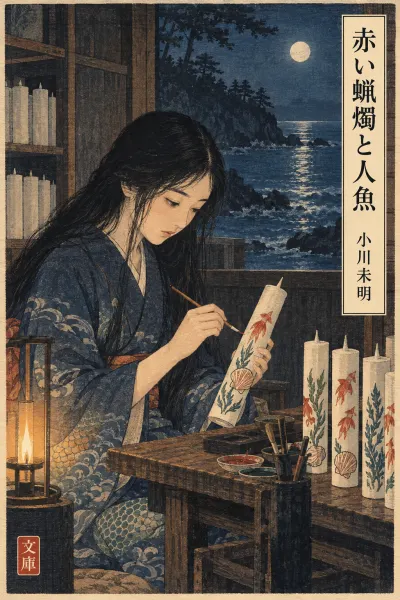
赤い蝋燭と人魚 (Red Candles on the Shrine Hill) is a literary fairy tale by Ogawa Mimei. It opens on a lonely rock in the cold northern sea. A mermaid, expecting a child, decides that her baby should grow up among human beings, whom she has heard are kind. In a small seaside town, an old couple who make candles take in a strange baby girl. Her red paintings on their candles bring fame to the shop and to the shrine on the pine-covered hill above it. Then a showman from the south makes the couple a tempting offer. On the surface the telling is calm and gentle, but it grows steadily more melancholy, and this is not a comforting tale. For learners, the plot is easy to follow and the vocabulary is concrete: the sea, candles, moonlight, the shrine. The main challenge is register. The narrator uses polite です/ます and formal であります, with old-fashioned forms such as 青うございました. The girl speaks humbly, using 妾 and 下さいまし. The long descriptive sentences reward slow, careful reading.
Contents
Easier versions
This story is also retold in simpler Japanese. Reading an easier version first makes the original much more approachable.
Before you read
- The narration often ends sentences with 〜のであります, a formal explanatory ending. Read it roughly as 'it was that…' or simply as a plain statement. It sets the storyteller's measured, old-fashioned voice.
- Learn the old adjective form 〜うございます: 青い becomes 青うございました ('it was blue'). To understand these forms, convert them back to the ordinary adjective (青い, 美しい, and so on).
- The girl's speech is humble and old-fashioned. 妾 is a humble first-person 'I', and 下さいまし is an older, softer form of 下さいませ / 下さい used when making a request. Her lines are short, so they are good places to practise this register.
- In Part 1, the mermaid's monologue uses the double negative 〜ないことはない (暮されないことはないだろう, 'it is not that one could not live…'). The narration also uses 〜のが常だ ('it was her habit to…') for her resting on the rock on moonlit nights. Also watch for 〜なければなりません and 〜ない日はない.
- Words to learn before you start: 蝋燭 (ろうそく, candle), 人魚 (にんぎょ, mermaid), 神様 (god), 嵐 (あらし, storm), and 月 (moon). Moonlit nights mark nearly every turning point in the story.
Words to know
The most useful words from the notes across the story.
| Word | Meaning | JLPT |
|---|---|---|
| 不吉ふきつ | unlucky, ill-omened | N1 |
| 参詣さんけい | visiting a shrine or temple to worshipA formal word; 参詣する means 'to go and pray at a shrine'. | — |
| 香具師やし | showman; travelling huckster who exhibits curiosities or sells goods at fairsAn irregular reading (jukujikun): the kanji do not spell out や・し. | — |
| お蔭おかげ | thanks to (someone's help or blessing)Survives in the everyday phrase おかげさまで. | N4 |
| 眺めながらながめる | to gaze at, to look out overdictionary form: 眺めるUsed for looking at a view or a scene, often at length. | N3 |
| 仕合せしあわせ | happiness; happilyAn older spelling of 幸せ. | N3 |
| 陸おか | land (as opposed to the sea)おか is the old, native reading. りく is the modern Sino-Japanese reading. | N3 |
| 噂うわさ | rumour, talk | N3 |
| 恩おん | a debt of gratitude, kindness receivedご恩を忘れない means 'never to forget the kindness one owes to someone'. | N3 |
| 評判ひょうばん | reputation, fame, public talk評判が立つ means 'word gets around'. | N3 |
| 憧がれてあこがれる | to long for, to yearn fordictionary form: 憧れるTakes を for the thing longed for. Now written 憧れる. | N2 |
| せっせとせっせと | busily, diligently, without a break | N2 |
| 災難さいなん | misfortune, disaster, mishap | N2 |
| 儲けもうける | to make a profit, earn moneydictionary form: 儲けるCommon in 金を儲ける and in the noun 儲け (profit). | N2 |
| 覗きましたのぞく | to peep, to peekdictionary form: 覗くUsed for looking through a small gap or opening. | N2 |
Plot summary
Show the full summary (contains spoilers)
A mermaid on a lonely rock in the northern sea is expecting a child. Believing humans are kind, she decides to give birth on land and swims toward the lights of a hilltop shrine. An old candle-making couple find a baby girl, a fish from the waist down, crying at the foot of the shrine's stone steps. They raise her as a gift from the god. She paints red pictures on their candles, which sell well, and the shrine becomes famous for protecting sailors. Then a showman from the south offers a fortune, and the couple sell her despite her pleas. Before she is taken away in an iron-barred cage, she paints a candle plain red. Later, on a calm night, a pale woman with wet hair buys a red candle and pays with seashells. That night a storm wrecks countless ships, including the one carrying the girl. After that, red candles bring storms every night, and the town falls into ruin.
About the author
Ogawa Mimei was a Japanese writer from Niigata Prefecture. He is often called the father of modern Japanese children's literature, and he is sometimes described as 'the Japanese Andersen.' He studied at Tokyo Senmon Gakkō (now Waseda University), where his teacher Tsubouchi Shōyō is said to have given him the pen name Mimei. He wrote both fiction for adults and fairy tales, and he later devoted himself mainly to children's stories. His tales are known for their lyrical, often melancholy atmosphere and their concern for the weak and the lonely. Among his best-known works is 赤い蝋燭と人魚 (The Red Candles and the Mermaid).