Intermediate · JLPT N3
あじさいAjisai — Hydrangea Weather
- JLPT N3
- 1,697 characters
- 1 part
- about 14 minutes
- 2 easier versions
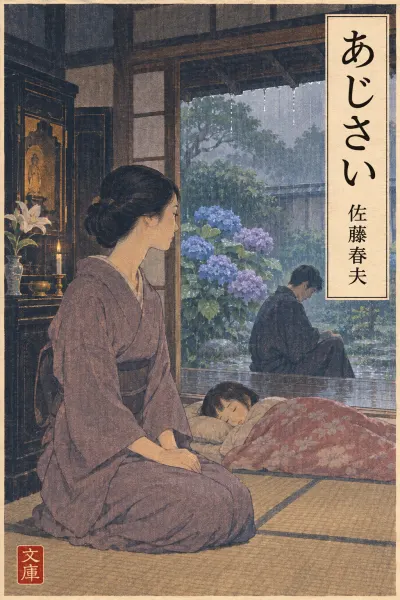
"Hydrangea Weather" is a very short psychological sketch by Satō Haruo, set in a single room on a single afternoon. During the early-summer rainy season, a widow and a man who has grown close to her sit by the household Buddhist altar while her little daughter lies ill beside them. Her husband drowned seven years earlier. Neither of them says much. The story's weight lies in what goes unsaid: her quiet guilt about their closeness, and a confession he rehearses in his head without being sure he should speak it. Satō writes in restrained, carefully measured prose, and the rain, the light and the hydrangeas in the small garden do much of the emotional work. The text is barely 1,700 characters, so you can finish it in one sitting. Its difficulty lies in nuance rather than length. The woman's soft, feminine speech, the man's hesitant inner monologue and a few older spellings and verb forms reward slow, attentive reading. It is a good text for learning to notice how Japanese conveys feeling through sentence endings and trailing-off phrases.
Contents
Easier versions
This story is also retold in simpler Japanese. Reading an easier version first makes the original much more approachable.
Before you read
- Watch for older written forms. しづく is the historical kana spelling of しずく (drop, drip). 思いまどうている is an older form of 思いまどっている ('is wavering, at a loss'). Recognizing these will keep you from stumbling over them.
- The man's inner debate is built on hesitation grammar. Learn 〜ようか〜まいか ('whether to … or not'), 〜さえ〜たら ('if only …'), as in 死んでさえくれたら, and 幾度〜か知れない ('countless times'). Together they carry the core of his unspoken confession.
- Expect emotional emphasis in compact forms. 〜てならない means 'can't help feeling', 〜ばこそ means 'precisely because', and 〜きらない means 'not completely'. They often mark the most important sentence in a passage, so slow down when you see them.
- Pay attention to the woman's sentence endings (わ, の, ですもの). They make her speech soft and intimate. The distance between her gentle words and the man's silent thoughts is the point of the scene. Track carefully which lines are spoken aloud and which are only thought.
- Learn a few setting words before you start: 仏壇 (household Buddhist altar), 六畳 (six-mat room), 梅雨 (rainy season), and あじさい (hydrangea). The ellipses and dashes are deliberate pauses, so don't read past them too quickly.
Words to know
The most useful words from the notes across the story.
| Word | Meaning | JLPT |
|---|---|---|
| 不意ふい | sudden, unexpectedOften 不意に (suddenly, without warning). | N1 |
| 三味線しゃみせん | shamisen, a three-stringed Japanese lutePlucked with a large plectrum; kept in Japanese as English has no equivalent. | N1 |
| 言い置いたいいおく | to leave word (before going or dying)dictionary form: 言い置くImplies last instructions left behind. | — |
| 気が引けてきがひける | to feel ashamed, to feel awkward or guiltydictionary form: 気が引ける | — |
| 思いまどうているおもいまどう | to be torn, unable to make up one's minddictionary form: 思い惑うまどうている is an older form of まどっている. | — |
| 打開けよううちあける | to confess, to open one's heartdictionary form: 打ち明けるUsually written 打ち明ける today. | — |
| 思いつめておもいつめる | to brood on, to dwell on obsessivelydictionary form: 思い詰める | — |
| やつれたやつれる | to become haggard, worn thindictionary form: やつれるFrom illness, grief or worry. | — |
| 見据えているみすえる | to fix one's eyes ondictionary form: 見据える | — |
| 肘枕ひじまくら | lying with one's head propped on one's elbowLiterally 'elbow pillow'. | — |
| さみだれさみだれ | early-summer rains (the rainy season)dictionary form: 五月雨Old-calendar 'fifth-month rain'; a poetic word for 梅雨. | — |
| つかぬことつかぬこと | something unrelated, beside the pointdictionary form: 付かぬことSet phrase; ぬ is classical negative. | — |
| にじり寄ったにじりよる | to edge closer on one's kneesdictionary form: 躙り寄るTypical movement when seated on tatami. | — |
| 凝視ぎょうし | a fixed stare, gazing intentlyWritten-style word; 凝視する. | — |
Plot summary
Show the full summary (contains spoilers)
On a day when the rainy-season downpours briefly ease, a widow sits in the six-mat altar room with a man she has become close to. Her small daughter lies sick beside them. Seven years have passed since her husband drowned. She confides that their closeness makes her feel guilty toward him. The man silently debates whether to tell her a secret. He once wished that her husband would die, and he has wondered whether, at the very moment of the drowning, he might have been wishing it. He cannot bring himself to decide whether to speak. Then the sun breaks through the rain. The sleeping child wakes, cries out for her father, and stares fixedly at an empty corner of the room. The story ends there, leaving the two adults, and the reader, with that silent, unexplained gaze.
About the author
Satō Haruo was a poet, novelist and critic from Wakayama Prefecture. He was one of the most versatile literary figures of early twentieth-century Japan. He first became known as a lyric poet and later won wide recognition for prose such as 田園の憂鬱 (Gloom in the Country), a dreamy, introspective novel of rural seclusion. His poem 秋刀魚の歌 (Song of the Saury) remains widely anthologized. He was a close friend of Tanizaki Jun'ichirō, and the two writers' personal entanglement became one of the best-known episodes in modern Japanese literary history. Satō also translated Chinese poetry, mentored many younger writers, and was awarded the Order of Culture.