Intermediate · JLPT N3
赤いろうそくと人魚Akai Rōsoku to Ningyo — The Mermaid and the Crimson Candles
- JLPT N3
- 7,041 characters
- 5 parts
- about 59 minutes
- 2 easier versions
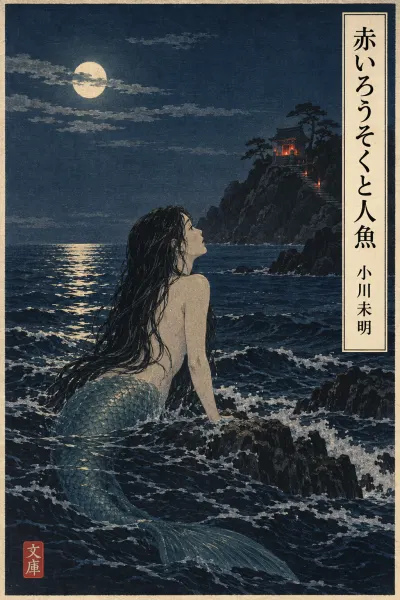
This is a literary fairy tale (童話) by Ogawa Mimei and one of his best-known works. A mermaid living in a cold, dark northern sea decides that her child should grow up among humans, whom she has heard are kind. She leaves her newborn daughter on the shore below a hilltop shrine. An elderly couple who make and sell candles find the child and raise her as a gift from the gods. The girl paints red pictures on their candles, and the candles become famous in the town. The story then asks how far human kindness and gratitude really go. The tone is quiet, sad and increasingly eerie, and the ending is not a happy one. The narration uses a gentle, formal storyteller's voice in です/ます style, with old-fashioned forms such as であります and 青うございました. The dialogue is also mildly archaic. These forms slow you down at first, but they repeat often and you will soon recognise them. The plot is simple and easy to follow. That makes it a good text for practising longer descriptive sentences at about N3 level.
Contents
Easier versions
This story is also retold in simpler Japanese. Reading an easier version first makes the original much more approachable.
Before you read
- Learn to undo the old adjectival ございます form. 青うございました is 青い + ございました, meaning 'was blue', and 気味悪うございました means 'was eerie'. Drop the う/ございます and rebuild the plain い-adjective.
- The narrator often ends sentences with ~のであります or ~のでありました. Read these as a formal, explanatory version of ~のです. They add a storytelling tone rather than new meaning.
- The dialogue uses old-fashioned forms. おくれ is a softer 'give me / please do' (≈ ください). くださいまし is a polite 'please'. なされた is an honorific of した. 思うて is the older form of 思って.
- Learn these key words before you start: 人魚 (mermaid), ろうそく (candle), お宮 (shrine), 神様 (god), 年寄り (old person), 香具師 (やし, travelling showman) and おり (cage). They carry the plot and appear repeatedly.
- Watch how the colour red (赤い, 赤く塗る) and the sea and weather are described. The same images return near the end with a different meaning, so noticing them helps you follow the story's quiet build-up.
Words to know
The most useful words from the notes across the story.
| Word | Meaning | JLPT |
|---|---|---|
| 罰ばち | divine punishment罰が当たる = to be punished by the gods; read ばつ for legal or ordinary punishment. | N1 |
| 内気うちき | timid, shy, reservedLiterally 'inward spirit'. Used as a な-adjective. | — |
| 燃えさしもえさし | a partly burnt stub (of a candle)〜さし attached to a verb stem means 'left partway done', as in 飲みさし. | — |
| 参詣さんけい | visiting a shrine or temple to worship | — |
| 香具師やし | travelling showman; peddler at fairsA fixed reading that cannot be guessed from the kanji. It suggests someone who makes money from shows and curiosities, often a little shady. | — |
| お蔭おかげ | thanks to (someone's help or grace)Usually written おかげ today, as in おかげさまで. | N4 |
| 承知しょうち | consent, agreement承知をしない means "to refuse to agree"; 承知しました is a polite "certainly". | N4 |
| ながめながめる | to gaze at, to look out overdictionary form: 眺めるUsed for looking at a view or scenery for a while. | N3 |
| 評判ひょうばん | reputation, public talk評判がたつ means 'a reputation spreads'. | N3 |
| あこがれてあこがれる | to long for, to yearn fordictionary form: 憧れるTakes を here (海の面をあこがれて). In modern Japanese, 〜に憧れる is more common. | N2 |
| 漁師りょうし | fisherman漁 is read りょう here, not ぎょ as in 漁業. | N2 |
| せっせとせっせと | busily, diligently, without a break | N2 |
| 災難さいなん | misfortune, disaster | N2 |
| もうけようもうける | to make a profit, to earn moneydictionary form: 儲ける金をもうける is the set phrase "to make money". | N2 |
| もうかるもうかる | to be profitable, to make moneydictionary form: 儲かるIntransitive; the transitive partner is 儲ける. | N2 |
Plot summary
Show the full summary (contains spoilers)
A mermaid gives birth on a lonely northern shore. She leaves her baby near a hilltop shrine, hoping humans will raise her kindly. An old candle-making couple take the girl in and love her. She grows up beautiful but shy of being seen, and she paints red designs on their candles. People come to believe these candles protect sailors from shipwreck, and the shop prospers. Then a travelling showman offers the couple a great sum of money for the 'mermaid' girl. They are tempted and sell her despite her pleas. Before she is taken away in a cage by ship, she paints her last candles all red. That night a pale woman with wet hair buys the red candles. A violent storm follows and ships are lost. From then on, red candles at the shrine bring disaster, and within a few years the town falls to ruin.
About the author
Ogawa Mimei was a Japanese writer from Niigata Prefecture. He is often called the father of modern Japanese children's literature, and he is sometimes described as 'the Japanese Andersen.' He studied at Tokyo Senmon Gakkō (now Waseda University), where his teacher Tsubouchi Shōyō is said to have given him the pen name Mimei. He wrote both fiction for adults and fairy tales, and he later devoted himself mainly to children's stories. His tales are known for their lyrical, often melancholy atmosphere and their concern for the weak and the lonely. Among his best-known works is 赤い蝋燭と人魚 (The Red Candles and the Mermaid).