Part 1 of 1 · JLPT N3
雨ふり坊主 Amefuribōzu, part 1: A Paper Doll That Brings Rain
In this part
During a long dry spell, Tarō's father worries that his rice will wither. Tarō makes a paper rain doll with a rhyming charm and ties it to the bush clover by the back gate, and that night a great storm fills the fields and ponds. In the morning the doll has washed away, so Tarō cries because he cannot give it the sake he promised, and his father comforts him by promising to pour sake into the river for it.
AI translation · independently checked
お天気が続いて、どこの田圃も水が乾上がりました。The fine weather went on and on, until the water dried up in every rice field.
太郎のお父さんも百姓でしたが、自分の田の稲が枯れそうになりましたので、毎日毎日外に出て、空ばかり見て心配をしておりました。Tarō's father was a farmer too, and because the rice in his own field looked ready to wither, he went outside day after day and did nothing but look at the sky and worry.
太郎は学校から帰って来まして鞄をかたづけるとすぐに、As soon as Tarō came home from school and put away his satchel,
「お父さんは」"Where's Father?"
と尋ねました。he asked.
お母さんは洗濯をしながら、His mother, busy with the washing,
「稲が枯れそうだから田を見に行っていらっしゃるのだよ」"The rice is about to wither, so he has gone to look at the field."
と悲しそうに云われました。she said sadly.
太郎はすぐに表に飛び出して田の処に行って見ると、お父さんが心配そうに空を見て立っておいでになりました。Tarō dashed straight out of the house and went to the field, and there stood his father, gazing anxiously at the sky.
「お父さん、お父さん。雨が降らないから心配してらっしゃるの」"Father, Father! Are you worried because it won't rain?"
と太郎はうしろから走り寄って行きました。Tarō said as he came running up from behind.
「ウン。どっちの空を見ても雲は一つも無い。困ったことだ」"Yes. Whichever way I look, there isn't a single cloud in the sky. It's a sorry business."
とお父さんはふりかえりながら言って、口に啣えたきせるから煙をプカプカ吹かされました。Father said this as he turned round, and he puffed away at the kiseru pipe held between his lips.
「僕が雨をふらして上げましょうか」"Shall I make it rain for you?"
と太郎はお父さんの顔を見上げながら、まじめくさってこう云いました。Tarō said this with a very solemn face, looking up at his father.
「アハハハ。馬鹿な事を云うな。お前の力で雨がふるものか」"Ha-ha-ha! Don't talk such nonsense. As if you could make it rain by your own power!"
とお父さんは腹を抱えて笑われました。Father clutched his sides with laughter.
「でもお父さん」"But, Father,"
と太郎は一生懸命になって云いました。Tarō said very earnestly.
「この間、運動会の前の日まで雨が降っていたでしょう。それに僕がテルテル坊主を作ったら、いいお天気になったでしょう」"The other day it rained right up to the day before sports day, didn't it? And then I made a teru teru bōzu, and the weather turned fine, didn't it?"
「ウン」"Yes."
「あの時みんなが大変喜びましたから、僕のテルテル坊主がお天気にしたんだって云ったら、皆えらいなあって云いましたよ」"Everyone was so happy then, and when I told them it was my teru teru bōzu that made the weather fine, they all said, 'How clever!'"
「アハハハハ。そうか。テルテル坊主はお前の云うことをそんなによくきくのか」"Ha-ha-ha-ha! Is that so? Does your teru teru bōzu really do what you tell it, then?"
「ききますとも。ですから今度は雨ふり坊主を作って、僕が雨を降らせるように頼もうと思うんです」"Of course it does. So this time I'm going to make a rain doll and ask it to make it rain."
「アハハハハ。そりゃあみんなよろこぶだろう。やってみろ。雨がふったら御褒美をやるぞ」"Ha-ha-ha-ha! Well, that would make everyone happy. Go on, try it. If it rains, I'll give you a reward!"
「僕はいりませんから、雨降り坊主にやって下さい」"I don't need one, so please give it to the rain doll."
太郎はすぐに半紙を一枚持って来て、平仮名でこんなことを書きました。Tarō at once fetched a sheet of writing paper and wrote this in hiragana:
「テルテル坊主テル坊主"Teru teru bōzu, sunny bōzu,
天気にするのが上手ならif you're so clever at bringing the sun,
雨ふらすのも上手だろthen bringing the rain should be easily done.
田圃がみんな乾上ってThe rice fields have all gone dry,
稲がすっかり枯れてゆくthe rice plants wither, the rice plants die,
雨をふらしてくれないかso won't you send some rain our way?
僕の父さん母さんもMy father and my mother too,
ほかの百姓さんたちもand all the other farmers too,
どんなに喜ぶことだろうoh, how happy they would be!
もしも降らせぬそのときはBut if you fail to make it rain,
嘘つきぼうずと名を書いてI'll write 'Liar Doll' for your name,
猫のオモチャにしてしまうand turn you into a toy for the cat.
それがいやなら明日からSo if you don't want that, from tomorrow,
ドッサリ雨をふらせろよsend down rain, and plenty, I say!
褒美にお酒をかけてやるAnd I'll pour you sake as your reward.
雨ふり坊主フリ坊主Rain doll, rain doll, rainy doll,
田圃もお池も一パイにfill the fields and the ponds to the brim,
ドッサリ雨をふらせろよ」send down rain, and plenty, I say!"
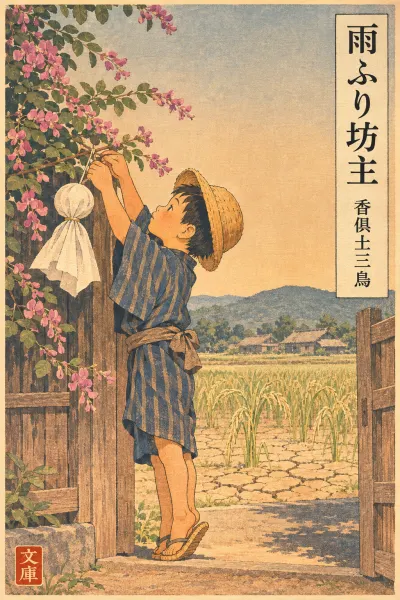
太郎はその手紙を丸めて坊主の頭にして、紙の着物を着せて、裏木戸の萩の枝に結びつけておきました。Tarō crumpled the letter into a ball to make the doll's head, dressed it in a paper kimono, and tied it to a branch of the bush clover by the back gate.
その晩、太郎の家で親子三人が寝ていると、夜中から稲妻がピカピカ光って雷が鳴り出したと思うと、たちまち天が引っくり返ったと思うくらいの大雨がふり出しました。That night, while the three of them lay asleep in Tarō's house, lightning began to flash in the middle of the night and thunder began to roll, and then all at once such a downpour began that it seemed the sky had turned upside down.
「ヤア、僕の雨ふり坊主が本当に雨をふらした」"Hooray! My rain doll really has made it rain!"
と太郎は飛び起きました。Tarō cried, jumping out of bed.
「僕はお礼を云って来よう」"I'm going to go and thank it."
と出かけようとすると、お父さんとお母さんが、But as he was about to go out, his father and mother
「あぶない、あぶない。今出ると雷が鳴っているよ。ゆっくり寝て、明日の朝よくお礼を云いなさい」"It's dangerous, it's dangerous! The thunder is still rumbling, so don't go out now. Get a good sleep, and thank it properly tomorrow morning."
と止められましたので、太郎はしかたなしに又寝てしまいました。stopped him, and Tarō had no choice but to go back to sleep.
あくる朝早く起きて見ると、もうすっかりいいお天気になっていましたが、池も田も水が一パイで皆大喜びをしていると、田を見まわりに行っていたお父さんはニコニコして帰ってこられました。When he got up early the next morning and looked out, the weather had turned perfectly fine again, but the ponds and the fields were full of water, and while everyone was rejoicing, his father, who had gone out to look over the fields, came home all smiles.
そうして太郎さんの頭を撫でて、Then he patted Tarō on the head
「えらいえらい、御褒美をやるぞ」"Well done, well done! I'll give you a reward."
とお賞めになりました。and praised him.
「僕はいりません。雨ふり坊主にお酒をかけてやって下さい」"I don't need one. Please pour some sake over the rain doll."
と云いました。Tarō said.
「よしよし、雨ふり坊主はどこにいるのだ」"All right, all right. Where is this rain doll of yours?"
とお父さんが云われましたから、太郎は喜んで裏木戸へお父さんをつれて行ってみると、萩の花が雨に濡れて一パイに咲いているばかりで、雨ふり坊主はどこかへ流れて行って見えなくなっていました。his father asked, so Tarō happily led him to the back gate. But there was nothing there except the bush clover, blooming in full and wet with rain, and the rain doll had washed away somewhere and could not be seen.
「お酒をかけてやると約束していたのに」"And I promised to pour sake over it!"
と太郎さんはシクシク泣き出しました。Tarō said, and he began to sob.
お父さんは慰めながら云われました。His father comforted him and said,
「おおかた恋の川へ流れて行ったのだろう。雨ふり坊主は自分で雨をふらして、自分で流れて行ったのだから、お前が嘘をついたと思いはしない。お父さんが川へお酒を流してやるから、そうしたらどこかで喜んで飲むだろう。泣くな泣くな。お前には別にごほうびを買ってやる……」"I expect it floated down into the Koi no Kawa. The rain doll made the rain fall by itself and floated away by itself, so it won't think you told it a lie. I'll pour some sake into the river for it, and then it will drink it happily wherever it is. Don't cry, don't cry. I'll buy you a reward of your own..."
Vocabulary
| Word | Meaning | JLPT |
|---|---|---|
| 乾上がりましたひあがる | to dry up completelydictionary form: 乾上がるUsually written 干上がる today. It is used for ponds, fields and riverbeds. | — |
| 百姓ひゃくしょう | farmer, peasantAn old-fashioned word that can sound rude today. 農家 is the neutral modern word. With さん (百姓さん) it sounds friendly. | — |
| 枯れそうかれる | to wither, to die (of plants)dictionary form: 枯れるIt is used for plants. For people or animals, use 死ぬ. | N2 |
| 啣えたくわえる | to hold in the mouth (between the lips or teeth)dictionary form: 啣えるAn old kanji spelling. Today it is written 咥える or in kana. | N2 |
| きせるきせる | kiseru, a long thin Japanese pipeA traditional pipe with a metal bowl and mouthpiece and a bamboo stem, made for smoking small pinches of tobacco. | N2 |
| まじめくさってまじめくさる | to put on a very serious facedictionary form: 真面目くさる〜くさる adds the sense of 'overly, affectedly', so the tone here is gently amused. | — |
| 腹を抱えてはらをかかえる | to hold one's sides with laughterdictionary form: 腹を抱えるAn idiom for laughing very hard. | — |
| テルテル坊主てるてるぼうず | teru teru bōzu, a paper or cloth doll hung up to wish for fine weatherdictionary form: てるてる坊主照る means 'to shine' and 坊主 means 'little monk' or 'shaven-headed boy'. There is no English equivalent. Tarō invents the opposite, a 雨ふり坊主, or rain doll. | — |
| 御褒美ほうび | reward, prizedictionary form: 褒美It is usually said with ご: ご褒美. | N1 |
| 半紙はんし | a sheet of Japanese writing paperThin washi paper of a standard size, used for calligraphy practice. | — |
| 裏木戸うらきど | wooden back gate裏 means 'back' and 木戸 means 'small wooden gate'. | — |
| 萩はぎ | bush cloverA shrub that flowers in autumn. The kanji combines 艹 (grass) and 秋 (autumn). | — |
| 稲妻いなずま | lightning (lit. 'rice plant's spouse', from the old belief that lightning makes rice ripen)Literally 'rice-plant wife'. People believed that lightning helped the rice ripen. | — |
| おおかたおおかた | probably, most likelydictionary form: 大方Often paired with 〜だろう, as here. | N1 |
Grammar
〜そうになる N4 to be on the verge of ~
The verb stem plus そうになる describes something that is about to happen but has not happened yet. The rice has not died yet, but it is close to dying.
自分の田の稲が枯れそうになりましたので
because the rice in his own field looked ready to wither
Honorific 〜れる/〜られる N4 respectful verb form
The narrator adds the passive-looking ending 〜れる/〜られる to the parents' actions to show respect, not to mark the passive. Other examples are 吹かされました, 笑われました and 帰ってこられました.
と悲しそうに云われました。
She said sadly.
〜ものか N2 as if ~! / there's no way ~
This is a strong rhetorical denial. The father is saying that a boy's strength could never make it rain.
お前の力で雨がふるものか
As if a little fellow like you could make it rain!
〜とも N2 of course ~ / certainly
Adding とも to the end of a sentence gives a confident 'of course!' in reply to a question. Tarō is firmly answering his father's teasing doubt.
ききますとも。
Of course it does.
〜ように頼む N3 to ask (someone) to ~
The plain form plus ように, followed by 頼む, tells us the content of a request. Here Tarō will ask the doll to make it rain.
僕が雨を降らせるように頼もうと思うんです
I'm going to ask it to make it rain.
〜ぬ (classical negative) N1 not ~
ぬ is an old negative ending equal to ない. It is used here in the chant because it sounds old-fashioned and fits the rhythm.
もしも降らせぬそのときは
But if you fail to make it rain,