Intermediate · JLPT N3
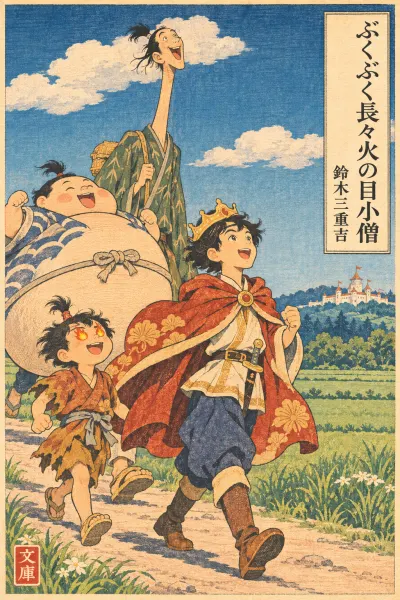
ぶくぶく長々火の目小僧Bukubuku Naganaga Hi no Mekozō — Puff, Stretch and Fire-Eyes
- JLPT N3
- 11,564 characters
- 9 parts
- about 96 minutes
- 2 easier versions
This is a fairy tale told by Suzuki Miekichi in gentle, child-directed Japanese. In a topsy-turvy age, a princess will marry only a suitor who can watch over her for three nights without falling asleep, and every man who dozes off is executed. A brave young prince sets out to try. On the road he gathers three odd companions: Bukubuku, who can swell up like a rubber bag; Naganaga, who can stretch up to the clouds; and Hinome Kozō, whose eyes shoot flames. The princess has magic of her own, and the story turns into a playful contest of tricks and transformations. The narrator speaks in polite です/ます style, sometimes turns to address the reader directly, and fills the telling with lively onomatopoeia. The plot is easy to follow, and the characters are vivid, so a learner can keep going even past unfamiliar words. The challenges are honorific verb forms used for the king, the shift between polite and casual speech among the characters, and a steady supply of set expressions such as 〜ものですから, 〜てたまらない and 〜と見えて, which are worth learning in context.
Contents
- The Princess Who Wanted No Suitors
- Two Strange Servants Join the Prince
- The Night Watch Begins
- The Princess Flies Off as a Dove
- The Princess Tries Her Deepest Magic
- Boiling the Fish Out of the Spring
- The Princess's Magic Holds Back the Soldiers
- Blotting Out the Sun, Swallowing an Army
- Coughing Out an Army, Then a Wedding
Easier versions
This story is also retold in simpler Japanese. Reading an easier version first makes the original much more approachable.
Before you read
- Learn the three servants' names first: ぶくぶく (puffing, swelling), 長々 (ながなが, long-long) and 火の目小僧 (ひのめこぞう, fire-eye lad). Each name describes the power that later matters in the plot, so the names help you predict what happens.
- Expect a lot of onomatopoeia and mimetic words. Read them aloud and guess their meaning from the action around them rather than stopping for each one. Many are repeated, so the sound often makes the meaning clear.
- The narration is polite です/ます style and sometimes speaks straight to the reader, as in おわかりになったでしょう. The king is referred to with honorific forms such as お〜になる, so learn this pattern early.
- Watch for shifts in speech level. The servants speak politely to the prince, but Naganaga and Hinome Kozō use the casual おれ with each other. These shifts tell you who is speaking and to whom.
- The scene where the princess pretends to fall asleep is a natural place to fix 〜ふりをする ('to pretend to'). Also note the old distance unit 里 (り, ri), which is used to measure Naganaga's enormous stride.
Words to know
The most useful words from the notes across the story.
| Word | Meaning | JLPT |
|---|---|---|
| いばっていばる | to swagger, to act proud and bossydictionary form: 威張る | N2 |
| 家来けらい | servant, retainerA follower serving a lord; common in folk tales. | N1 |
| またげますまたぐ | to step over, to stride acrossdictionary form: 跨ぐPotential form またげる = can stride across. | N2 |
| まごまごまごまご | flustered, at a lossA mimetic word for confused, aimless fumbling. | N2 |
| もがきましたもがく | to struggle, to flounderdictionary form: もがく | N1 |
| 寝ずの番ねずのばん | an all-night watch, keeping guard without sleeping寝ず is the classical negative of 寝る (= 寝ない). | — |
| お供とも | attendant, companion on a journeydictionary form: 供 | — |
| 里り | ri (old unit of distance)About 3.9 km. No English equivalent, so it is kept as 'ri'. | — |
| 言いふくめていいふくめる | to instruct carefully, to impress on someonedictionary form: 言い含める | — |
| かんづくかんづく | to sense, notice, suspectdictionary form: 感づく | — |
| ときの声ときのこえ | battle cry, war crydictionary form: 鬨の声A fixed expression, usually with 上げる. | — |
| またたく間またたくま | in the blink of an eyedictionary form: 瞬く間瞬く means to blink or twinkle. | — |
| 商ばいしょうばい | trade, business, line of workdictionary form: 商売Written here half in kana; normally 商売. | N3 |
| かんしんかんしん | being impressed, admirationdictionary form: 感心Different from 関心 (interest), which has the same reading. | N3 |
| 番ばん | watch, guard duty番をする = to keep watch; 番をしとおす = to keep watch to the very end. | N3 |
Plot summary
Show the full summary (contains spoilers)
A prince sets out to win a princess who marries only a suitor able to stay awake guarding her for three nights. On the way he takes on three servants: swelling Bukubuku, stretching Naganaga and fire-eyed Hinome Kozō. On the first night everyone dozes off and the princess escapes as a dove, but Naganaga wakes, Hinome Kozō scorches her wings and Naganaga catches her. The second night goes no better for her. On the third night she becomes a fly, then a fish hiding in a bottomless spring, until Hinome Kozō boils the water and she leaps out. The prince reveals himself and she gladly goes with him, but the king breaks his word and sends an army after them. The princess makes a forest and a river, Naganaga covers the sun with his hat, and Bukubuku swallows the whole army, later coughing it up. The king attends the wedding, and the servants are richly rewarded.
About the author
Suzuki Miekichi was a Japanese novelist and children's writer from Hiroshima. He studied English literature at Tokyo Imperial University, where he came under the influence of Natsume Sōseki. He later devoted himself to literature for children and founded the magazine 赤い鳥 (Akai Tori, 'Red Bird'). The magazine published stories and poems by leading writers of the day and played a central role in the modern Japanese 童話 (children's story) movement. Suzuki also retold many tales himself and encouraged children's own composition writing.