Intermediate · JLPT N3
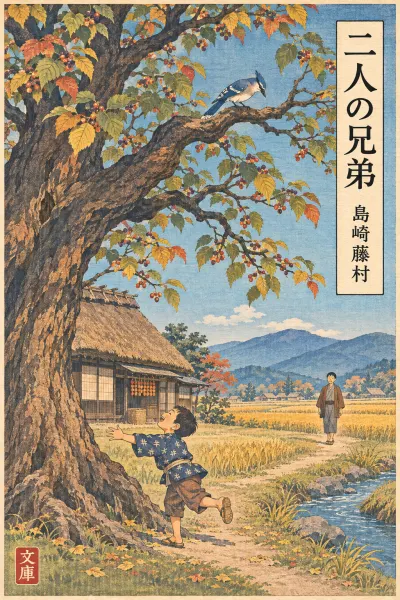
二人の兄弟Futari no Kyōdai — Two Brothers and the Hackberry Tree
- JLPT N3
- 2,144 characters
- 1 part
- about 18 minutes
- 2 easier versions
This is a short children's story by Shimazaki Tōson, told in a gentle, kindly voice that speaks directly to young readers as 皆さん. Two brothers live in a country house with a large hackberry tree. They both want to gather its small fruit, but they could not be more different. The younger brother cannot wait, and the older one never hurries. A kind old servant watches over them, and a jay from the tree has something to say as well. The story is built on simple repeated scenes and echoing refrains, almost like a folk tale, and it carries a quiet lesson about the brothers' opposite natures. For learners, the polite です/ます narration is steady and predictable, and the vocabulary stays close to everyday country life: trees, fruit, fields, a stream and fishing. The main challenges are the slightly old-fashioned spellings and usages, such as 居る and 呉れる, and a few older grammatical patterns. At about 2,100 characters in a single part, it is a manageable complete read at around N3 level.
Contents
Easier versions
This story is also retold in simpler Japanese. Reading an easier version first makes the original much more approachable.
Before you read
- Learn 〜過ぎる ("too ~") before you start. The story turns on the brothers being too early or too late, and you will see forms like 早過ぎた ("was too early"). Knowing 早い and 遅い well will help you follow the refrains.
- Expect older spellings of common words. 居る is just いる, 楽み is 楽しみ ("something to look forward to"), and 呉れる is くれる. 申しました is a humble or formal way of saying 言いました.
- The narrator speaks to the reader as 皆さん and uses polite です/ます forms throughout. Sentences tend to be short and evenly paced, so try reading aloud to get used to the rhythm.
- The old servant gives gentle instructions with 〜なさい, as in お待ちなさい ("wait now"). Treat these as kindly polite commands from an elder, not harsh orders.
- Other patterns covered in the notes are 〜たことがある, 〜ずに ("without ~ing"), 〜うちに ("while ~"), 〜きれないほど ("more than one can ~"), and the older forms 〜かろう and いかに〜でも ("no matter how ~"). Review them briefly so they are familiar when they appear.
Words to know
The most useful words from the notes across the story.
| Word | Meaning | JLPT |
|---|---|---|
| 序ついで | while one is at it; on the occasiondictionary form: 序でUsually written ついでに today. | N2 |
| 渋くてしぶい | astringent, bitter (unripe fruit)dictionary form: 渋いDescribes the mouth-puckering taste of unripe fruit; it can also mean 'tasteful, understated'. | N1 |
| 構えてかまえる | to take (a certain attitude)dictionary form: 構えるゆっくり構える means 'to take things easy, to take one's time'. | N1 |
| 御褒美ほうび | reward, prizedictionary form: 褒美Usually used with the polite prefix ご. | N1 |
| 斑ふ | spots, speckles, mottled markings斑が入る means 'to have spots or markings'. | N1 |
| 待遠しくてまちどおしい | long-awaited; can hardly waitdictionary form: 待ち遠しいExpresses impatience for something to come. | N1 |
| 掻廻すかきまわす | to stir up, churndictionary form: 掻き回すModern spelling: かき回す. | N1 |
| 榎木えのき | Chinese hackberry treedictionary form: 榎A large shade tree with small berries that ripen red-orange in autumn. Here it is written with an extra 木. | — |
| 時分じぶん | time; season (when something happens)Slightly old-fashioned; close to 頃. Not to be confused with 自分. | — |
| 奉公してほうこうする | to work in service (in a household)dictionary form: 奉公するAn older word for living and working as a servant or apprentice. | — |
| 気の短いきがみじかい | impatient, quick-tempereddictionary form: 気が短いIts opposite is 気が長い / 気長 (patient, easygoing), which describes the older brother. | — |
| 橿鳥かしどり | jay (Eurasian jay)Another name for カケス, a bird known for its blue-patterned wing feathers. | — |
| 栗虫くりむし | chestnut caterpillar (a silk-spinning moth larva)Its silk was once made into fishing line (てぐす). | — |
| 鰍かじか | sculpin (small freshwater fish)A small bottom-dwelling fish of clear streams that likes to hide under stones. | — |
Plot summary
Show the full summary (contains spoilers)
Two brothers long to gather the fruit of the big hackberry tree by their home. The impatient younger brother rushes out before the fruit is ready and is told he is too early. The easygoing older brother goes out after the right moment has passed and is told he is too late. Finally the kind old servant tells them when the right time has come. They go together, and a jay rewards them with a feather. Later the old man makes them fishing rods and lines, since there is no shop nearby that sells them. The brothers go fishing but catch nothing, because one is too slow and the other too hasty. The old man laughs and tells them that tools alone do not catch fish.
About the author
Shimazaki Tōson was a Japanese poet and novelist, born in Magome in the old Shinano region. He first became known as a poet of the new-style verse movement with the collection Wakanashū. He then turned to prose. His novel Hakai (The Broken Commandment) is regarded as a landmark of Japanese naturalist fiction, and he went on to write autobiographical novels. His late historical novel Yoake mae (Before the Dawn) is set in his home region during the Meiji Restoration.