Intermediate · JLPT N3
雨ふり坊主Amefuribōzu — Tarō's Rain Doll
- JLPT N3
- 1,692 characters
- 1 part
- about 14 minutes
- 2 easier versions
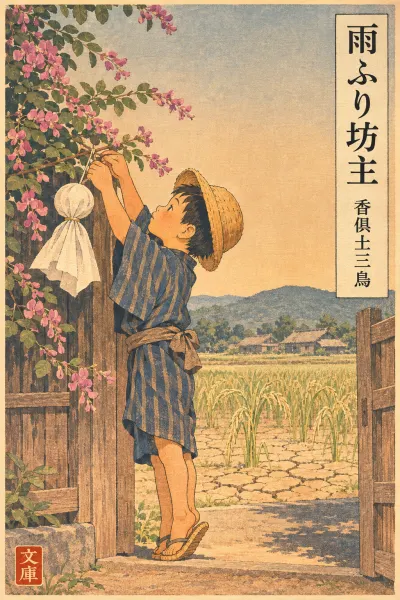
Tarō's Rain Doll is a short children's tale set in a Japanese rice-farming village during a long dry spell. Tarō's father worries that his rice will wither, so Tarō makes an amebuli bōzu, a paper doll meant to call down rain. It is the reverse of the familiar teru teru bōzu that children hang up for fine weather. He ties it to the bush clover by the back gate, and the doll is given a promise in return for its help. The story is told in gentle desu/masu storybook narration, with honorific verbs for the parents and a rhythmic charm that Tarō chants in 7-5 meter. At about 1,700 characters in a single part, it can be read in one sitting. It also gives a natural first taste of older written Japanese: spellings like 云う for 言う, words like 啣える and きせる (a long tobacco pipe), and the classical negative 〜ぬ. The father's hearty plain speech and Tarō's polite replies make a clear contrast in speech styles. The emotional core, a child's sincere bargain with a paper doll, is easy to follow even when individual words are unfamiliar.
Contents
Easier versions
This story is also retold in simpler Japanese. Reading an easier version first makes the original much more approachable.
Before you read
- Watch for honorific 〜れる/〜られる on the parents' actions (云われました, お賞めになりました, おいでになりました). These verbs mean the parents themselves are acting, not being acted upon, so don't read them as passives.
- Learn the old spelling 云う (= 言う) before you start, since it marks almost every line of dialogue. Also expect the classical negative 〜ぬ (= 〜ない) in the charm and in older phrasing.
- Notice the contrast in speech: the father uses blunt, emphatic forms like 〜ものか ('as if…!' / 'I won't…') and 〜とも ('of course!'), while Tarō answers him politely. Reading the two voices aloud helps you sense their relationship.
- Pre-learn the drought and farming words: 枯れる (to wither), 田 / 田圃 (rice field), 池 (pond), 萩 (bush clover), 裏門 (back gate), 酒 (sake). Also learn 〜そうになる ('to be about to…'), which describes the rice nearly dying.
- Read Tarō's charm aloud and count the syllables in 7-5 rhythm, as in a children's song. Its 〜ように頼む-style request ('please make it so that…') sets up the promise that drives the ending.
Words to know
The most useful words from the notes across the story.
| Word | Meaning | JLPT |
|---|---|---|
| 枯れそうかれる | to wither, to die (of plants)dictionary form: 枯れるIt is used for plants. For people or animals, use 死ぬ. | N2 |
| 啣えたくわえる | to hold in the mouth (between the lips or teeth)dictionary form: 啣えるAn old kanji spelling. Today it is written 咥える or in kana. | N2 |
| きせるきせる | kiseru, a long thin Japanese pipeA traditional pipe with a metal bowl and mouthpiece and a bamboo stem, made for smoking small pinches of tobacco. | N2 |
| 御褒美ほうび | reward, prizedictionary form: 褒美It is usually said with ご: ご褒美. | N1 |
| おおかたおおかた | probably, most likelydictionary form: 大方Often paired with 〜だろう, as here. | N1 |
| 乾上がりましたひあがる | to dry up completelydictionary form: 乾上がるUsually written 干上がる today. It is used for ponds, fields and riverbeds. | — |
| 百姓ひゃくしょう | farmer, peasantAn old-fashioned word that can sound rude today. 農家 is the neutral modern word. With さん (百姓さん) it sounds friendly. | — |
| まじめくさってまじめくさる | to put on a very serious facedictionary form: 真面目くさる〜くさる adds the sense of 'overly, affectedly', so the tone here is gently amused. | — |
| 腹を抱えてはらをかかえる | to hold one's sides with laughterdictionary form: 腹を抱えるAn idiom for laughing very hard. | — |
| テルテル坊主てるてるぼうず | teru teru bōzu, a paper or cloth doll hung up to wish for fine weatherdictionary form: てるてる坊主照る means 'to shine' and 坊主 means 'little monk' or 'shaven-headed boy'. There is no English equivalent. Tarō invents the opposite, a 雨ふり坊主, or rain doll. | — |
| 半紙はんし | a sheet of Japanese writing paperThin washi paper of a standard size, used for calligraphy practice. | — |
| 裏木戸うらきど | wooden back gate裏 means 'back' and 木戸 means 'small wooden gate'. | — |
| 萩はぎ | bush cloverA shrub that flowers in autumn. The kanji combines 艹 (grass) and 秋 (autumn). | — |
| 稲妻いなずま | lightning (lit. 'rice plant's spouse', from the old belief that lightning makes rice ripen)Literally 'rice-plant wife'. People believed that lightning helped the rice ripen. | — |
Plot summary
Show the full summary (contains spoilers)
During a long drought, Tarō's father fears that his rice plants will wither and die. To help, Tarō makes a paper rain doll and recites a rhyming charm to it, promising it sake if it brings rain. He ties it to the bush clover by the back gate. That night a great storm breaks, and by morning the rice fields and ponds are full of water. The doll, however, has disappeared, probably washed away into the river his father calls Koi no Kawa. Tarō bursts into tears because he can no longer give the doll the sake he promised. His father praises him and comforts him by promising to pour sake into the river so that the doll will receive its reward after all.
About the author
Kagutsuchi Midori (香倶土三鳥) was one of the pen names of the writer best known as Yumeno Kyūsaku (夢野久作), whose real name was Sugiyama Taidō. Before and alongside his literary career he worked as a newspaper reporter. He is famous today for strange, unsettling mystery and detective fiction, above all the novel Dogra Magra (ドグラ・マグラ), which is often counted among the great eccentric works of Japanese literature. Under names such as Kagutsuchi Midori he also wrote gentle fairy tales for children, and this story is one of them.