 N5 · easy
Simplified retelling · JLPT N5
僕の帽子のお話 Boku no Bōshi no Ohanashi in easy Japanese (N5)
This is our own simplified retelling of The Tale of My School Cap, written for N5 learners and checked word by word against the N5 vocabulary list. A few story words and grammar patterns go beyond N5; the notes below give each one's level. It keeps the characters, events and ending of the original. When it feels easy, move on to the N4 version or the original text.
The story in brief
A boy loves the cap his father bought him and sleeps holding it every night. After he writes a school composition about it and his teacher reads it aloud and laughs, he dreams that the cap has run away. He chases it through the dark streets to his school and out onto a wide plain, and grows frightened when his crying parents cannot see or touch him. He leaps up, grabs the cap, falls into a bright, hot place, and wakes with the cap safe in his hand and his mother beside him.
AI translation · independently checked
ぼくの ぼうしは、お父さんが かって きました。My cap is one that Father bought and brought home for me.
とても いい ぼうしです。It is a very fine cap.
お父さんは「たいせつに しなさい。」と いいました。Father said, "Take good care of it."
ぼくも この ぼうしが とても すきです。I like this cap very much, too.
まいばん、ぼうしを てに もって ねます。Every night, I go to sleep holding the cap in my hand.
学校で、ぼくは この 話を さくぶんに 書きました。At school, I wrote about this in a composition.
先生は みんなの 前で それを 読んで、大きな くちで わらいました。The teacher read it out in front of everyone and laughed with his mouth wide open.
みんなも わらいました。Everyone laughed, too.
ぼくも わらいました。I laughed, too.
ある 夜、ぼくは めを あけました。One night, I opened my eyes.
てに ぼうしが ありません。The cap was not in my hand.
まくらの そばにも ありません。It was not beside my pillow, either.
お父さんと お母さんは よく ねて います。Father and Mother were sound asleep.
ぼくは へやの 中を さがしました。I searched inside the room.
本だなも 見ました。I looked on the bookshelf, too.
でも、ありません。But it was not there.
ぼくは なきたく なりました。I felt like crying.
「きのうは もたないで ねたのでしょう。げんかんに あるでしょう。」ぼくは うれしく なって、げんかんへ 行きました。"I must have gone to sleep last night without holding it. It's probably in the front hall." I grew happy and went to the front hall.
でも、お父さんの ちゃいろの ぼうしだけが かかって いました。But only Father's brown hat was hanging there.
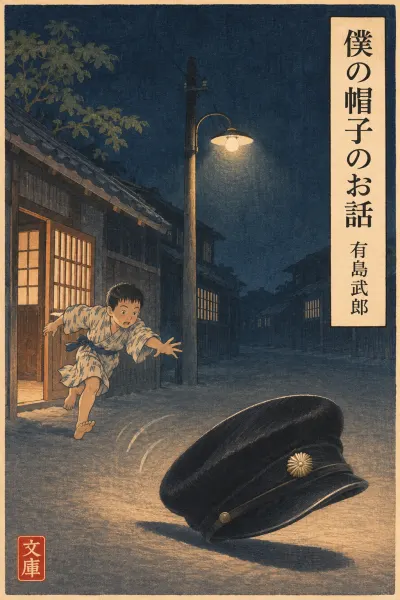
ドアの 下に、くろい ものが あります。Under the door, there was something black.
ぼくの ぼうしです。It was my cap!
ぼうしは 外へ 出て いきました。The cap went outside.
ぼくも 外へ はしりました。I ran outside, too.
かぜは ありません。There was no wind.
でも、ぼうしは みちを はしります。And yet the cap ran along the road.
ぼくが てを 出すと、ぼうしは 先へ にげます。Whenever I reached out my hand, the cap ran away ahead of me.
ぼくは 大きな こえで「まって!」と いいました。I called out in a loud voice, "Wait!"
学校の もんの 前で、ぼうしは とまって「ここまで 来て!」と いいました。In front of the school gate, the cap stopped and said, "Come this far!"
ぼくは ぼうしと いっしょに もんの 中へ 入りました。I went in through the gate together with the cap.
そこは ほかの クラスの きょうしつでした。It was the classroom of another class.
先生が せいとに しつもんを して いました。The teacher was asking the pupils a question.
ぼくは その 話を 聞いて いました。I was listening to what they were saying.
あ、ぼうしが いません。Oh! The cap was gone.
ぼくは きょうしつを 出ました。I went out of the classroom.
そこは ひろい のはらでした。It was a wide, grassy plain.
ぼうしは くらい そらの とても 高い ところに あります。The cap was very, very high up in the dark sky.
くろくて まるい ぼうしです。It was a black, round cap.
ぼくは なきました。I cried.
のはらは だんだん くらく なります。The plain grew darker and darker.
いえへの みちも わかりません。I did not know the way home, either.
「あの ぼうしは たぬきでしょうか。」ぼくは こわく なりました。"Could that cap be a tanuki?" I became frightened.
そこへ お父さんと お母さんが 来ました。Just then, Father and Mother came.
二人は なきながら、ぼくの 名前を よんで、本だなを さがして います。The two of them were crying, calling my name, and searching the bookshelf.
ぼくは うれしく なって、二人の ほうへ はしりました。I grew happy and ran toward them.
でも、二人に さわれません。But I could not touch them.
「ぼくは ここです!」でも、二人には ぼくが 見えません。"I'm here!" But they could not see me.
「あの たぬきの ぼうしが わるいんだ。」ぼくは 大きく とびました。"It's that tanuki cap's fault!" I jumped high.
からだは 高く 高く 上がって、ぼうしを とりました。My body rose up high, high into the air, and I caught the cap.
ぼうしは「いたい!」と いいました。The cap said, "Ouch!"
そして、ぼくと ぼうしは 下へ おちて いきました。And then the cap and I fell down, down below.
下は とても あかるくて、あついです。Down below it was very bright and hot.
ぼくは こわくて、大きな こえを 出しました。I was so frightened that I cried out in a loud voice.
だれかが ぼくの からだを おしました。Someone gave my body a push.
めを あけると、ゆめでした。When I opened my eyes, it had been a dream.
お母さんが そばに いました。Mother was beside me.
「どう したの? もう あさですよ。学校へ 行きましょう。」"What's the matter? It's morning already. Let's go to school."
ぼうしは、ぼくの 右の ての 中に ありました。The cap was in my right hand.
ぼくは とても うれしく なって、お母さんを 見て わらいました。I became very happy, and I looked at Mother and laughed.
Vocabulary
| Word | Meaning | JLPT |
|---|---|---|
| たいせつにたいせつ | precious; (with に する) to take good care ofdictionary form: 大切A na-adjective; 大切に する means "treat with care." | N5 |
| まくらまくら | pillowdictionary form: 枕 | N2 |
| さがしましたさがす | to search for, to look fordictionary form: 探す | N4 |
| 本だなほんだな | bookshelfdictionary form: 本棚本 (book) + 棚 (shelf); た becomes だ (rendaku). | N5 |
| げんかんげんかん | front entrance hall of a housedictionary form: 玄関The area inside the front door where shoes are taken off and hats and coats are kept. | N5 |
| かかってかかる | to hang (on a hook)dictionary form: 掛かるIntransitive; 〜て いる shows the state: "was hanging." | N5 |
| にげますにげる | to run away, to escapedictionary form: 逃げる | N4 |
| のはらのはら | open field, grassy plaindictionary form: 野原 | — |
| だんだんだんだん | gradually, little by littledictionary form: 段々Often used with 〜く なる / 〜に なる for slow change. | N1 |
| たぬきたぬき | tanuki (raccoon dog)dictionary form: 狸A real animal, but in Japanese folk tales a tanuki is a trickster that can change its shape and fool people. | — |
| さわれませんさわる | to touchdictionary form: 触るさわれる is the potential form: "can touch." Takes に: 二人に さわる. | N4 |
| おちておちる | to fall, to dropdictionary form: 落ちる | N4 |
| ゆめゆめ | dreamdictionary form: 夢 | N4 |
Grammar
〜なさい N4 do ~ (a command)
Verb stem + なさい is a gentle but firm command, typically from parents or teachers to children. Here 大切に しなさい means "take good care of it."
お父さんは「たいせつに しなさい。」と いいました。
Father said, "Take good care of it."
〜たく なる N4 to come to want to ~; to feel like ~ing
The 〜たい form (want to) changes to 〜たく before なる, showing that a feeling arises. なきたく なりました means the wish to cry welled up in him.
ぼくは なきたく なりました。
I felt like crying.
〜でしょう N5 probably ~; I suppose ~
でしょう after a verb or noun expresses a guess. The boy is guessing where the cap might be.
げんかんに あるでしょう。
It must be in the front hall.
〜と (when / whenever) N4 when ~, (then) ~; whenever ~
Dictionary form + と links an action to a result that follows each time. Every time he reaches out, the cap runs ahead.
ぼくが てを 出すと、ぼうしは 先へ にげます。
Whenever I reached out my hand, the cap ran away ahead of me.
〜ながら N4 while ~ing
Verb stem + ながら shows two actions done by the same person at the same time. The parents are crying while they call his name.
二人は なきながら、ぼくの 名前を よんで、本だなを さがして います。
The two of them were crying, calling my name, and searching the bookshelf.
〜て いく N4 to go ~ing; movement away
て-form + いく adds the sense of moving away from the speaker or continuing onward. おちて いきました pictures the boy and the cap falling further and further down.
そして、ぼくと ぼうしは 下へ おちて いきました。
And then the cap and I fell down, down below.