 N5 · easy
Simplified retelling · JLPT N5
張紅倫 Chōkōrin in easy Japanese (N5)
This is our own simplified retelling of A Boy Named Chō Kōrin, written for N5 learners and checked word by word against the N5 vocabulary list. A few story words and grammar patterns go beyond N5; the notes below give each one's level. It keeps the characters, events and ending of the original. When it feels easy, move on to the N4 version or the original text.
The story in brief
During a war in China, a Japanese soldier named Aoki falls into an old dry well and cannot get out. A Chinese man and his son Kōrin rescue him and look after him, until the father warns that villagers plan to sell him to Russian soldiers; Aoki flees, leaving Kōrin his big watch. Years later in Japan, a young man selling fountain pens shows Aoki the same watch but denies being Kōrin; the next morning a letter reveals that he is Kōrin and lied to protect Aoki.
AI translation · independently checked
ちゅうごくでせんそうがありました。There was a war in China.
あおきさんは日本のへいたいでした。Aoki was a Japanese soldier.
さむいよるでした。It was a cold night.
あおきさんは一人で、くらい道をあるいていました。Aoki was walking alone along a dark road.
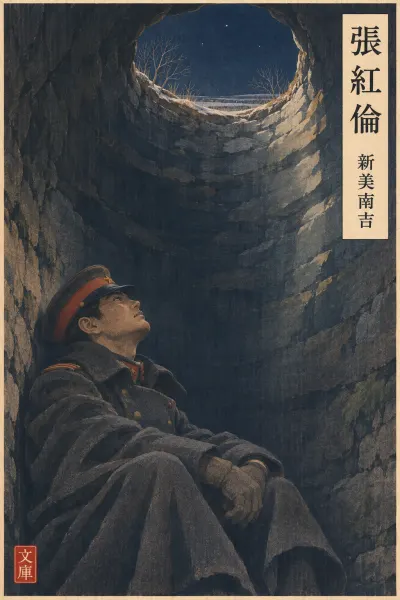
そして、ふるいいどの中におちました。Then he fell into an old well.
いどに水はありませんでした。There was no water in the well.
でも、とても高くて、外に出られませんでした。But the walls were very high, and he could not get out.
大きなこえで人をよびたかったです。He wanted to call for someone in a loud voice.
でも、ちかくにロシアのへいたいがいるかもしれません。But there might be Russian soldiers nearby.
あおきさんは何もいいませんでした。Aoki said nothing.
あさになりました。Morning came.
でも、だれも来ません。But nobody came.
ひるになりました。Noon came.
あおきさんは何も食べていません。Aoki had not eaten anything.
水ものんでいません。He had not drunk any water either.
大きなこえで何かいもよびました。He called out in a loud voice many times.
でも、だれも来ませんでした。But nobody came.
またよるになりました。Night came again.
「わたしはここでしぬかもしれない。」あおきさんは小さなこえでいいました。"I might die here," Aoki said in a small voice.
そして、つかれて、ねました。Then, worn out, he fell asleep.
それから、人のこえが聞こえました。After that, he heard a person's voice.
ちゅうごくの男の人のこえでした。It was the voice of a Chinese man.
「だいじょうぶですか。たすけます。」男の人は、なわであおきさんをいどの外に出しました。"Are you all right? I'll help you." With a rope, the man pulled Aoki out of the well.
その人のいえは、小さくてふるいいえでした。The man's house was small and old.
お父さんと男の子の二人が、すんでいました。Two people lived there, a father and his son.
男の子の名前はこうりんでした。The boy's name was Kōrin.
十三か十四の男の子でした。He was a boy of thirteen or fourteen.
「わたしがあなたのこえを聞きました。そして、お父さんとたすけました。」こうりんは、あおきさんに水をもって来ました。"I heard your voice. Then my father and I helped you." Kōrin brought Aoki some water.
あおきさんは、日本にいる自分の子どもの話をしました。Aoki told him about his own children back in Japan.
こうりんはとても楽しそうでした。Kōrin looked very happy.
「わたしも日本へ行きたいです。あなたの子どもと友だちになりたいです。」"I want to go to Japan too. I want to be friends with your children."
五日あとのゆうがた、お父さんがいそいでかえって来ました。Five days later, in the evening, the father came home in a hurry.
「むらの人たちが、あなたをロシアのへいたいにうりたいといっています。こんばん、ここに来ます。はやくにげてください。」"The people of the village say they want to sell you to the Russian soldiers. They are coming here tonight. Please run away quickly."
あおきさんはいえを出ました。Aoki left the house.
後ろを見ると、こうりんがこちらを見ていました。When he looked back, Kōrin was watching him.
あおきさんは、またこうりんのところへ行きました。Aoki went back to Kōrin.
そして、大きなとけいをこうりんのてにわたしました。And he put his big watch into Kōrin's hand.
それから、くらい道を走って行きました。Then he ran off along the dark road.
せんそうがおわって、あおきさんは日本にかえりました。The war ended, and Aoki went home to Japan.
かいしゃではたらきました。He worked at a company.
こうりんに何かいも手がみを書きました。He wrote to Kōrin many times.
でも、へんじは来ませんでした。But no reply ever came.
十年あと、わかいちゅうごくの男の人が、かいしゃに来ました。Ten years later, a young Chinese man came to the company.
「まんねんひつ、いかがですか。」あおきさんは「一本かいましょう。」といいました。"How about a fountain pen?" Aoki said, "I'll buy one."
男の人は、出る前に、ポケットからとけいを出しました。Before he left, the man took a watch out of his pocket.
あおきさんはそのとけいを見ました。Aoki looked at the watch.
十年前に、こうりんにわたしたとけいでした。It was the watch he had given Kōrin ten years before.
「あなたはこうりんさんでしょう。いどからわたしをたすけましたね。」"You're Kōrin, aren't you? You saved me from the well."
「いいえ、わたしはこうりんではありません。このとけいは、みせでかいました。」男の人はそういって、出て行きました。"No, I am not Kōrin. I bought this watch at a shop." Saying this, the man went out.
つぎのあさ、かいしゃにあおきさんへの手がみが来ました。The next morning, a letter for Aoki arrived at the company.
「わたしはこうりんです。あなたに会えて、とてもよかったです。お父さんはきょねんしにました。本当は、あなたと話したかったです。でも、日本のへいたいだったあなたが、ちゅうごくの人にたすけられた。みんながそれを知ると、あなたによくないでしょう。だから、うそをいいました。わたしはあした、ちゅうごくへかえります。おげんきで。」"I am Kōrin. I was very glad to be able to meet you. My father died last year. Actually, I wanted to talk with you. But you, a Japanese soldier, were saved by a Chinese person. If everyone found out, it would probably not be good for you. So I lied. Tomorrow I am going back to China. Take care."
Vocabulary
| Word | Meaning | JLPT |
|---|---|---|
| せんそうせんそう | wardictionary form: 戦争Here it is the Russo-Japanese War (1904–05), fought partly in northeast China. | N4 |
| へいたいへいたい | soldierdictionary form: 兵隊 | N2 |
| いどいど | well (for water)dictionary form: 井戸The kanji 井 is a picture of the wooden frame around the top of a well. | N2 |
| おちましたおちる | to fall (into), to dropdictionary form: 落ちるIntransitive: the thing itself falls. Use に for the place it falls into. | N4 |
| よびよぶ | to call (out to someone)dictionary form: 呼ぶ | N5 |
| しぬしぬ | to diedictionary form: 死ぬ | N5 |
| たすけますたすける | to help, to rescuedictionary form: 助けるA key word in this story: it means saving someone from danger, not just helping with a task. | N3 |
| なわなわ | ropedictionary form: 縄 | N3 |
| にげてにげる | to run away, to escapedictionary form: 逃げる | N4 |
| とけいとけい | watch, clockdictionary form: 時計Here it is a pocket watch, the object that links the two halves of the story. | N5 |
| わたしましたわたす | to hand over, to give (into someone's hand)dictionary form: 渡す | N5 |
| へんじへんじ | reply, answerdictionary form: 返事 | N4 |
| まんねんひつまんねんひつ | fountain pendictionary form: 万年筆Literally "ten-thousand-year brush", a pen that seems to write forever. | N5 |
| うそうそ | liedictionary form: 嘘"To tell a lie" is うそをいう or うそをつく. | N4 |
Grammar
〜たい N5 want to (do)
Add たい to the verb's ます-stem to say what you want to do. It conjugates like an い-adjective, so the past is 〜たかった.
大きなこえで人をよびたかったです。
He wanted to call for someone in a loud voice.
〜かもしれない N4 might, may
Put かもしれない (polite: かもしれません) after a plain form to say something is possible but not certain. Aoki stays quiet because Russian soldiers might be near.
ちかくにロシアのへいたいがいるかもしれません。
There might be Russian soldiers nearby.
〜ていません N5 have not (done) yet
The negative of 〜ている describes a state of not having done something up to now. Here it shows how long Aoki has gone without food.
あおきさんは何も食べていません。
Aoki had not eaten anything.
〜そう (appearance) N4 looks ~, seems ~
Drop the い of an い-adjective and add そう to say how something looks from outside. 楽しい becomes 楽しそう, "looks happy".
こうりんはとても楽しそうでした。
Kōrin looked very happy.
〜と (when / upon) N4 when ~, (and then found that) ~
Verb in dictionary form + と, followed by a past-tense clause, shows what you noticed right after doing something. Aoki turned around and saw Kōrin watching.
後ろを見ると、こうりんがこちらを見ていました。
When he looked back, Kōrin was watching him.
〜られる (passive) N4 be (done) by someone
The passive form turns the person receiving the action into the subject, and the doer is marked with に. Here it stresses that Aoki was the one who was saved by a Chinese person.
日本のへいたいだったあなたが、ちゅうごくの人にたすけられた。
You, a Japanese soldier, were saved by a Chinese person.