 N4 · easy
Simplified retelling · JLPT N4
僕の帽子のお話 Boku no Bōshi no Ohanashi in easy Japanese (N4)
This is our own simplified retelling of The Tale of My School Cap, written for N4 learners and checked word by word against the N4 vocabulary list. A few story words and grammar patterns go beyond N4; the notes below give each one's level. It keeps the characters, events and ending of the original. When it feels easy, move on to the original text.
The story in brief
A boy loves the fine cap his father bought him in Tōkyō so much that he sleeps holding it every night. One night the cap seems to roll away on its own, and he chases it through the town, into a strange classroom, across a dark plain and up into the sky, until he falls toward a sea of fire. He wakes up and finds that it was all a dream, and the precious cap is still in his hand.
AI translation · independently checked
ぼくのぼうしは、お父さんが東京で買って来てくれた物です。My cap is one that Father bought in Tōkyō and brought home for me.
とてもりっぱなぼうしです。It is a very fine cap.
お父さんは「大切にしなさい」と話しました。Father said, "Take good care of it."
ぼくも、このぼうしが大すきです。I love this cap very much, too.
それで、毎ばん、ぼうしを手に持ってねます。So every night I go to sleep holding the cap in my hand.
ある日、ぼくはそのことを作文に書きました。One day I wrote about that in a composition.
先生はそれをみんなに読んで、大きな口を開けてわらいました。The teacher read it out to everyone, opened his mouth wide and laughed.
みんなもわらいました。Everyone laughed too.
ぼくもおかしくなって、わらいました。I began to find it funny as well, and I laughed.
ある夜、起きたら、ぼうしがありませんでした。One night, when I woke up, my cap was gone.
まくらの近くにも、ふとんの中にもありません。It was not near my pillow, and it was not inside my futon either.
お父さんとお母さんは、となりでよくねています。Father and Mother were sound asleep beside me.
ぼくはだんだんしんぱいになりました。Little by little I grew worried.
目から水が出て、なきそうになりました。Water came out of my eyes, and I was about to cry.
本だなも見ましたが、ありません。I looked on the bookshelf too, but it was not there.
「きのうの夜は、ぼうしを持つのをわすれたのかもしれない。それなら、げんかんにあるはずだ」"Maybe last night I forgot to hold my cap. If so, it ought to be in the entrance hall."
ぼくはうれしくなって、げんかんへ行きました。I felt glad, and I went to the entrance hall.
電気がついていて、よく見えました。The electric light was on, so I could see well.
でも、そこにはお父さんの茶色のぼうししかありませんでした。But there was nothing there except Father's brown hat.
よく見ると、ドアの下に黒い物がありました。When I looked carefully, there was something black under the door.
ぼくのぼうしです。It was my cap.
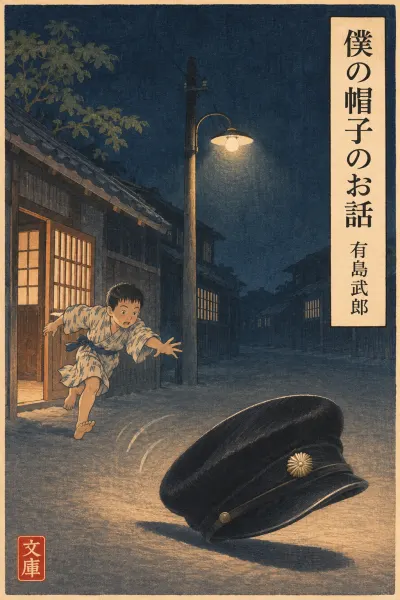
ひろおうとすると、ドアが音もなく開いて、ぼうしは外の道へ転がって行きました。Just as I tried to pick it up, the door opened without a sound, and the cap rolled away into the street outside.
風もないのに、へんです。There wasn't even any wind, and yet it was strange.
ぼくはぼうしのあとを走りました。I ran after the cap.
手が近くなると、ぼうしはまた先へ転がります。Whenever my hand came close, the cap rolled on ahead again.
何度やっても、つかまえられません。No matter how many times I tried, I could not catch it.
町の中を、右へ左へ走りました。I ran through the town, to the right and to the left.
くらい夜でしたが、ぼうしだけはよく見えました。It was a dark night, but the cap alone I could see clearly.
ぼくはなきそうになって、「待って!」と大きなこえを出しました。I was nearly crying, and I shouted in a loud voice, "Wait!"
すると、ぼうしは学校のもんの前で止まりました。Then the cap stopped in front of the school gate.
そして、こちらを見て、「つかまえられるなら、つかまえてみろ」と話しました。And it looked my way and said, "Catch me if you can!"
ぼくは、まけないぞと思って、ぼうしの方へ走りました。I thought, "I won't lose!" and ran toward the cap.
すると、ぼうしもぼくも、学校のもんを通って、中へ入りました。Then the cap and I both went through the school gate and inside.
気がつくと、ぼくはとなりのクラスの教室にいました。When I came to myself, I was in the classroom of the class next to mine.
先生がお金を一まい見せて、「これを何まい飲むと、おなかのいたいのがなおりますか」と聞きました。The teacher showed a coin and asked, "How many of these must you swallow to cure a stomachache?"
くりはらくんは「一まいです」と答えました。Kurihara answered, "One."
先生は「ちがいます」と話しました。The teacher said, "Wrong."
しずかないとうくんが「二まいです」と答えると、先生は「よろしい」と話しました。When quiet Itō answered, "Two," the teacher said, "Very good."
あっ、ぼうしは?Oh! What about my cap?
ぼくは急いで教室を出ました。I hurried out of the classroom.
そこは、くさばかりの広いところでした。Outside was a wide place with nothing but grass.
くらい空に、ぼくのぼうしが黒い月のように、高くかかっていました。High up in the dark sky, my cap was hanging like a black moon.
高すぎて、何もできません。It was too high, and I could do nothing at all.
ぼうしは、知らないかおをしています。The cap was wearing a face as if it knew nothing about it.
ぼうしがないと、あしたから学校へ行けません。Without my cap, I cannot go to school from tomorrow on.
ぼくはまたなきました。I cried again.
まわりはだんだんくらくなって、家への帰り道もわかりません。All around me it grew darker and darker, and I did not even know the way back home.
「もしかしたら、たぬきがぼうしになって、ぼくをいじめているのかもしれない」と思いました。I thought, "Perhaps a tanuki has turned itself into my cap and is being cruel to me."
ぼくはこわくなりました。I became frightened.
すると、とおくで、ぼくの名前をよぶこえが聞こえました。Then, far away, I heard a voice calling my name.
見ると、お父さんとお母さんが、ねまきを着て、なきながらぼくをさがしていました。When I looked, Father and Mother were in their nightclothes, crying as they searched for me.
お母さんはたんすのひきだしを、お父さんは本だなの本を、一つずつ見ています。Mother was looking through the drawers of the chest, and Father through the books on the bookshelf, one by one.
ほんとうのお父さんとお母さんです。They were my real father and mother.
ぼくはうれしくなって、二人の方へ走りました。I was overjoyed and ran toward the two of them.
でも、ぼくの体は、空気のように二人の中を通りました。But my body passed right through them like air.
何度さわろうとしても、さわれません。However many times I tried to touch them, I could not.
「お父さん、お母さん、ぼくはここにいますよ!」と大きなこえでよびましたが、二人には聞こえません。I called in a loud voice, "Father, Mother, I'm here!" but they could not hear me.
ぼくは考えました。I thought hard.
「あのたぬきのぼうしが、何か悪いことをしているんだ。ぼうしをつかまえよう」"That tanuki cap must be doing something wicked. I'll catch the cap!"
ぼくは力を入れて、高くとびました。I put all my strength into it and jumped high.
体はどんどん上へのぼって行きます。My body went up and up, higher and higher.
とうとう、ぼうしを強くつかみました。At last I grabbed the cap tightly.
ぼうしが「いたい!」とこえを出しました。The cap cried out, "Ouch!"
すると、ぼくはぼうしを持って、下へおちはじめました。Then, holding the cap, I began to fall downward.
どこまでもおちて行きます。I fell and fell, on and on without end.
まわりがだんだん光って、かみなりがなりました。Little by little everything around me began to flash, and thunder rumbled.
下には火の海が見えます。Below me I could see a sea of fire.
ぼうしが「だれか来て!」と大きなこえを出しました。The cap shouted loudly, "Somebody come!"
ぼくもこわくて、こえを出しました。I was frightened too, and I cried out.
その音で、ぼくの体がゆれました。At that sound, my body was shaken.
目を開けると、ゆめでした。When I opened my eyes, it had been a dream.
お母さんがそばにいて、「どうしたの。もう学校へ行く時間ですよ」と話しました。Mother was beside me and said, "What's the matter? It's already time to go to school."
ぼくは急いで、自分の手を見ました。Quickly I looked at my own hand.
ぼくの手には、あの大切なぼうしがありました。In my hand was that precious cap.
ぼくはとてもうれしくなって、お母さんのかおを見てわらいました。I was so very happy that I looked up at Mother's face and laughed.
Vocabulary
| Word | Meaning | JLPT |
|---|---|---|
| りっぱりっぱ | fine, splendid, granddictionary form: 立派A na-adjective: りっぱなぼうし. | N5 |
| 大切たいせつ | precious, important大切にする means "to take good care of, to treasure". | N5 |
| 作文さくぶん | composition, essay (school writing) | N5 |
| まくらまくら | pillowdictionary form: 枕 | N2 |
| ふとんふとん | futon, Japanese bedding laid on the floordictionary form: 布団Kept as "futon" in English, which has no exact equivalent. | N4 |
| げんかんげんかん | entrance hall of a housedictionary form: 玄関The area inside the front door where shoes are taken off. | N5 |
| 転がってころがる | to rolldictionary form: 転がる | N2 |
| つかまえられませんつかまえる | to catchdictionary form: つかまえるHere in the potential negative: "cannot catch". | N4 |
| もんもん | gatedictionary form: 門 | N5 |
| たぬきたぬき | tanuki, raccoon dogdictionary form: 狸In Japanese folklore the tanuki can change its shape and play tricks on people. | — |
| いじめていじめる | to tease, to be cruel to, to bullydictionary form: いじめる | N4 |
| ねまきねまき | nightclothes, pyjamasdictionary form: 寝間着 | N2 |
| ひきだしひきだし | drawerdictionary form: 引き出しFrom 引く (pull) + 出す (take out). | N4 |
| かみなりかみなり | thunderdictionary form: 雷かみなりがなる: "thunder rumbles". | N3 |
Grammar
〜てくれる N4 someone does something for me
Attached to the te-form, くれる shows that someone else does an action that benefits the speaker. The boy feels grateful that his father bought the cap for him.
お父さんが東京で買って来てくれた物です。
It is one that Father bought in Tōkyō and brought home for me.
〜そうになる N3 to be about to, to nearly do
The verb stem plus そうになる means something almost happens but does not quite. なきそう means "nearly crying".
目から水が出て、なきそうになりました。
Water came out of my eyes, and I was about to cry.
〜はずだ N4 it should be, it ought to be
はず expresses a confident expectation based on reasoning. The boy reasons that if he forgot his cap, it must be in the entrance hall.
それなら、げんかんにあるはずだ
If so, it ought to be in the entrance hall.
〜しか〜ない N4 nothing but, only
しか always comes with a negative verb and stresses that there is only this one thing. Here only Father's hat was there, not the boy's cap.
そこにはお父さんの茶色のぼうししかありませんでした。
There was nothing there except Father's brown hat.
〜(よ)うとする N3 to try to, to be about to
The volitional form plus とする describes an attempt or the moment just before an action. With と after it, something else happens at that moment.
ひろおうとすると、ドアが音もなく開いて
Just as I tried to pick it up, the door opened without a sound
〜のに N4 even though, despite
のに joins two facts where the result is unexpected, often with surprise or complaint. After a noun or na-adjective in the present it becomes なのに, but here it follows the adjective ない.
風もないのに、へんです。
There wasn't even any wind, and yet it was strange.