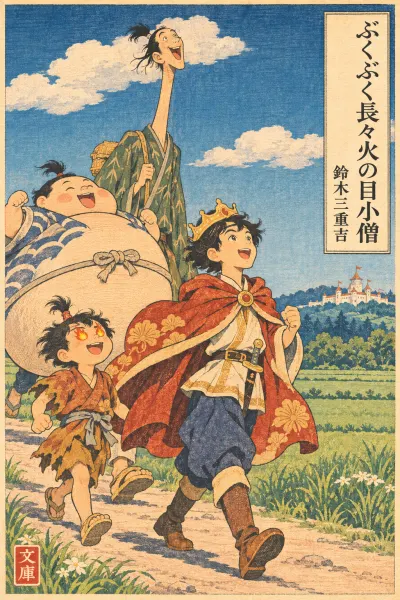
Part 1 of 9 · JLPT N3
ぶくぶく長々火の目小僧 Bukubuku Naganaga Hi no Mekozō, part 1: The Princess Who Wanted No Suitors
In this part
In a topsy-turvy age, a princess tired of suitors agrees to marry anyone who can keep watch over her for three nights without falling asleep. Anyone who dozes off is executed, and every suitor fails. A brave young prince finally wears down his father, sets out alone, and on the second day meets a fat man who is searching the world for happiness.
AI translation · independently checked
一1
これは昔も昔も大昔のお話です。This is a story from long, long ago, from very long ago indeed.
そのじぶんは今とすっかりちがって、鼠でも靴をはいて歩いていました。In those days things were completely different from now: even mice wore shoes when they walked about.
そして猫を片はしから取って食べました。And they caught cats, one after another, and ate them.
ろばも剣をつるしていばっていました。Donkeys, too, swaggered about with swords hanging at their sides.
にわとりは、しじゅう犬をおっかけまわしていじめていました。Chickens were forever chasing dogs around and bullying them.
こんなに、何でもものがさかさまだったときのことですから、今から言えば、それこそ昔も昔も大昔の、そのまたずっとずっと昔のお話です。Since it was a time when everything was upside down like this, it is, as we would say today, a story from long, long ago, from very long ago, and from far, far before even that.
だから、いろんなおかしなことばかり出て来ます。So all sorts of funny things happen in it.
しかし、けっしてうそではありません。But it is by no means a lie.
そのころ或国の王さまに、美しい王女がありました。In those days the king of a certain country had a beautiful princess.
その王女を世界中の王さまや王子が、だれもかれもお嫁にほしがって、入りかわりもらいに来ました。Every king and prince in the world, every last one of them, wanted to marry her, and they came one after another to ask for her hand.
しかし王女は、どんなりっぱな人のところから話があっても、厭だ、と言って、はねつけてしまいました。But no matter how fine a man asked for her, the princess said, "I won't!" and turned him away.
世界中の王さまや王子たちは、それでもまだこりないで、なんども出かけて来ました。Even so, the kings and princes of the world never learned their lesson, and they came again and again.
王女は、うるさくてたまらないものですから、とうとうお父さまの王さまに向って、The princess found it so unbearably tiresome that at last she turned to her father, the king, and
「ではだれでも三晩の間、私をお部屋の外へ出さないように、寝ずの番をして見せる人がありましたら、その方のお嫁になりましょう。」と言いました。said, "Very well. If anyone can keep watch without sleeping for three nights and make sure I never leave my room, I will become that person's bride."
王さまはさっそくそのことを世界中へお知らせになりました。The king at once announced this to the whole world.
そのかわり、もし途中で少しでもい眠りをすると、すぐにきり殺してしまうから、そのつもりでおいで下さいとお言いになりました。But in return, he said, if anyone dozed off even a little before the watch was over, he would be cut down on the spot, so they should come prepared for that.
すると方々の王さまや王子たちは、何だ、そんなことなら、だれにだって出来ると言って、どんどんおしかけて来ました。Then kings and princes from all around said, "What? If that's all it takes, anyone can do it," and they came crowding in, one after another.
ところが、夜になって、王女のお部屋へとおされて、しばらく王女の顔を見ていると、どんな人でもついうとうと眠くなって、いつの間にかぐうぐう寝こんでしまいました。But when night came and they were shown into the princess's room, every one of them, after gazing at her face for a while, grew drowsy and began to nod, and before they knew it they were fast asleep and snoring.
それで、来る人来る人が、一人ものこらず、みんな王さまにきり殺されてしまいました。And so everyone who came, every single one without exception, was cut down by the king.
すると、或王さまのところに、鹿のようにきれいな、そしてたかのように勇しい、年わかい王子がいました。Now, at the court of a certain king there lived a young prince, as handsome as a deer and as bold as a hawk.
この王子がその話を聞いて、私ならきっと眠らないで番をして見せる、一つ行ってためして来ようと思いました。When this prince heard the story, he thought, "I'm sure I could stay awake and keep watch. I'll go and give it a try."
しかしお父さまの王さまは、王子がうっかり眠りでもしたらたいへんですから、いやいやそれはいけないと言って、どうしてもおゆるしになりませんでした。But his father, the king, knew it would be terrible if the prince carelessly fell asleep, so he said, "No, no, you may not," and would not give him permission at all.
そうなると王子はなおさらいきたくて、毎日々々、That only made the prince want to go all the more, and day after day,
「どうかいかせて下さいまし。たった三晩ぐらいのことですもの。かならず眠りはいたしません。」と言いながら、王さまにつきまとって、ねだりました。he followed the king around and begged him, saying, "Please let me go. It's only three nights or so, after all. I promise I won't fall asleep."
さすがの王さまもとうとう根まけをなすって、それでは、どうなりとするがいいと、しかたなしにこう仰いました。Even the king finally gave in, and having no other choice, he said, "Very well, then, do as you please."
王子は大よろこびで、お金入れへお金をどっさり入れて、それから、よく切れるりっぱな剣をつるすが早いか、お供もつれないで、大勇みに勇んで出かけました。The prince was overjoyed. He stuffed his purse full of money, and the moment he had hung a fine, sharp sword at his side, he set off in high spirits, without even taking a single attendant.
二2
王子は遠い遠い長い道をどんどん急いでいきました。The prince hurried on and on along a long, long road that went far, far away.
すると二日目に、途中で一人のふとった男に出あいました。Then, on the second day, he met a fat man along the way.
その男はよっぽどからだがおもいと見えて、足を引きずるようにして、のッそりそり歩いていました。The man's body must have been very heavy, for he was plodding slowly along, almost dragging his feet.
「もしもし、おまえさんはどこまでいくのです。」と、王子はその男に話しかけました。"Excuse me, how far are you going?" the prince asked the man.
「私は、仕合せというものをさがしに世界中を歩いているのでございます。」と、そのふとった男がこたえました。"I am travelling all over the world in search of the thing called happiness," the fat man replied.
Vocabulary
| Word | Meaning | JLPT |
|---|---|---|
| 片はしかたはし | one after another, every one in turn (片はしから)dictionary form: 片端Literally 'from one end'. 片っ端から is the more common modern form. | — |
| いばっていばる | to swagger, to act proud and bossydictionary form: 威張る | N2 |
| しじゅうしじゅう | all the time, constantlydictionary form: 始終 | N2 |
| さかさまさかさま | upside down, topsy-turvy, the wrong way rounddictionary form: 逆様 | N2 |
| はねつけてはねつける | to reject flatly, to turn awaydictionary form: 撥ね付ける | — |
| こりないでこりる | to learn one's lesson (from a bad experience)dictionary form: 懲りるVery often used in the negative: 懲りない 'never learning'. | N1 |
| 寝ずの番ねずのばん | an all-night watch, keeping guard without sleeping寝ず is the classical negative of 寝る (= 寝ない). | — |
| おしかけておしかける | to come crowding in, to turn up uninviteddictionary form: 押し掛ける | — |
| うとうとうとうと | drowsily, nodding offCompare ぐうぐう later in the same sentence: snoring in a deep sleep. | — |
| ねだりましたねだる | to beg, to pester someone for somethingdictionary form: ねだる | N1 |
| つきまとってつきまとう | to follow someone around, to hang about someonedictionary form: 付き纏う | — |
| 根まけこんまけ | giving in because one's patience has run outdictionary form: 根負け根 here means 'stamina, perseverance' and is read こん. | — |
| お供とも | attendant, companion on a journeydictionary form: 供 | — |
Grammar
〜てたまらない N3 unbearably ~, so ~ one can't stand it
The て-form of an adjective plus たまらない shows a feeling too strong to bear. Here the suitors are so annoying that the princess can't stand it any longer.
王女は、うるさくてたまらないものですから
Because the princess found them unbearably tiresome
〜ものですから N3 because, since (giving an explanation)
Attached to a plain form, ものですから gives a reason, often in a slightly explanatory or apologetic tone. It explains why the princess finally speaks to the king.
王女は、うるさくてたまらないものですから、とうとうお父さまの王さまに向って
Because they pestered the princess so much, she at last turned to her father, the king
お〜になる N4 honorific form of a verb
お + verb stem + になる raises the subject respectfully. The narrator uses it for the king's actions, such as お知らせになる 'to announce' and お言いになる 'to say'.
王さまはさっそくそのことを世界中へお知らせになりました。
The king at once announced this to the whole world.
〜が早いか N1 the moment ~, no sooner ~ than
Attached to a dictionary-form verb, が早いか means the next action follows immediately. The prince sets off as soon as his sword is on.
よく切れるりっぱな剣をつるすが早いか、お供もつれないで、大勇みに勇んで出かけました
the moment he had hung a fine, sharp sword at his side, he set off in high spirits without even taking an attendant
〜と見えて N1 apparently ~, it seems that ~ (so...)
This pattern presents a guess based on what can be seen, followed by the evidence. The man's slow, dragging walk suggests that his body is heavy.
その男はよっぽどからだがおもいと見えて、足を引きずるようにして
The man's body must have been very heavy, for he was almost dragging his feet