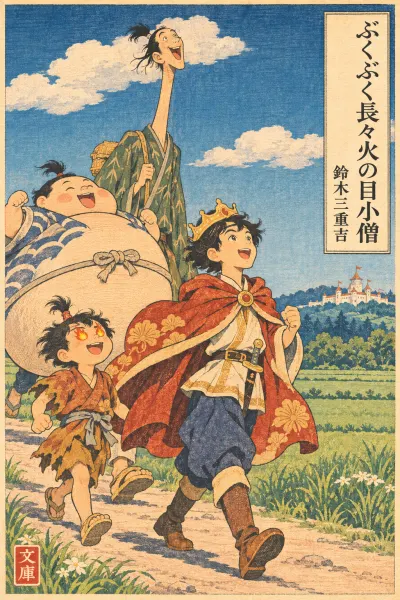
Part 8 of 9 · JLPT N3
ぶくぶく長々火の目小僧 Bukubuku Naganaga Hi no Mekozō, part 8: Blotting Out the Sun, Swallowing an Army
In this part
Naganaga stretches up to the sky and covers half the sun with his hat, so the pursuing soldiers are left in darkness while the prince and princess escape. When the army appears again near the prince's town, Bukubuku stays behind, swells up as big as a mountain, and swallows every soldier, horses and all, because they mistake his open mouth for the town gate. The town celebrates the prince's return with his bride, and Bukubuku pats his full belly to show where the soldiers went.
AI translation · independently checked
「ああ、それならぞうさもありません。」と言いながら、からだをするするのばしました。"Oh, if that's all, it's no trouble at all," he said, and he began stretching his body up, smooth and quick.
そして、あッと言う間に天までのび上りました。And in the blink of an eye he had stretched all the way up to the sky.
みんなはびっくりして、何をするのかと見ていますと、長々はたかいたかい雲の中で帽子をぬいで、その帽子を、ひょいとお日さまの片がわへかぶせました。Everyone watched in amazement, wondering what he was going to do, and up in the high, high clouds Naganaga took off his hat and popped it neatly over one side of the sun.
すると下界は王子たちのいる方に光がさすだけで、兵たいがかけて来る方の半分は、ふいに夜のようにまっくらになってしまいました。At once, down on the earth below, the light shone only on the side where the prince and his companions were, while the half where the soldiers were charging in suddenly went pitch-dark, like night.
王子たちは、兵たいが暗がりでまごまごしている間に、While the soldiers were stumbling about in the darkness, the prince and the others
「さあ、走れ走れ。」と言いながら、ふたたび王女の手をとって、おおいそぎでかけ出しました。cried, "Come on, run, run!" and, taking the princess by the hand once more, they dashed off as fast as they could.
長々は王子たちが、いいかげん遠くまでにげのびたのを見すまして、ひょいと帽子をはずして、頭にかぶりました。Naganaga waited until he was sure the prince and the others had got a good long way off, then whisked his hat off the sun and put it back on his head.
そして一と足で一里またげる、その長い足で、ひょいょいょいと、またたく間に王子のそばへ追いつきました。Then, on those long legs that could cross a whole ri in a single step, he went hop, hop, hop, and in no time at all he had caught up with the prince.
それからみんなは、また一しょに走りつづけました。After that they all ran on together again.
そのうちに向うの方に、王子の御殿のある町が見え出しました。Before long, the town where the prince's palace stood came into sight in the distance.
王子は、The prince turned
「どうだ、兵たいはもうひきかえしたか。ちょっと見てくれ。」と、火の目小僧に言いました。to Hinome Kozō and said, "Well? Have the soldiers turned back yet? Take a quick look for me."
火の目小僧はまた後をふりかえって、Hinome Kozō looked back behind them again
「おや、またじきあすこに砂烟が見えます。これはたいへんだ。」とあわてました。and cried in alarm, "Oh no, there's a cloud of dust again, right over there! This is terrible!"
すると、ぶくぶくが、Then Bukubuku said,
「じゃァみなさんはかまわずおにげ下さい。私がここにのこって、ちゃんとしますから。」と、王子たちをさきににがしました。"Well then, please don't worry, all of you, just run. I'll stay here and take proper care of things," and he sent the prince and the others on ahead.
八Eight
ぶくぶくはそのあとへ一人で立ちはだかったまま、ぶくぶくぶくぶくと、見る見るうちに大きな大きな大山のようにふくれ上りました。Bukubuku stood alone, blocking the way behind them, and puff, puff, puff, puff, before anyone's eyes he swelled up as huge as a great big mountain.
そしてその大きな口をぱくりとあいて、Then he opened his enormous mouth wide with a gulp
「さあ来い。」と言いながら、ゆうゆうとまちかまえていました。and waited calmly, saying, "Come on, then!"
兵たいたちは、The soldiers
「うわあ、うわあ。」と、ときの声を上げて、死にものぐるいでかけつけて来ました。came charging up desperately, raising their battle cry: "Waaah! Waaah!"
みんなは、もうこうなれば、たとい火の中をくぐっても王女さまを取りかえして見せる、もし相手が王女をわたさないと言うなら、すぐに町をせめかこんで、町中のものを一人も残さず斬り殺してやろうと、こう腹をきめているのでした。Now that things had come to this, they had all made up their minds: they would win back the princess even if they had to pass through fire, and if the other side refused to hand her over, they would surround the town at once and cut down every last person in it.
間もなく兵たいたちは、ぶくぶくの口のまん前までかけて来ました。Soon the soldiers came running right up to the front of Bukubuku's mouth.
するとみんなは火の子のようにあわて切っているものですから、ぶくぶくの大きな口を町の入口の門とまちがえて、片はしからどんどんどんどんその口の中へとびこみました。And because they were all in such a frantic hurry, like flying sparks, they mistook Bukubuku's huge mouth for the gate at the entrance to the town, and one after another, on and on and on, they leapt straight into it.
ぶくぶくはその何千人という兵たいがすっかりお腹の中へはいってしまうと、Once every one of those thousands of soldiers had gone right down into his belly,
「ははは。これでよし。」と笑いながら、そのままのそりのそりと町の方へ歩いていきました。Bukubuku laughed, "Ha ha ha! That's that taken care of," and just as he was, he went lumbering off toward the town.
ぶくぶくはそれだけの兵たいを馬ぐるみお腹へ入れたのですから、少し歩き悪くはありましたが、それでも大またにのこのこと歩いて町へはいりました。Since he had put that many soldiers into his belly, horses and all, walking was a little hard for him, but even so he plodded along with great long strides and entered the town.
町中では王子がうまく寝ずの番をして、世界一のりっぱな王女をお嫁にもらってかえって来たというので、みんな大よろこびで、おどりさわぎました。All through the town, people were overjoyed to hear that the prince had kept his sleepless watch so well and had come home with the finest princess in the world as his bride, and they were dancing and celebrating.
王子はぶくぶくの姿を見ると、When the prince saw Bukubuku,
「おお、かえったか。あの兵たいたちはどうした。」と聞きました。he asked, "Ah, you're back! What happened to those soldiers?"
ぶくぶくはにたにた笑いながら大きなお腹をぽんとたたいて、Grinning slyly, Bukubuku gave his big belly a pat,
「このとおりでございます。みんなこの中へ入れてしまいました。」と言いました。and said, "Just as you see, sir. I've put every one of them in here."
王子は、はっはと笑って、The prince laughed, "Ha ha!" and
Vocabulary
| Word | Meaning | JLPT |
|---|---|---|
| ぞうさぞうさ | trouble, effortdictionary form: 造作Usually in the negative: 造作もない = it's no trouble at all, easy. | — |
| かぶせましたかぶせる | to put (something) over, to cover withdictionary form: かぶせるTransitive partner of かぶる (to put on one's own head). | N2 |
| 下界げかい | the world below, the earth (seen from the sky) | — |
| まごまごまごまご | flustered, at a loss, fumbling aboutOften used with する. | N2 |
| 見すましてみすます | to watch carefully and make sure (e.g. that the right moment has come)dictionary form: 見すますLiterary; 見澄ます. | — |
| またたく間またたくま | in the blink of an eye, in an instantdictionary form: 瞬く間またたく = to blink, twinkle. | — |
| 里り | ri, an old unit of distance (about 4 km) | — |
| 砂烟すなけむり | a cloud of dustdictionary form: 砂煙Kicked up by a marching army or horses; 烟 is an old variant of 煙. | — |
| 立ちはだかったたちはだかる | to stand in the way, to block someone's pathdictionary form: 立ちはだかる | — |
| まちかまえていましたまちかまえる | to lie in wait, to be ready and waiting fordictionary form: 待ち構える | — |
| ときの声ときのこえ | a battle cry, war crydictionary form: 鬨の声 | — |
| 死にものぐるいしにものぐるい | desperately, frantically, like one possesseddictionary form: 死に物狂い | — |
| 腹をきめているはらをきめる | to make up one's mind, to resolve firmlydictionary form: 腹を決める腹 (belly) stands for one's resolve or true intentions. | — |
| 寝ずの番ねずのばん | an all-night watch, keeping guard without sleepingず is the classical negative: 寝ず = without sleeping. | — |
Grammar
あっという間に N3 in an instant, before you know it
Literally 'in the time it takes to say "ah!"'. It stresses how suddenly Naganaga's stretch is finished.
あッと言う間に天までのび上りました。
In the blink of an eye he had stretched all the way up to the sky.
見る見るうちに N2 before one's very eyes, rapidly
Describes a change happening so fast you can watch it unfold. Here it goes with ふくれ上がる to show Bukubuku swelling visibly.
見る見るうちに大きな大きな大山のようにふくれ上りました。
Before anyone's eyes he swelled up as huge as a great big mountain.
たとい〜ても N3 even if ~
たとい is an older form of たとえ. It strengthens the concessive 〜ても: no matter how extreme the condition (even passing through fire), the result will not change.
たとい火の中をくぐっても王女さまを取りかえして見せる
we will win back the princess even if we have to pass through fire
〜てみせる N2 to definitely do ~, to show that one will do ~
Attached to a verb in the て-form, みせる (here written 見せる) expresses a strong determination to achieve something. The soldiers are vowing that they will get the princess back.
王女さまを取りかえして見せる
we will win back the princess, you'll see
〜ものですから N3 because ~ (giving a reason)
A polite form of 〜ものだから. It gives a reason that explains an unexpected result, here the soldiers' panic explaining why they mistook a mouth for a gate.
みんなは火の子のようにあわて切っているものですから
because they were all in such a frantic hurry, scattering like sparks
〜というので N3 because (people heard/said) that ~
It gives a reason based on news or something people are saying. The townspeople celebrate because word has spread that the prince came home with a bride.
世界一のりっぱな王女をお嫁にもらってかえって来たというので、みんな大よろこびで、おどりさわぎました。
Because they heard he had come home with the finest princess in the world as his bride, everyone was overjoyed and danced and celebrated.