Part 2 of 9 · JLPT N3
ぶくぶく長々火の目小僧 Bukubuku Naganaga Hi no Mekozō, part 2: Two Strange Servants Join the Prince
In this part
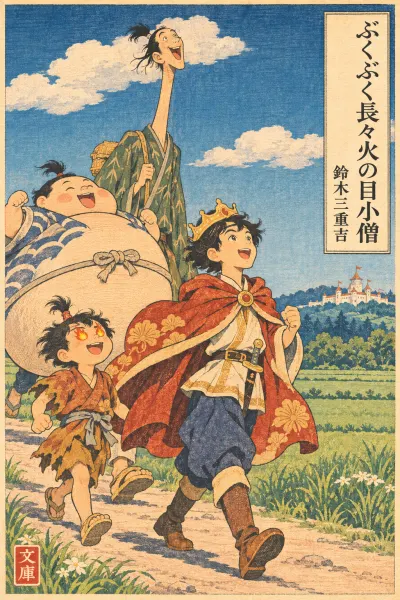
The fat man introduces himself as Bukubuku, who can swell up like a rubber bag, and he gladly becomes the prince's servant. Next they meet Naganaga, a stick-thin man who can stretch up to the clouds and cover a ri in a single stride, and he joins too. In a forest they find a man who shoots flames from his eyes and burns a whole pile of logs to ash, and the prince invites him along as well.
AI translation · independently checked
「一たいあなたの商ばいは何です。」と王子は聞きました。"So what exactly is your trade?" asked the prince.
「私にはこれという商ばいはございません。ただ人の出来ないことがたった一つ出来るだけでございます。」"I have no trade to speak of, sir. There is just one thing I can do that other people cannot, and that is all."
「では、その人に出来ないことというのはどんなことです。」"Well then, what is this thing that other people cannot do?"
「なに、たいしたことではございません。私はぶくぶくという名前で、いつでも勝手なときに、ひとりでにからだがゴムの袋のようにぶくぶくふくれます。まず一聯隊ぐらいの兵たいなら、すっかり腹の中へはいるくらいふくれます。」"Oh, it is nothing much, sir. My name is Bukubuku, and whenever I like, my body puffs up all by itself, bukubuku, like a rubber bag. I can swell up so big that a whole regiment of soldiers would fit inside my belly."
ふとった男はこう言って、にたにた笑いながら、いきなりぷうぷうふくれ出して、またたく間に往来一ぱいにつかえるくらいの、大きな大きな大男になって見せました。With these words the fat man, grinning, suddenly began to puff up, poof, poof, and in the blink of an eye he turned into a huge, huge giant, big enough to block the whole road, to show them.
王子はびっくりして、The prince was astonished and said,
「ほほう、これはちょうほうな男だ。どうです、きょうから私のお供になってくれませんか。私もちょうど、お前さんと同じように、仕合せをさがして歩いているのだから。」と、聞いて見ました。"Well, well, what a useful man you are! What do you say, will you come along with me as my companion from today? I am just like you, you see, walking the world in search of my fortune," he asked.
するとぶくぶくはよろこんで、Bukubuku was delighted.
「どうぞおともにつけて下さいまし。何よりの仕合せでございます。」と言って、すぐに家来になりました。"Please take me along with you, sir. Nothing could make me happier," he said, and at once he became the prince's servant.
二人はそれからしばらく、てくてく歩いていきますと、こんどは向うから、まるで棒のようにやせた、ひょろ長い男が出て来ました。The two of them walked on and on for a while, and this time a tall, lanky man as thin as a stick came toward them from up ahead.
王子は、The prince thought,
「おや、へんなやつが来たぞ。」と思いながらそばへいって、Thinking, "Well, here comes an odd fellow," he went over to the man.
「もしもし、おまえさんはどこまでいくのです。」と聞きました。"Excuse me, how far are you going?" he asked.
「私は世界中を歩くのです。」と、その棒が言いました。"I am walking all over the world," said the stick.
「一たいおまえさんは何商ばいです。」と王子は聞きました。"And what is your trade, exactly?" asked the prince.
「私には商ばいはありません。ただ人の出来ないことが、たった一つ出来るだけでございます。私の名前は長々と申します。私がちょいと、こう爪立ちをしますと、すうッと天まで手がとどきます。それから一と足で一里さきまでまたげます。このとおりです。」"I have no trade. There is just one thing I can do that other people cannot, and that is all. My name is Naganaga. If I just stand on tiptoe like this, my hands reach right up to the sky, whoosh. And with a single step I can stride a whole ri ahead. Look, like this."
棒はこう言うが早いか、たちまちするするとからだをのばして、おやッという間に、もう高い高い雲の中へ頭をつっこんでしまいました。No sooner had the stick said this than he stretched his body up and up, and before anyone could say "Oh!" his head was already poking into the high, high clouds.
そして、ひょいょいょいと五足六足歩いたと思いますともう五、六里向うへとんでいました。Then, no sooner had he taken five or six steps, hop, hop, hop, than he was already five or six ri away.
それからまたひょいょいょいと、またたく間に目の前へかえって来ました。Then, hop, hop, hop again, in the blink of an eye he was back in front of them.
王子は、The prince said to himself,
「いや、これは便利な男がいたものだ。」と、すっかりかんしんして、"My, what a handy man to have come across!" He was thoroughly impressed.
「これから私のお供になってくれないか。」と言いました。"Will you be my companion from now on?" he said.
「へいへい、それはねがってもない幸でございます。」と、棒は大喜びで、すぐに家来になりました。"Yes, yes, sir, that is a stroke of luck I could hardly have wished for!" said the stick, overjoyed, and he became a servant at once.
王子は二人をつれて、またどんどんいきました。The prince set off again at a brisk pace, taking the two with him.
そして間もなく、ある大きな森の中へ来ました。Before long they came into a great forest.
するとそこに、だれだか一人の男がいて、ぐるりの大きな木を片ッぱしからひきぬいては、どんどんつみ上げていました。There they found some man or other pulling up the big trees all around him one after another and piling them higher and higher.
王子は、The prince asked,
「もしもし、それをつみ上げてどうするのです。」と聞きました。"Excuse me, what are you going to do with all that once you have piled it up?"
するとその男は、The man answered,
「なァに、ただ目から火をふいて、この丸太を一どきにもやすんです。」と言いながら、じっと目をすえて、その山のようにつみかさねた木をにらみつけました。"Oh, nothing much. I'm just going to shoot fire out of my eyes and burn up these logs all at once," and as he spoke he fixed his eyes and glared hard at the mountain of piled-up wood.
すると、両方の目の中から、しゅうしゅうと、長い焔がふき出て、それだけの丸太をまたたく間に灰にしてしまいました。At once long flames came hissing out of both his eyes, and in the blink of an eye they burned that whole heap of logs to ash.
「ほほう、これはすばらしい。どうです。私のお供になりませんか。」と王子は言いました。"Well, well, this is marvelous! What do you say? Will you be my companion?" said the prince.
Vocabulary
| Word | Meaning | JLPT |
|---|---|---|
| 商ばいしょうばい | trade, business, line of workdictionary form: 商売Written here half in kana; normally 商売. | N3 |
| 勝手かって | as one pleases; at will勝手なときに = whenever one likes. Often also means selfish. | — |
| ふくれますふくれる | to swell, to puff updictionary form: ふくれるKanji 膨れる. Also used for sulking with puffed cheeks. | N1 |
| 往来おうらい | road, streetLiterally 'going and coming'; an old-fashioned word for a public road. | — |
| ちょうほうちょうほう | handy, usefuldictionary form: 重宝Describes someone or something convenient to have around. | N1 |
| お供とも | attendant, companion on a journeydictionary form: 供お供になる = to go along as someone's attendant. | — |
| 家来けらい | servant, retainerA follower serving a lord; common in folk tales. | N1 |
| 爪立ちつまだち | standing on tiptoe爪 here means the tips of the toes. | — |
| 里り | ri (old unit of distance)About 3.9 km. No English equivalent, so it is kept as 'ri'. | — |
| またげますまたぐ | to step over, to stride acrossdictionary form: 跨ぐPotential form またげる = can stride across. | N2 |
| かんしんかんしん | being impressed, admirationdictionary form: 感心Different from 関心 (interest), which has the same reading. | N3 |
| 片ッぱしかたっぱし | one end; (片っ端から) one after another, all without exceptiondictionary form: 片っ端片っ端から = one after another, all of them without exception. | — |
| 丸太まるた | logA rough tree trunk with the branches removed. | — |
| にらみつけましたにらみつける | to glare at, to stare fiercely atdictionary form: 睨みつける〜つける adds force to the action. | — |
Grammar
〜て見せる N3 to do something to show someone
The て-form plus 見せる means doing an action as a demonstration. Bukubuku turns into a giant to show the prince what he can do.
大きな大きな大男になって見せました
he showed them how he could become a huge, huge giant
〜が早いか N1 no sooner … than
Dictionary form plus が早いか shows that the second action follows the first immediately. It is a literary expression.
棒はこう言うが早いか、たちまちするするとからだをのばして
No sooner had the stick said this than he stretched his body up and up
〜たものだ N2 expresses wonder or admiration
Past tense plus ものだ can express surprise or admiration at a situation. Here the prince marvels that such a handy man exists.
いや、これは便利な男がいたものだ。
My, what a handy man to come across!
〜ては N2 repeatedly doing A, then B
The て-form plus は links two actions repeated over and over. The man keeps pulling up trees and piling them, again and again.
片ッぱしからひきぬいては、どんどんつみ上げていました
pulling up the trees one after another and piling them higher and higher
これという〜はない N2 no particular …, nothing worth calling a …
これという with a negative means there is nothing specific worth mentioning. Bukubuku modestly says he has no real trade.
私にはこれという商ばいはございません。
I have no trade to speak of, sir.
〜てしまう N4 to do completely
The て-form plus しまう shows that an action is finished completely. Here it stresses that every single log was turned to ash.
それだけの丸太をまたたく間に灰にしてしまいました。
in the blink of an eye they burned that whole heap of logs to ash.