Part 9 of 9 · JLPT N3
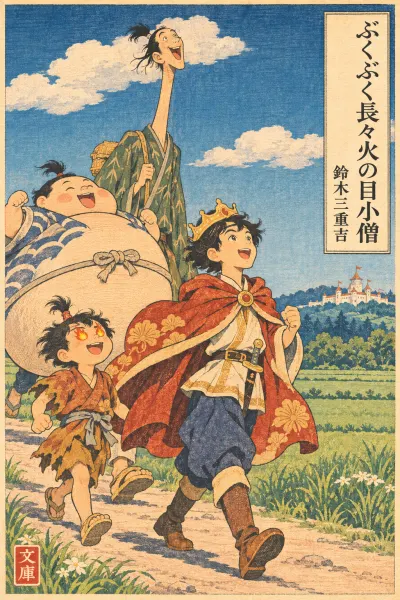
ぶくぶく長々火の目小僧 Bukubuku Naganaga Hi no Mekozō, part 9: Coughing Out an Army, Then a Wedding
In this part
Bukubuku walks to the town square and coughs up the thousands of cavalrymen he swallowed while the townspeople cheer, and the frightened soldiers flee home. When the wedding of the prince and princess is arranged, Naganaga is sent to invite the princess's father, arrives ahead of the soldiers, and uses the chance to plead for the general's life. The king comes, the wedding goes smoothly, and Bukubuku, Naganaga and Hinome Kozō are richly rewarded.
AI translation · independently checked
「もういいから出しておやりよ。」と言いました。"That's enough now, let them out," he said.
「そうですね。兵たいや馬はこなれがわるいでしょうね。あとで腹が下るとやっかいですから出してしまいましょう。」"You're right. Soldiers and horses must be hard to digest. It would be a nuisance if they upset my stomach later, so I'll get them all out."
ぶくぶくはこう言って、わざわざ町のまん中の大きな広場まで歩いていきました。With these words, Bukubuku took the trouble to walk all the way to the big square in the middle of the town.
町中のものは大山のような大きな大きな大男が来たのでびっくりして、わいわい言いながら、みんなでぞろぞろ後へついていきました。Everyone in the town was startled to see a huge, huge giant as big as a mountain coming along, and chattering noisily, they all trooped along behind him.
ぶくぶくは広場へ来ると、When Bukubuku reached the square,
「さあ、みんなどけどけ、あぶないぞいぞ。」と言いながら、大通りにたかっている人を追いはらいました。he said, "Come on now, everybody, out of the way, out of the way! It's dangerous!" and he shooed off the people crowding the main street.
そして両手で横腹をおさえて、Then he pressed both hands against his sides,
「ゴホンホンホン。」と、せきをしました。and coughed: "Ahem-hem-hem!"
するとそのたんびに腹の中から騎兵が十人ずつかたまって、すぽんすぽんととび出しました。And every time he did, cavalrymen came popping out of his belly, pop, pop, ten at a time in a bunch.
町のものは、The townspeople
「うわァうわァ。」とおもしろがって、みんなで手をたたいてはやし立てました。cried "Wow! Wow!" in delight, and all clapped their hands and cheered.
ころがり出た騎兵たちは、死んだようにまっ青な顔をして、あとをも見ずににげていきました。The cavalrymen who came tumbling out were as pale as death, and they ran away without even looking back.
ぶくぶくは、Bukubuku
「ゴホンホン、ゴホンホン。」と、せきつづけにせいて、とうとう何千人という騎兵を一人ものこさずはき出してしまいました。coughed and coughed, "Ahem-hem, ahem-hem!", until at last he had spat out every last one of the many thousands of cavalrymen.
その一ばんしまいにとび出した兵たいは、戸まどいをして、ぶくぶくの鼻の穴へとびこんで、もがいていました。The very last soldier to fly out got confused about which way to go, shot into Bukubuku's nostril, and was struggling about in there.
ぶくぶくは、Bukubuku
「ちょッ、うるさいね。」と言って、クシャンと、くしゃみをしました。said, "Tch, what a bother," and sneezed: "Atchoo!"
するとその兵たいは、ぱたんと鼻の穴からふきとばされて、馬と一しょにころころころがりながらにげていきました。At that, the soldier was blown out of the nostril with a whoosh, and ran off, rolling over and over together with his horse.
御殿では王子と王女との御婚礼の式をあげることになりました。At the palace, it was decided that the wedding ceremony of the prince and the princess would be held.
それで、王女のお父さまの王さまにも来ていただかないといけないというので、王子はいそいで長々をおつかいに出しました。And since the princess's father, the king, would have to be asked to come as well, the prince quickly sent Naganaga off on the errand.
長々は例の足でひょいょいょいと、一どに一里ずつまたいで、じきに向うの王さまの御殿へ着きました。With those famous legs of his, Naganaga went hop, hop, hop, stepping over one ri at a time, and soon arrived at the other king's palace.
見ると、さっきの兵たいたちは、馬でにげて行ったくせに、まだ一人もかえりついていませんでした。When he looked around, he saw that not a single one of the soldiers from before had made it back yet, even though they had fled on horseback.
長々は先に着いたのを幸に、王さまに向って、兵たいの大将の命を許しておやりになるように、よくおねがいしてやりました。Taking advantage of having arrived first, Naganaga earnestly pleaded with the king to spare the life of the soldiers' general.
それでないと、大将は王女をとりかえさないで空手でかえって来たばつに、きっとくびをきられるにきまっていました。Otherwise, the general would certainly have had his head cut off as punishment for coming back empty-handed without having brought the princess back.
王さまは、王女のお婿さんがそういう立派な王子だったと聞くと、おおよろこびで、すぐにおともをつれて、王子のところへ出ていらっしゃいました。When the king heard that his daughter's bridegroom was such a fine prince, he was overjoyed, and at once set out with his attendants to visit the prince.
それで御婚礼の式もとどこおりなくすみました。And so the wedding ceremony went off without a hitch.
王子をたすけていろんな大てがらをした、ぶくぶくと長々と火の目小僧の三人は、大そうなごほうびをもらいました。The three who had helped the prince and done so many great deeds, Bukubuku, Naganaga and Hinome Kozō, received a splendid reward.
Vocabulary
| Word | Meaning | JLPT |
|---|---|---|
| こなれこなれる | digestion; こなれが悪い = hard to digestdictionary form: こなれるこなれがわるい = hard to digest. Also used for language that 'flows naturally' (こなれた文章). | — |
| 腹が下るはらがくだる | to have an upset stomach, have diarrhoeaMore commonly お腹をこわす or 下痢をする in modern speech. | — |
| やっかいやっかい | troublesome, a nuisancedictionary form: 厄介Often in やっかいな問題 'a tricky problem'. | N3 |
| たかっているたかる | to crowd around, swarmdictionary form: たかるUsed for people or insects gathering in a mass. | — |
| 追いはらいましたおいはらう | to drive away, shoo offdictionary form: 追い払う | — |
| はやし立てましたはやしたてる | to cheer loudly, make a lively noisedictionary form: はやし立てるCan also mean to jeer or tease, depending on context. | — |
| 戸まどいとまどい | confusion, losing one's waydictionary form: 戸惑い戸惑いをする here means he lost his bearings; the modern verb is 戸惑う. | — |
| もがいてもがく | to struggle, writhedictionary form: もがく | N1 |
| 例のれいの | the usual, that (well-known)Points to something both speaker and listener already know about. | — |
| またいでまたぐ | to step over, stride acrossdictionary form: 跨ぐ里 (ri) is an old unit of distance, about 3.9 km. | N2 |
| 空手からて | empty-handedSame kanji as the martial art karate; 手ぶら is the everyday word. | — |
| お婿さんむこ | bridegroom, son-in-lawdictionary form: 婿Opposite: 嫁 (よめ), bride. | N1 |
| とどこおりなくとどこおりなく | smoothly, without a hitchdictionary form: 滞りなくSet phrase for ceremonies and events. | — |
| てがらてがら | great deed, achievementdictionary form: 手柄大てがら = a great exploit. | — |
Grammar
〜ておやり N3 do something for someone (to a lower-status recipient)
〜ておやり is the soft imperative of 〜てやる ('do something for someone'), used in a familiar, gentle tone. Here it asks that the swallowed soldiers be let out.
もういいから出しておやりよ。
That's enough now, let them out.
〜たんびに (= たびに) N3 every time
たんび is a colloquial form of たび. その〜たんびに means 'each time that happened', so each cough brings out another batch of soldiers.
するとそのたんびに腹の中から騎兵が十人ずつかたまって、すぽんすぽんととび出しました。
And every time he did, cavalrymen came popping out of his belly, pop, pop, ten at a time in a bunch.
〜ずに N3 without doing
ず is a literary negative; 見ずに equals 見ないで. With the emphatic をも, あとをも見ずに means 'without even looking back'.
あとをも見ずににげていきました。
they ran away without even looking back.
〜くせに N3 even though, despite (with criticism or surprise)
くせに links two facts that clash and adds a tone of reproach or irony. The soldiers had horses, yet they were slower than Naganaga on foot.
馬でにげて行ったくせに、まだ一人もかえりついていませんでした。
not a single one had made it back yet, even though they had fled on horseback.
〜にきまっている N2 to be certain to, surely
Expresses strong conviction that something is or will be the case. Combined with きっと, it stresses that the general's execution would have been certain.
きっとくびをきられるにきまっていました。
he would certainly have had his head cut off.
〜ないといけない N4 must, have to
Literally 'if one doesn't do it, it won't do'. Here it is attached to the humble request 来ていただく, so the meaning is 'we must ask him to come'.
王さまにも来ていただかないといけないというので
since the king would have to be asked to come as well