Upper intermediate · JLPT N2
注文の多い料理店Chūmon no Ōi Ryōriten — The Restaurant That Asked Too Much
- JLPT N2
- 5,400 characters
- 4 parts
- about 45 minutes
- 1 easier version
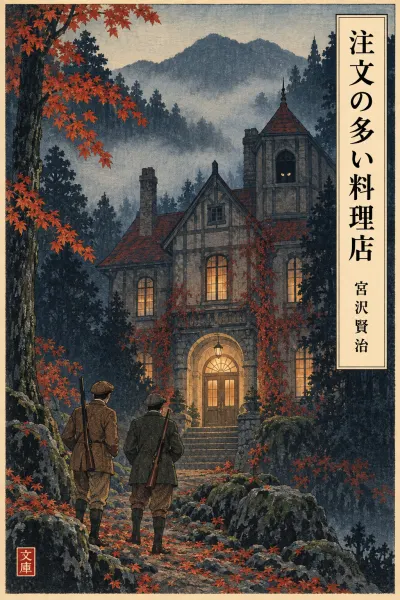
Miyazawa Kenji's 注文の多い料理店 is a darkly comic fairy tale. Two young gentlemen from Tōkyō come to the mountains to shoot something, anything, for the fun of it. They lose their guide, grow hungry, and come upon a smart Western-style restaurant called 山猫軒, 'Wildcat House', standing in the pampas grass. Inside, one door leads to another, and each door carries a polite notice asking the guests to do something more. The gentlemen read every request in the way that flatters them most. The reader soon begins to suspect otherwise. The humour comes from that gap. The narrator speaks in a soft, courteous storyteller's voice, while the gentlemen are smug and shallow. The text is full of lively sound words, and wind, grass and doors all make noises. For a learner, the story is built from repetition: door, notice, reaction, next door. This pattern lets you predict the structure and concentrate on the language. The challenges are the older spellings, the stiff shop-keigo on the signs, and a clipped, old-fashioned male speech style. Once you are used to these, the story reads quickly and rewards rereading, because many lines carry a second meaning.
Contents
Easier versions
This story is also retold in simpler Japanese. Reading an easier version first makes the original much more approachable.
Before you read
- Learn the older spellings before you start. 云う is 言う, 斯う is こう, and 二疋 (にひき) uses 疋 as the counter for animals, where modern Japanese writes 匹.
- Each door notice uses formal shop language: どうか〜ください, ご承知ください, and 当軒 meaning 'this establishment'. Read each notice twice, once as the gentlemen understand it and once as the owners mean it. Most of the irony lives in these lines.
- The gentlemen use casual male plain speech: ぼく, 君, 〜だ, 〜じゃないか, 〜ぜ. They often finish each other's thoughts. Track who is speaking by their reactions rather than by names, because the text never names them.
- Don't skip the onomatopoeia. Sound words such as ざわざわ, かさかさ and ごとんごとん mark the eerie shifts in atmosphere. Notice how they cluster at the moments when the mood changes.
- The word 注文 carries the whole joke. It can mean a customer's order or a demand made on someone. Also learn 扉 (door), 外套 (overcoat), 帽子, クリーム, 塩 and 香水 early, since the instructions keep reusing them.
Words to know
The most useful words from the notes across the story.
| Word | Meaning | JLPT |
|---|---|---|
| お気の毒きのどく | sorry (for someone's trouble), pitiabledictionary form: 気の毒Here a polite expression of sympathy for the inconvenience. | N3 |
| 扉とびら | doorA slightly more formal or literary word than 戸 (と). The doors are a key image in the story. | N1 |
| 遠慮えんりょ | hesitation; holding back out of politenessThe sign's ご遠慮はありません is ambiguous. The men take it as 'feel free'. | N4 |
| ご馳走ごちそう | treat (someone to food); feastご馳走する means 'to treat someone to a meal'. | N4 |
| 承知しょうち | understanding; acceptanceご承知ください is polite notice language: 'please be aware and accept this'. | N4 |
| 尤ももっとも | reasonable; quite rightAn adjective meaning 'reasonable'. It is different from the adverb 最も (most). | N4 |
| 塗ってぬる | to spread on, to apply, to smeardictionary form: 塗るUsed for paint, cream, butter, etc. | N4 |
| 損害そんがい | loss; damage (financial)The men think of their dead dogs only in terms of money. | N3 |
| 札ふだ | sign; placardRead さつ when it means a banknote (お札 おさつ). | N3 |
| 作法さほう | manners; etiquette | N3 |
| 金庫きんこ | safe; strongbox | N3 |
| 勘定かんじょう | the bill, the checkSomewhat old-fashioned; today お会計 is common in restaurants. | N3 |
| 錠じょう | lock錠をかける = to lock (something). | N3 |
| 予防よぼう | prevention, precaution | N3 |
| 責任せきにん | responsibility, blame | N3 |
Plot summary
Show the full summary (contains spoilers)
Two gentlemen dressed like British soldiers are hunting deep in the mountains. Their guide wanders off, and their two dogs collapse, apparently dead. The men only complain about what the dogs cost. Cold and hungry, they find the restaurant Wildcat House. A series of doors gives them instructions. They must tidy their hair, leave their guns, and remove their coats, shoes, glasses and metal items. Then they must rub cream on their skin, douse themselves with vinegary 'perfume' and cover themselves in salt. At last they realise that they are the meal. Eyes watch them through a keyhole, and voices invite them in. They weep in terror, and their faces crumple like wastepaper. Suddenly their dogs burst in, alive, and charge through the inner door. The restaurant vanishes, leaving the men shivering in the grass among their scattered clothes. The guide finds them, and they return to Tōkyō. Their crumpled faces never recover.
About the author
Miyazawa Kenji was a poet and writer of children's stories from Hanamaki in Iwate Prefecture. He studied agricultural science in Morioka and later taught at an agricultural school. He devoted much of his life to helping local farmers improve their methods and their cultural lives. He was a devout Buddhist, and his faith, love of nature and interest in science run through his writing. His fame came after his death, with works such as 銀河鉄道の夜, 風の又三郎 and the poem 雨ニモマケズ.