Part 1 of 4 · JLPT N2
注文の多い料理店 Chūmon no Ōi Ryōriten, part 1: Lost Hunters Find a Restaurant
In this part
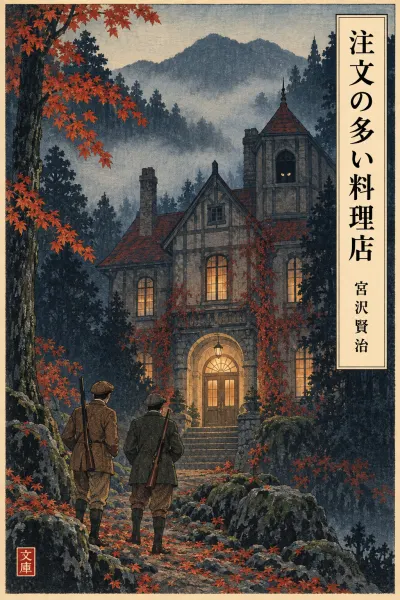
Two young gentlemen from the city go hunting deep in the mountains, dressed like British soldiers. Their guide wanders off and their two expensive dogs collapse and die, but the men mostly complain about the money they have lost. Cold, hungry and lost, they suddenly find a fine Western-style restaurant called Wildcat House, whose door invites everyone to come in, and they eagerly step inside.
AI translation · independently checked
二人の若い紳士が、すっかりイギリスの兵隊のかたちをして、ぴかぴかする鉄砲をかついで、白熊のような犬を二疋つれて、だいぶ山奥の、木の葉のかさかさしたとこを、こんなことを云いながら、あるいておりました。Two young gentlemen, dressed from head to toe like British soldiers, with gleaming guns on their shoulders and two dogs like polar bears at their heels, were walking along a spot deep in the mountains where the leaves rustled dry and crisp, and as they went they said things like this:
「ぜんたい、ここらの山は怪しからんね。鳥も獣も一疋も居やがらん。なんでも構わないから、早くタンタアーンと、やって見たいもんだなあ。」"Honestly, these mountains around here are a disgrace. Not a single bird or beast to be found. I don't care what it is, I just want to let off a good bang-bang at something, and soon!"
「鹿の黄いろな横っ腹なんぞに、二三発お見舞もうしたら、ずいぶん痛快だろうねえ。くるくるまわって、それからどたっと倒れるだろうねえ。」"Wouldn't it be a thrill to pay a deer a visit with two or three shots, right in its yellowish flank? It would spin round and round, and then drop with a thud."
それはだいぶの山奥でした。It was very deep in the mountains indeed.
案内してきた専門の鉄砲打ちも、ちょっとまごついて、どこかへ行ってしまったくらいの山奥でした。It was so deep in the mountains that even the professional hunter who had come along as their guide had lost his bearings a little and wandered off somewhere.
それに、あんまり山が物凄いので、その白熊のような犬が、二疋いっしょにめまいを起こして、しばらく吠って、それから泡を吐いて死んでしまいました。What's more, the mountains were so fearsome that both of the polar-bear-like dogs grew dizzy at the same time, growled for a while, and then foamed at the mouth and died.
「じつにぼくは、二千四百円の損害だ」と一人の紳士が、その犬の眼ぶたを、ちょっとかえしてみて言いました。"This is a real loss for me — two thousand four hundred yen," said one of the gentlemen, turning back one of the dog's eyelids for a look.
「ぼくは二千八百円の損害だ。」と、もひとりが、くやしそうに、あたまをまげて言いました。"And for me it's two thousand eight hundred yen," said the other, tilting his head in vexation.
はじめの紳士は、すこし顔いろを悪くして、じっと、もひとりの紳士の、顔つきを見ながら云いました。The first gentleman turned a little pale and spoke while staring hard at the other gentleman's face.
「ぼくはもう戻ろうとおもう。」"I think I'll head back now."
「さあ、ぼくもちょうど寒くはなったし腹は空いてきたし戻ろうとおもう。」"Well, I'm just getting cold and hungry myself, so I think I'll head back too."
「そいじゃ、これで切りあげよう。なあに戻りに、昨日の宿屋で、山鳥を拾円も買って帰ればいい。」"Then let's call it a day. Oh, never mind — on the way back we can just buy ten yen's worth of pheasants at yesterday's inn and take them home."
「兎もでていたねえ。そうすれば結局おんなじこった。では帰ろうじゃないか」"They had rabbits out too, didn't they? Then it'll come to the same thing in the end. Well, let's go home, shall we?"
ところがどうも困ったことは、どっちへ行けば戻れるのか、いっこうに見当がつかなくなっていました。But the trouble was that they no longer had the faintest idea which way to go to get back.
風がどうと吹いてきて、草はざわざわ、木の葉はかさかさ、木はごとんごとんと鳴りました。The wind came blowing with a whoosh, and the grass went rustle-rustle, the leaves went crackle-crackle, and the trees creaked and groaned.
「どうも腹が空いた。さっきから横っ腹が痛くてたまらないんだ。」"I'm really hungry. My side's been aching something awful for a while now."
「ぼくもそうだ。もうあんまりあるきたくないな。」"Same here. I don't feel like walking much further."
「あるきたくないよ。ああ困ったなあ、何かたべたいなあ。」"I don't want to walk. Oh, this is awful — I want something to eat."
「喰べたいもんだなあ」"I'd love a bite to eat."
二人の紳士は、ざわざわ鳴るすすきの中で、こんなことを云いました。The two gentlemen said such things in the midst of the rustling pampas grass.
その時ふとうしろを見ますと、立派な一軒の西洋造りの家がありました。Just then, happening to glance behind them, they saw a fine Western-style house standing there.
そして玄関にはAnd at the entrance hung
RESTAURANTRESTAURANT
西洋料理店Western Cuisine
WILDCAT HOUSEWILDCAT HOUSE
山猫軒Yamaneko-ken
という札がでていました。That was what the sign hanging there said.
「君、ちょうどいい。ここはこれでなかなか開けてるんだ。入ろうじゃないか」"Say, this is just the thing. This place is rather civilised after all. Let's go in, shall we?"
「おや、こんなとこにおかしいね。しかしとにかく何か食事ができるんだろう」"Well now, it's odd to find one in a place like this. But anyway, I suppose we can get a meal of some kind."
「もちろんできるさ。看板にそう書いてあるじゃないか」"Of course we can. Doesn't the sign say so?"
「はいろうじゃないか。ぼくはもう何か喰べたくて倒れそうなんだ。」"Let's go in, then. I'm so desperate for something to eat I could drop."
二人は玄関に立ちました。The two of them stood at the entrance.
玄関は白い瀬戸の煉瓦で組んで、実に立派なもんです。The entrance was built of white porcelain bricks and was truly splendid.
そして硝子の開き戸がたって、そこに金文字でこう書いてありました。There stood a glass door that swung open, and on it these words were written in gold letters:
「どなたもどうかお入りください。決してご遠慮はありません」"All are welcome — please do come in. There is no need whatsoever for hesitation."
二人はそこで、ひどくよろこんで言いました。At this the two were overjoyed and said:
「こいつはどうだ、やっぱり世の中はうまくできてるねえ、きょう一日なんぎしたけれど、こんどはこんないいこともある。このうちは料理店だけれどもただでご馳走するんだぜ。」"Well, how about that! The world is well arranged after all. We've had a hard time of it all day, but now something good like this turns up. This place may be a restaurant, but it serves food for free, you know."
「どうもそうらしい。決してご遠慮はありませんというのはその意味だ。」"So it seems. That's what 'no need whatsoever for hesitation' means."
二人は戸を押して、なかへ入りました。The two pushed the door and went inside.
そこはすぐ廊下になっていました。It opened straight onto a corridor.
その硝子戸の裏側には、金文字でこうなっていました。On the back of the glass door, in gold letters, were these words:
Vocabulary
| Word | Meaning | JLPT |
|---|---|---|
| 紳士しんし | gentlemanHere it is used with some irony for the two self-important city hunters. | N1 |
| 山奥やまおく | deep in the mountains山 (mountain) + 奥 (inner part). | — |
| 疋ひき | counter for animalsOld spelling of 匹; it becomes ぴき/びき after some numbers (いっぴき, さんびき). | N1 |
| 怪しからんけしからん | outrageous; disgracefulA fixed expression of indignation. The kanji spelling is unusual; it is normally written in kana. | — |
| 痛快つうかい | thrilling; delightfulDescribes the satisfying, exhilarating feeling of something going well. | — |
| まごついてまごつく | to be flustered; to be at a loss; to not know what to dodictionary form: まごつく | N1 |
| 物凄いものすごい | eerie; terrifyingOlder meaning is 'frightening'. In modern speech it usually means 'tremendous'. | N2 |
| 損害そんがい | loss; damage (financial)The men think of their dead dogs only in terms of money. | N3 |
| 切りあげようきりあげる | to wrap up; to call it a daydictionary form: 切り上げる | — |
| 見当がつかなくけんとうがつく | to have an idea; to be able to guessdictionary form: 見当がつくMost often used in the negative: 見当がつかない 'to have no idea'. | — |
| 札ふだ | sign; placardRead さつ when it means a banknote (お札 おさつ). | N3 |
| 遠慮えんりょ | hesitation; holding back out of politenessThe sign's ご遠慮はありません is ambiguous. The men take it as 'feel free'. | N4 |
| なんぎなんぎ | hardship; troubledictionary form: 難儀Somewhat old-fashioned. なんぎする means 'to have a hard time'. | — |
| ご馳走ごちそう | treat (someone to food); feastご馳走する means 'to treat someone to a meal'. | N4 |
Grammar
〜やがる N2 rude or contemptuous verb ending
〜やがる is a rude or contemptuous verb ending added to the masu-stem (居[い] → 居やがる). It shows the speaker's annoyance or scorn. 居やがらん is the old-fashioned negative (ん = ない), roughly 'there's not a damn one around'. It is not a standard JLPT item and appears mainly in rough colloquial or old-fashioned speech.
鳥も獣も一疋も居やがらん。
Not a single bird or beast to be found.
〜てみたいもんだ N3 I'd really like to try ~
〜てみたい means 'want to try doing'. The added もんだ (casual ものだ) with なあ turns it into a heartfelt wish.
早くタンタアーンと、やって見たいもんだなあ。
I just want to let off a good bang-bang, and soon!
〜ようじゃないか N3 let's ~, shall we?
The volitional form plus じゃないか makes a strong, persuasive invitation. It is typical of the slightly old-fashioned male speech of the two gentlemen.
では帰ろうじゃないか
Well, let's go home, shall we?
〜てたまらない N3 unbearably ~; can't stand how ~
The te-form of an adjective or verb plus たまらない expresses a feeling or sensation so strong it is hard to bear.
さっきから横っ腹が痛くてたまらないんだ。
My side's been aching something awful for a while now.
〜てある N4 has been done (resulting state)
A transitive verb in the te-form plus ある describes a state left by someone's action. Here the words are written on the sign.
看板にそう書いてあるじゃないか
Doesn't the sign say so?
〜そうだ (appearance / about to) N4 looks like ~; about to ~
The verb stem plus そう means something seems about to happen. 倒れそう means 'about to collapse'.
ぼくはもう何か喰べたくて倒れそうなんだ。
I'm so desperate for something to eat I could drop.