Part 2 of 5 · JLPT N2
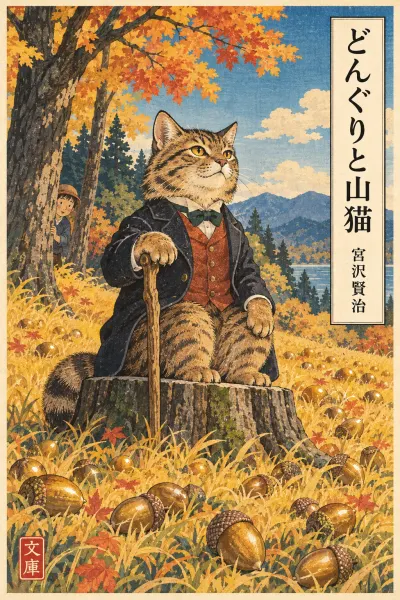
どんぐりと山猫 Donguri to Yamaneko, part 2: The Strange Man in the Golden Meadow
In this part
Ichirō follows a new little path up a steep slope through a dark kaya forest and comes out into a shining golden meadow. There he meets an odd, one-eyed man with goat-like legs who turns out to have written the postcard and is anxious about how poorly he wrote it. Ichirō kindly praises the man's writing, and the man becomes serious and says he is the Wildcat's coachman.
AI translation · independently checked
「みなみへ行ったなんて、二とこでそんなことを言うのはおかしいなあ。けれどもまあもすこし行ってみよう。りす、ありがとう。」りすはもう居ませんでした。"The south, it said. It's strange that two different places told me the same thing. Still, I'll go on a little farther and see. Thank you, squirrel." But the squirrel was already gone.
ただくるみのいちばん上の枝がゆれ、となりのぶなの葉がちらっとひかっただけでした。All that happened was that the topmost branch of the walnut tree swayed, and the leaves of the beech beside it gave a quick flash of light.
一郎がすこし行きましたら、谷川にそったみちは、もう細くなって消えてしまいました。When Ichirō had gone a little farther, the path along the mountain stream grew narrow and then vanished altogether.
そして谷川の南の、まっ黒な榧の木の森の方へ、あたらしいちいさなみちがついていました。And a new little path led off toward a pitch-black forest of kaya trees to the south of the stream.
一郎はそのみちをのぼって行きました。Ichirō climbed up that path.
榧の枝はまっくろに重なりあって、青ぞらは一きれも見えず、みちは大へん急な坂になりました。The kaya branches overlapped thick and black, so that not a single scrap of blue sky could be seen, and the path became a very steep slope.
一郎が顔をまっかにして、汗をぽとぽとおとしながら、その坂をのぼりますと、にわかにぱっと明るくなって、眼がちくっとしました。Ichirō climbed the slope with his face bright red and sweat dropping off him drip, drip, drip, when all at once everything turned dazzlingly bright, and his eyes stung.
そこはうつくしい黄金いろの草地で、草は風にざわざわ鳴り、まわりは立派なオリーブいろのかやの木のもりでかこまれてありました。It was a beautiful golden meadow, the grass rustled and swished in the wind, and all around it stood a forest of splendid olive-coloured kaya trees.
その草地のまん中に、せいの低いおかしな形の男が、膝を曲げて手に革鞭をもって、だまってこっちをみていたのです。In the middle of that meadow a short, oddly shaped man, knees bent and a leather whip in his hand, was silently watching him.
一郎はだんだんそばへ行って、びっくりして立ちどまってしまいました。Ichirō went slowly closer, then stopped dead in surprise.
その男は、片眼で、見えない方の眼は、白くびくびくうごき、上着のような半纒のようなへんなものを着て、だいいち足が、ひどくまがって山羊のよう、ことにそのあしさきときたら、ごはんをもるへらのかたちだったのです。The man had only one eye, and the blind one twitched and twitched, all white; he was wearing a strange garment somewhere between a jacket and a workman's coat, and, above all, his legs were badly bent like a goat's, and as for his feet, why, they were shaped just like rice paddles.
一郎は気味が悪かったのですが、なるべく落ちついてたずねました。Ichirō felt uneasy, but he asked as calmly as he could:
「あなたは山猫をしりませんか。」"Do you know the Wildcat?"
するとその男は、横眼で一郎の顔を見て、口をまげてにやっとわらって言いました。At that the man looked at Ichirō's face out of the corner of his eye, twisted his mouth into a grin, and said:
「山ねこさまはいますぐに、ここに戻ってお出やるよ。おまえは一郎さんだな。」"His Lordship the Wildcat'll be back here directly. You'd be Master Ichirō, now."
一郎はぎょっとして、一あしうしろにさがって、Ichirō gave a start and stepped back a pace.
「え、ぼく一郎です。けれども、どうしてそれを知ってますか。」と言いました。"Yes, I'm Ichirō. But how do you know that?" he said.
するとその奇体な男はいよいよにやにやしてしまいました。At that the peculiar man grinned wider than ever.
「そんだら、はがき見だべ。」"Then ye've seen the postcard, ain't ye."
「見ました。それで来たんです。」"I have. That's why I came."
「あのぶんしょうは、ずいぶん下手だべ。」と男は下をむいてかなしそうに言いました。"That writin' were mighty poor, weren't it," said the man, looking down sadly.
一郎はきのどくになって、Ichirō felt sorry for him.
「さあ、なかなか、ぶんしょうがうまいようでしたよ。」"Oh no, it seemed very well written to me."
と言いますと、男はよろこんで、息をはあはあして、耳のあたりまでまっ赤になり、きもののえりをひろげて、風をからだに入れながら、When he said this, the man was delighted; he puffed and panted, went bright red right up to his ears, and, opening the collar of his kimono to let the breeze in on his body,
「あの字もなかなかうまいか。」とききました。asked, "And the handwritin', were that pretty good too?"
一郎は、おもわず笑いだしながら、へんじしました。Ichirō answered, starting to laugh in spite of himself.
「うまいですね。五年生だってあのくらいには書けないでしょう。」"It was very good. I don't think even a fifth-grader could write that well."
すると男は、急にまたいやな顔をしました。At that the man suddenly made a sour face again.
「五年生っていうのは、尋常五年生だべ。」その声が、あんまり力なくあわれに聞えましたので、一郎はあわてて言いました。"Fifth grade, that'd be fifth year of elementary school, I reckon." His voice sounded so feeble and pitiful that Ichirō hurriedly said:
「いいえ、大学校の五年生ですよ。」"No, no, I mean the fifth year of university."
すると、男はまたよろこんで、まるで、顔じゅう口のようにして、にたにたにたにた笑って叫びました。At that the man was delighted again, and grinning, grinning, grinning until his whole face seemed to be one big mouth, he shouted:
「あのはがきはわしが書いたのだよ。」"It were me as wrote that postcard!"
一郎はおかしいのをこらえて、Ichirō held back his laughter
「ぜんたいあなたはなにですか。」とたずねますと、男は急にまじめになって、and asked, "Who on earth are you, anyway?" At once the man turned serious
「わしは山ねこさまの馬車別当だよ。」と言いました。and said, "I'm His Lordship the Wildcat's coachman."
そのとき、風がどうと吹いてきて、草はいちめん波だち、別当は、急にていねいなおじぎをしました。Just then the wind came blowing with a great whoosh, the grass rippled into waves all over the meadow, and the coachman suddenly made a deep, polite bow.
Vocabulary
| Word | Meaning | JLPT |
|---|---|---|
| 谷川たにがわ | mountain stream, a stream running through a valley谷 (valley) + 川 (river); かわ becomes がわ by rendaku. | — |
| 榧かや | kaya, Japanese torreya (sometimes called Japanese nutmeg-yew); a dark evergreen coniferNo common English name; a yew-like tree with dense, dark needles, often called Japanese nutmeg-yew. | — |
| 急なきゅう | steep (of a slope)dictionary form: 急急 also means 'sudden' (急に, later in this passage) and 'urgent'. | N4 |
| にわかににわかに | suddenly, all at onceSlightly literary synonym of 急に; also seen in にわか雨 (sudden shower). | — |
| 草地くさち | grassy field, meadow | — |
| 革鞭かわむち | leather whip革 is tanned leather (not 皮, raw skin); a fitting tool for a coachman. | — |
| 気味が悪かったきみがわるい | to feel uneasy; creepy, eeriedictionary form: 気味が悪いDescribes something that gives you an unpleasant, uncanny feeling. | — |
| ぎょっとぎょっと | (to be) startled, taken abackMimetic word, used with する for a sudden shock. | — |
| 奇体きたい | strange, peculiarOld-fashioned; today 奇妙 (きみょう) would be more usual. | — |
| きのどくきのどく | sorry for someone, pitifuldictionary form: 気の毒気の毒になる = to come to feel sorry for someone. | N3 |
| 尋常じんじょう | (pre-war) ordinary elementary schoolShort for 尋常小学校, the compulsory elementary school of the old system; otherwise 尋常 means 'ordinary, normal'. | — |
| こらえてこらえる | to hold back, suppress (laughter, tears, pain)dictionary form: こらえる | N2 |
| 別当べっとう | groom, stableman (one who tends horses); in 馬車別当, the Wildcat's coachman/groomOld word for a man who looks after horses; 馬車別当 = the one who drives the carriage. | — |
| おじぎおじぎ | bowdictionary form: お辞儀おじぎをする = to bow. | N2 |
Grammar
〜なんて N3 such a thing as; saying that…
なんて quotes or points to something with a sense of surprise or doubt. Here it picks up what Ichirō has just been told ('went south') and marks it as odd.
みなみへ行ったなんて、二とこでそんなことを言うのはおかしいなあ。
The south, it said. It's strange that two different places told me the same thing.
〜てしまう N4 to end up; to do completely
Adds a sense of completion, often with surprise or regret. The path doesn't just get narrow: it vanishes completely.
谷川にそったみちは、もう細くなって消えてしまいました。
The path along the mountain stream grew narrow and then vanished altogether.
〜と (discovery) N4 when… (then something happened)
Verb + と followed by a past-tense clause describes what happened or what someone found as a result of an action. The polite form (のぼりますと) is typical of storytelling narration.
その坂をのぼりますと、にわかにぱっと明るくなって
when he climbed the slope, all at once everything turned dazzlingly bright
〜ときたら N1 as for…, speaking of… (with emphasis)
Brings up a topic to comment on it strongly, usually something remarkable or bad. Here it singles out the man's feet as the oddest thing of all.
ことにそのあしさきときたら、ごはんをもるへらのかたちだったのです。
and as for his feet, why, they were shaped just like rice paddles.
〜だべ (dialect) N2 …, right? / must be…
Northern (Tōhoku) dialect for standard だろう/でしょう, used to guess or ask for agreement. The coachman uses it throughout, which marks him as a rustic.
そんだら、はがき見だべ。
Then ye've seen the postcard, ain't ye.
〜だって N3 even…
Casual equivalent of でも after a noun: 'even X'. Ichirō means that even an older schoolchild couldn't write that well.
五年生だってあのくらいには書けないでしょう。
I don't think even a fifth-grader could write that well.