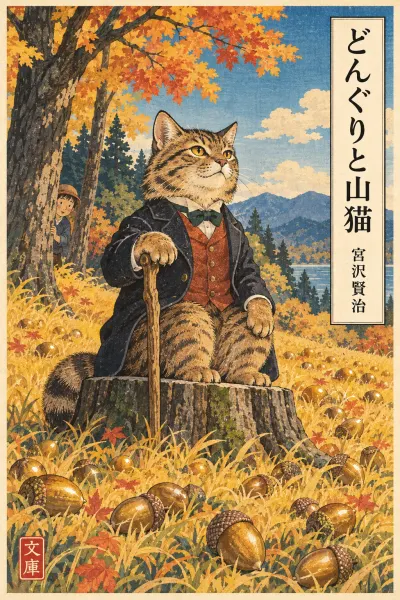
Part 4 of 5 · JLPT N2
どんぐりと山猫 Donguri to Yamaneko, part 4: Ichirō Settles the Acorn Quarrel
In this part
The acorns keep arguing over whether the pointed, round, big, tall, or best-pushing acorn is the greatest, and the wildcat's shouts and the coachman's whip only quiet them for a moment. When the wildcat asks for help, Ichirō suggests declaring that the silliest, most hopeless acorn is the greatest, and the verdict silences them at once. The delighted wildcat asks Ichirō to become an honorary judge and insists on rewarding him.
AI translation · independently checked
「大きなことだよ。大きなのがいちばんえらいんだよ。わたしがいちばん大きいからわたしがえらいんだよ。」"It's size! The big one is the greatest. I'm the biggest, so I'm the greatest!"
「そうでないよ。わたしのほうがよほど大きいと、きのうも判事さんがおっしゃったじゃないか。」"That's not so! I'm far bigger than you. Why, the judge said so himself only yesterday!"
「だめだい、そんなこと。せいの高いのだよ。せいの高いことなんだよ。」"No good, that's nonsense. It's height! Being tall is what counts!"
「押しっこのえらいひとだよ。押しっこをしてきめるんだよ。」もうみんな、がやがやがやがや言って、なにがなんだか、まるで蜂の巣をつっついたようで、わけがわからなくなりました。"It's whoever's best at pushing! We'll settle it with a pushing match!" By now they were all jabbering away, babble-babble-babble-babble. It was just like poking a hornets' nest, and nobody could make head or tail of anything.
そこでやまねこが叫びました。Then the wildcat shouted.
「やかましい。ここをなんとこころえる。しずまれ、しずまれ。」"Silence! Where do you think you are? Be quiet, be quiet!"
別当がむちをひゅうぱちっとならしましたのでどんぐりどもは、やっとしずまりました。The coachman cracked his whip, whoosh-crack!, and at last the acorns quieted down.
やまねこは、ぴんとひげをひねって言いました。The wildcat gave his whiskers a smart twirl and said:
「裁判ももうきょうで三日目だぞ。いい加減に仲なおりしたらどうだ。」"This trial is already in its third day. Isn't it high time you made peace?"
すると、もうどんぐりどもが、くちぐちに云いました。At that, the acorns all spoke up at once:
「いえいえ、だめです。なんといったって、頭のとがっているのがいちばんえらいのです。」"No, no, impossible! Whatever anyone says, the one with the most pointed head is the greatest."
「いいえ、ちがいます。まるいのがえらいのです。」"No, that's wrong! The round one is the greatest."
「そうでないよ。大きなことだよ。」がやがやがやがや、もうなにがなんだかわからなくなりました。"That's not so! It's size!" Babble-babble-babble-babble, until nobody could tell what was what anymore.
山猫が叫びました。The wildcat shouted.
「だまれ、やかましい。ここをなんと心得る。しずまれしずまれ。」"Hold your tongues! Silence! Where do you think you are? Be quiet, be quiet!"
別当が、むちをひゅうぱちっと鳴らしました。The coachman cracked his whip, whoosh-crack!
山猫がひげをぴんとひねって言いました。The wildcat twirled his whiskers smartly and said:
「裁判ももうきょうで三日目だぞ。いい加減になかなおりをしたらどうだ。」"This trial is already in its third day. Isn't it high time you made peace?"
「いえ、いえ、だめです。あたまのとがったものが……。」がやがやがやがや。"No, no, impossible! The one with the pointed head…" Babble-babble-babble-babble.
山ねこが叫びました。The wildcat shouted.
「やかましい。ここをなんとこころえる。しずまれ、しずまれ。」"Silence! Where do you think you are? Be quiet, be quiet!"
別当が、むちをひゅうぱちっと鳴らし、どんぐりはみんなしずまりました。The coachman cracked his whip, whoosh-crack!, and all the acorns fell quiet.
山猫が一郎にそっと申しました。The wildcat spoke softly to Ichirō.
「このとおりです。どうしたらいいでしょう。」"You see how it is. What am I to do?"
一郎はわらってこたえました。Ichirō laughed and answered.
「そんなら、こう言いわたしたらいいでしょう。このなかでいちばんばかで、めちゃくちゃで、まるでなっていないようなのが、いちばんえらいとね。ぼくお説教できいたんです。」"Well then, why not pronounce it like this: whichever of them is the silliest, the most muddled, the most completely hopeless, is the greatest. I heard that in a sermon."
山猫はなるほどというふうにうなずいて、それからいかにも気取って、繻子のきものの胸を開いて、黄いろの陣羽織をちょっと出してどんぐりどもに申しわたしました。The wildcat nodded as if to say, "I see," and then, with a great air of importance, he opened the front of his satin robe, let a little of his yellow battle surcoat peep out, and pronounced his verdict to the acorns.
「よろしい。しずかにしろ。申しわたしだ。このなかで、いちばんえらくなくて、ばかで、めちゃくちゃで、てんでなっていなくて、あたまのつぶれたようなやつが、いちばんえらいのだ。」"Very well. Quiet! Here is the verdict. Whichever of you is the least great, the silliest, the most muddled, the most utterly hopeless, the one whose head looks squashed flat, that one is the greatest!"
どんぐりは、しいんとしてしまいました。The acorns fell completely silent.
それはそれはしいんとして、堅まってしまいました。Oh, they were so very, very silent, frozen stiff where they stood.
そこで山猫は、黒い繻子の服をぬいで、額の汗をぬぐいながら、一郎の手をとりました。Then the wildcat took off his black satin coat, wiped the sweat from his forehead, and took Ichirō by the hand.
別当も大よろこびで、五六ぺん、鞭をひゅうぱちっ、ひゅうぱちっ、ひゅうひゅうぱちっと鳴らしました。The coachman was overjoyed too, and he cracked his whip five or six times: whoosh-crack! whoosh-crack! whoosh-whoosh-crack!
やまねこが言いました。The wildcat said:
「どうもありがとうございました。これほどのひどい裁判を、まるで一分半でかたづけてくださいました。どうかこれからわたしの裁判所の、名誉判事になってください。これからも、葉書が行ったら、どうか来てくださいませんか。そのたびにお礼はいたします。」"I thank you most sincerely. You have settled this dreadful trial in a mere minute and a half. I beg you to become an honorary judge of my court from now on. Whenever a postcard reaches you in future, would you be so good as to come? I shall reward you each time."
「承知しました。お礼なんかいりませんよ。」"All right, I will. But you don't need to give me anything."
「いいえ、お礼はどうかとってください。わたしのじんかくにかかわりますから。そしてこれからは、葉書にかねた一郎どのと書いて、こちらを裁判所としますが、ようございますか。」"No, please do accept a reward. My dignity depends on it. And henceforth I shall address the postcards to 'Kaneta Ichirō, Esquire,' and refer to this place as 'the Court.' Is that agreeable to you?"
Vocabulary
| Word | Meaning | JLPT |
|---|---|---|
| 判事はんじ | judge (in a court of law)Here it means the wildcat. Compare 裁判 (trial) and 裁判所 (court). | N2 |
| こころえるこころえる | to understand; to regard (something) asdictionary form: 心得るここをなんと心得る is a stock stern rebuke: 'What do you take this place for?' | N2 |
| 別当べっとう | groom; coachman (a man who tends horses)An old-fashioned word. In this story it refers to the wildcat's odd servant. | — |
| いい加減にいいかげん | (it's) high time; enough alreadydictionary form: いい加減いい加減に+verb shows impatience. As an adjective, いい加減 can also mean 'careless'. | N1 |
| 仲なおりなかなおり | making up; reconciliationdictionary form: 仲直りOften used as 仲直りする. | N2 |
| くちぐちにくちぐちに | all at once; each speaking at the same timedictionary form: 口々に | — |
| とがってとがる | to be pointed or sharpdictionary form: 尖るThe ている form describes a state: 'pointed'. | N2 |
| 言いわたしたらいいわたす | to pronounce (a verdict); to announce formallydictionary form: 言い渡すThe noun 申しわたし in the wildcat's speech is the humble, formal version. | — |
| 説教せっきょう | sermon; lectureIchirō's idea echoes the Buddhist and Christian teaching that the lowest shall be the highest. | — |
| 気取ってきどる | to put on airs; to act self-importantlydictionary form: 気取る | — |
| 陣羽織じんばおり | sleeveless battle surcoatWorn over armour by samurai commanders. The wildcat shows it off to look important. | — |
| 繻子しゅす | satin | — |
| 名誉めいよ | honour; honorary名誉判事 means 'honorary judge'. | N1 |
| かかわりますかかわる | to affect; to be at stakedictionary form: 関わる〜にかかわる means 'to affect (something important)'. じんかく (人格) means one's character or dignity. | N2 |
Grammar
〜たらどうだ N4 why don't you…?; how about…?
This pattern is the conditional たら plus どうだ ('how is it?'), and it makes a suggestion. The plain だ form sounds bossy and impatient, which fits the wildcat. The polite version is 〜たらどうですか.
いい加減に仲なおりしたらどうだ。
Isn't it high time you made peace?
まるで〜ようで N4 just like…; as if…
まるで strengthens a comparison made with よう. The て-form ようで links the comparison to the result that follows.
まるで蜂の巣をつっついたようで、わけがわからなくなりました。
It was just like poking a hornets' nest, and nobody could make head or tail of anything.
なんといったって N2 whatever anyone says; after all
This is a casual form of 何と言っても. It insists that the speaker's point is the most important one, whatever others may argue.
なんといったって、頭のとがっているのがいちばんえらいのです。
Whatever anyone says, the one with the most pointed head is the greatest.
〜てしまう N4 to end up completely (in a state)
Here 〜てしまう stresses that the change is total and sudden. The acorns become completely silent and frozen stiff.
それはそれはしいんとして、堅まってしまいました。
Oh, they were so very, very silent, frozen stiff where they stood.
〜ながら N4 while doing…
The verb stem plus ながら shows two actions done by the same person at the same time. Here the wildcat wipes his forehead while doing the next thing.
額の汗をぬぐいながら、一郎の手をとりました。
Wiping the sweat from his forehead, he took Ichirō by the hand.
〜てくださいませんか N4 would you kindly…?
This is a very polite request, literally 'won't you give me the favour of…?'. The negative question makes it softer than 〜てください.
葉書が行ったら、どうか来てくださいませんか。
Whenever a postcard reaches you, would you be so good as to come?