Part 3 of 5 · JLPT N2
どんぐりと山猫 Donguri to Yamaneko, part 3: The Wildcat Opens the Acorn Trial
In this part
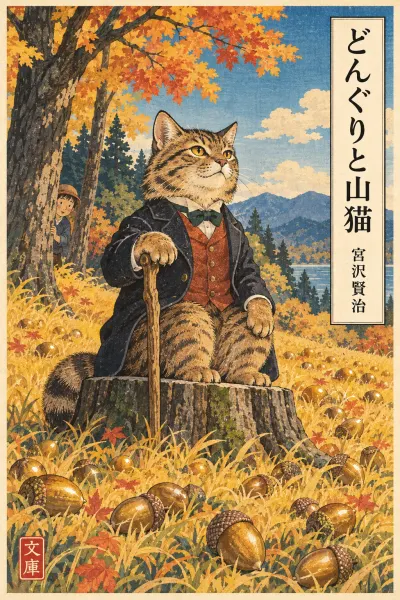
Ichirō turns and finds the wildcat, dressed in something like a yellow battle coat, who greets him politely and explains that he needs Ichirō's opinion on a troublesome dispute. Hundreds of shining golden acorns in red trousers pour out of the grass. The wildcat, now in a black satin robe, sits before them and urges them to make up, but they shout that the pointiest, or the roundest, is the greatest.
AI translation · independently checked
一郎はおかしいとおもって、ふりかえって見ますと、そこに山猫が、黄いろな陣羽織のようなものを着て、緑いろの眼をまん円にして立っていました。Ichirō thought this was strange, and when he turned around to look, there stood the wildcat, wearing something like a yellow battle coat, its green eyes open perfectly round.
やっぱり山猫の耳は、立って尖っているなと、一郎がおもいましたら、山ねこはぴょこっとおじぎをしました。Just as Ichirō was thinking, "So a wildcat's ears really do stand up in sharp points," the wildcat gave a quick little bob of a bow.
一郎もていねいに挨拶しました。Ichirō politely greeted him back.
「いや、こんにちは、きのうははがきをありがとう。」"Oh, hello. Thank you for the postcard yesterday."
山猫はひげをぴんとひっぱって、腹をつき出して言いました。The wildcat gave his whiskers a sharp tug, stuck out his belly and said:
「こんにちは、よくいらっしゃいました。じつはおとといから、めんどうなあらそいがおこって、ちょっと裁判にこまりましたので、あなたのお考えを、うかがいたいとおもいましたのです。"Good day to you, and welcome indeed. The fact is, since the day before yesterday a most tiresome dispute has arisen, and I have found myself somewhat at a loss in judging it, and so I wished to inquire as to your esteemed opinion.
まあ、ゆっくり、おやすみください。じき、どんぐりどもがまいりましょう。どうもまい年、この裁判でくるしみます。Now, please, do rest at your leisure. The acorns will no doubt be arriving presently. Really, every year this trial is a great torment to me.
」山ねこは、ふところから、巻煙草の箱を出して、じぶんが一本くわえ、" The wildcat took a box of cigarettes out of the front of his coat, put one in his own mouth,
「いかがですか。」と一郎に出しました。and held out the box to Ichirō, saying, "Would you care for one?"
一郎はびっくりして、Ichirō was startled,
「いいえ。」と言いましたら、山ねこはおおようにわらって、and when he said, "No, thank you," the wildcat laughed in a lordly, generous way,
「ふふん、まだお若いから、」と言いながら、マッチをしゅっと擦って、わざと顔をしかめて、青いけむりをふうと吐きました。and saying, "Hmph, well, you're still young," he struck a match with a *fsst*, made a show of screwing up his face, and blew out a puff of blue smoke, *whoosh*.
山ねこの馬車別当は、気を付けの姿勢で、しゃんと立っていましたが、いかにも、たばこのほしいのをむりにこらえているらしく、なみだをぼろぼろこぼしました。The wildcat's coachman stood stiffly at attention, but he was plainly holding back how badly he wanted a smoke, for big tears came rolling down his face.
そのとき、一郎は、足もとでパチパチ塩のはぜるような、音をききました。Just then, Ichirō heard a sound at his feet, *pop, pop, crackle*, like salt popping.
びっくりして屈んで見ますと、草のなかに、あっちにもこっちにも、黄金いろの円いものが、ぴかぴかひかっているのでした。Startled, he crouched down to look, and there in the grass, here, there and everywhere, were round golden things, shining and sparkling.
よくみると、みんなそれは赤いずぼんをはいたどんぐりで、もうその数ときたら、三百でも利かないようでした。When he looked closely, every one of them was an acorn wearing red trousers, and as for how many there were, it seemed three hundred wouldn't even begin to cover it.
わあわあわあわあ、みんななにか云っているのです。Babble, babble, babble, babble, they were all saying something.
「あ、来たな。蟻のようにやってくる。おい、さあ、早くベルを鳴らせ。今日はそこが日当りがいいから、そこのとこの草を刈れ。」やまねこは巻たばこを投げすてて、大いそぎで馬車別当にいいつけました。"Ah, here they come. They swarm in like ants. You there, quick, ring the bell. The sun is good over there today, so cut the grass in that spot." The wildcat flung away his cigarette and hurriedly gave the coachman his orders.
馬車別当もたいへんあわてて、腰から大きな鎌をとりだして、ざっくざっくと、やまねこの前のとこの草を刈りました。The coachman, in a great fluster too, pulled a big sickle from his belt and cut the grass in front of the wildcat, *swish, swash, swish*.
そこへ四方の草のなかから、どんぐりどもが、ぎらぎらひかって、飛び出して、わあわあわあわあ言いました。At that, the acorns came leaping out of the grass on every side, glittering and gleaming, and babbled, babble, babble, babble.
馬車別当が、こんどは鈴をがらんがらんがらんがらんと振りました。This time the coachman shook a bell, *clang-a-lang, clang-a-lang, clang-a-lang, clang-a-lang*.
音はかやの森に、がらんがらんがらんがらんとひびき、黄金のどんぐりどもは、すこししずかになりました。The sound rang out through the kaya forest, *clang-a-lang, clang-a-lang, clang-a-lang, clang-a-lang*, and the golden acorns grew a little quieter.
見ると山ねこは、もういつか、黒い長い繻子の服を着て、勿体らしく、どんぐりどもの前にすわっていました。When Ichirō looked, the wildcat had at some point put on a long black satin robe and was sitting in front of the acorns with a very self-important air.
まるで奈良のだいぶつさまにさんけいするみんなの絵のようだと一郎はおもいました。Ichirō thought it was just like a picture of crowds of people paying their respects to the Great Buddha of Nara.
別当がこんどは、革鞭を二三べん、ひゅうぱちっ、ひゅう、ぱちっと鳴らしました。This time the coachman cracked his leather whip two or three times, *whish-crack, whish, crack*.
空が青くすみわたり、どんぐりはぴかぴかしてじつにきれいでした。The sky was clear and blue all over, and the acorns sparkled; it was truly beautiful.
「裁判ももう今日で三日目だぞ、いい加減になかなおりをしたらどうだ。」山ねこが、すこし心配そうに、それでもむりに威張って言いますと、どんぐりどもは口々に叫びました。"This is already the third day of the trial, you know. Isn't it about time you made up?" When the wildcat said this, looking a little worried but still forcing himself to sound grand, the acorns all shouted at once:
「いえいえ、だめです、なんといったって頭のとがってるのがいちばんえらいんです。そしてわたしがいちばんとがっています。」"No, no, that won't do! Whatever anyone says, the one with the pointiest head is the greatest. And I'm the pointiest!"
「いいえ、ちがいます。まるいのがえらいのです。いちばんまるいのはわたしです。」"No, that's wrong! Being round is what makes you great. And the roundest one is me!"
Vocabulary
| Word | Meaning | JLPT |
|---|---|---|
| 陣羽織じんばおり | sleeveless battle coat worn over armourA samurai garment; here it makes the wildcat look grand and official. | — |
| 尖ってとがる | to be pointed, sharpdictionary form: 尖るAlso a key word later: the acorns argue about whose head is most pointed (とがってる). | N2 |
| 裁判さいばん | trial, court caseA key story word. | N3 |
| あらそいあらそい | dispute, quarreldictionary form: 争いNoun from the verb 争う (to argue, compete). | N1 |
| ふところふところ | the fold at the front of a kimono (used as a pocket)dictionary form: 懐Things were carried inside the kimono at the chest. | — |
| 巻煙草まきたばこ | cigaretteOld-fashioned word; modern Japanese says タバコ. | — |
| おおようにおうよう | in a magnanimous, easygoing mannerdictionary form: 鷹揚Describes a relaxed, lordly generosity; written おおよう in older spelling. | — |
| 馬車別当べっとう | groom, coachman (who looks after horses)dictionary form: 別当Old word for a stableman or driver. | — |
| こらえてこらえる | to hold back, enduredictionary form: 堪えるUsed for holding in feelings, tears, laughter or desires. | N2 |
| はぜるはぜる | to pop, burst open (with a crackle)dictionary form: 爆ぜるUsed for chestnuts or salt popping in a fire. | — |
| 利かないきく | (in negative) not be enough, not coverdictionary form: 利く〜でも利かない: 'even ~ wouldn't be enough'. | N3 |
| 鎌かま | sickle | — |
| 勿体らしくもったいらしい | self-important, pompous-lookingdictionary form: 勿体らしいRelated to もったいぶる (to put on airs). | — |
| 威張っていばる | to act big, swagger, be bossydictionary form: 威張る | N2 |
Grammar
〜と (discovery) N4 when ~, (found that) ...
Verb + と followed by a past-tense clause describes what someone discovered after doing an action. Here turning around leads to seeing the wildcat standing there.
ふりかえって見ますと、そこに山猫が、黄いろな陣羽織のようなものを着て、緑いろの眼をまん円にして立っていました。
When he turned around to look, there stood the wildcat, wearing something like a yellow battle coat, its green eyes open perfectly round.
いかにも〜らしく N3 clearly seeming to ~, apparently
らしい expresses a judgement based on what one observes; its adverb form らしく links to the next clause. いかにも strengthens it: 'it was plain that…'.
いかにも、たばこのほしいのをむりにこらえているらしく、なみだをぼろぼろこぼしました。
He was plainly holding back how badly he wanted a smoke, for big tears came rolling down his face.
〜ときたら N1 as for ~ (with surprise or exaggeration)
Brings up a topic the speaker finds remarkable, often extreme. Here it stresses how astonishingly many acorns there were.
もうその数ときたら、三百でも利かないようでした。
As for how many there were, it seemed three hundred wouldn't even begin to cover it.
まるで〜のようだ N4 just like ~, as if ~
まるで emphasises a comparison made with ようだ. Ichirō compares the scene to a picture of worshippers before the Great Buddha.
まるで奈良のだいぶつさまにさんけいするみんなの絵のようだ
It was just like a picture of crowds paying their respects to the Great Buddha of Nara.
〜たらどうだ N4 why don't you ~?
A suggestion or mild order; どうだ is the blunt plain form of どうですか, fitting the wildcat's bossy tone toward the acorns.
いい加減になかなおりをしたらどうだ。
Why not have the sense to make up now?
なんといったって N2 whatever anyone says, after all
A casual form of 何と言っても; it insists that the speaker's point is beyond argument.
なんといったって頭のとがってるのがいちばんえらいんです。
Whatever anyone says, the one with the pointiest head is the greatest.