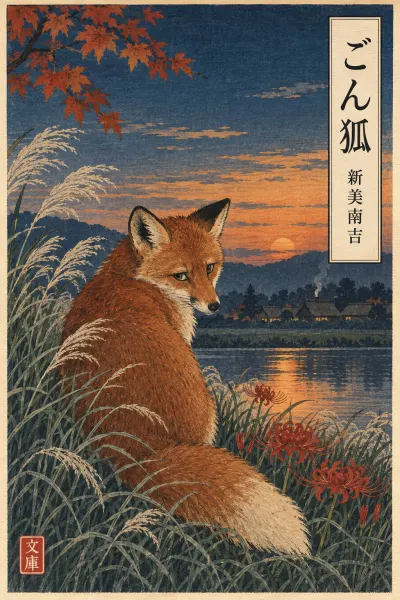
Part 6 of 6 · JLPT N2
ごん狐(六) Gongitsune, part 6: Gon's Last Visit
In this part
The next day Gon brings chestnuts to Hyōjū's house again, but Hyōjū sees a fox slipping inside, thinks Gon has come to make mischief, and shoots him. Only then does he notice the chestnuts on the floor and realise that Gon was the one who had been leaving the gifts. Gon, dying, nods, and Hyōjū drops his gun as smoke still rises from its barrel.
AI translation · independently checked
そのあくる日もごんは、栗をもって、兵十の家へ出かけました。The next day, too, Gon set off for Hyōjū's house with chestnuts.
兵十は物置で縄をなっていました。Hyōjū was in the shed, twisting straw into rope.
それでごんは家の裏口から、こっそり中へはいりました。So Gon slipped quietly into the house through the back door.
そのとき兵十は、ふと顔をあげました。Just then, Hyōjū happened to look up.
と狐が家の中へはいったではありませんか。And what did he see but a fox going into his house!
こないだうなぎをぬすみやがったあのごん狐めが、またいたずらをしに来たな。That rotten Gon fox who stole my eel the other day, he's come back to make more trouble!
「ようし。」"Right, then."
兵十は立ちあがって、納屋にかけてある火縄銃をとって、火薬をつめました。Hyōjū stood up, took down the matchlock gun that hung in the shed, and packed it with gunpowder.
そして足音をしのばせてちかよって、今戸口を出ようとするごんを、ドンと、うちました。Then he crept up without a sound, and just as Gon was about to come out the doorway, he fired. Bang!
ごんは、ばたりとたおれました。Gon fell over with a thud.
兵十はかけよって来ました。Hyōjū came running up.
家の中を見ると、土間に栗が、かためておいてあるのが目につきました。When he looked inside the house, his eye fell on a pile of chestnuts heaped together on the dirt floor.
「おや」と兵十は、びっくりしてごんに目を落しました。"What's this?" Hyōjū said, and looked down at Gon in astonishment.
「ごん、お前だったのか。いつも栗をくれたのは」"Gon, was it you? Was it you who kept bringing me chestnuts?"
ごんは、ぐったりと目をつぶったまま、うなずきました。Gon lay limp with his eyes closed, and nodded.
兵十は火縄銃をばたりと、とり落しました。Hyōjū let the matchlock slip from his hands, and it fell with a clatter.
青い煙が、まだ筒口から細く出ていました。A thin wisp of blue smoke was still rising from the muzzle.
Vocabulary
| Word | Meaning | JLPT |
|---|---|---|
| 物置ものおき | storage shed, storeroomLiterally "place to put things". | N2 |
| 縄をなってなわをなう | 綯う (なう): to twist (straw or fibres) into rope; to twine. Here it is used with 縄 as its object: 縄をなう, 'to make rope by twisting straw'.dictionary form: 縄をなうなう (綯う) means to twist fibres together; a typical farm chore. | — |
| 裏口うらぐち | back door, back entrance裏 = back/reverse + 口 = opening (with rendaku: ぐち). | N2 |
| こっそりこっそり | secretly, stealthily | N2 |
| 火縄銃ひなわじゅう | matchlock gunAn old gun fired by a slow-burning cord (火縄). | — |
| 火薬かやく | gunpowder | — |
| しのばせてしのばせる | to muffle, to hidedictionary form: 忍ばせる足音を忍ばせる = to walk without making a sound. | — |
| 戸口とぐち | doorway | — |
| 土間どま | earthen-floored area of a traditional houseThe unfloored entrance and work area of an old farmhouse. | — |
| 目につきめにつく | to catch one's eye, to be noticeddictionary form: 目につく | — |
| ぐったりぐったり | limp, completely drained of strength | — |
| とり落しましたとりおとす | to drop (something one was holding), to let slipdictionary form: 取り落とすSuggests losing one's grip, here from shock. | — |
| 筒口つつぐち | muzzle (of a gun)筒 = tube/barrel. | — |
Grammar
〜ではありませんか N2 expresses surprise: "why, ... !"
Not a real question. The narrator uses this rhetorical negative to convey Hyōjū's surprise at what he sees.
と狐が家の中へはいったではありませんか。
And what did he see but a fox going into his house!
〜やがる N1 rude verb suffix showing contempt
Attached to the masu-stem, やがる expresses anger or scorn toward the person doing the action. Together with the pejorative suffix め on ごん狐め, it shows how angry Hyōjū is.
こないだうなぎをぬすみやがったあのごん狐めが
That rotten Gon fox who stole my eel the other day
〜ようとする N3 to be about to do; to try to do
Volitional form + とする describes an action on the point of happening. Here Gon is just about to leave through the doorway.
今戸口を出ようとするごんを、ドンと、うちました。
Just as Gon was about to come out the doorway, he fired. Bang!
〜てある N4 something has been done (and remains so)
て-form of a transitive verb + ある describes a state left by someone's action. おいてある shows the chestnuts had been placed there on purpose.
土間に栗が、かためておいてあるのが目につきました。
His eye fell on a pile of chestnuts heaped together on the dirt floor.
〜のは…だった(のか) N3 it was ... who/that ...
A cleft sentence that highlights who did something. Here the order is inverted: the realisation お前だったのか comes first, then the explanation いつも栗をくれたのは.
ごん、お前だったのか。いつも栗をくれたのは
Gon, was it you? Was it you who kept bringing me chestnuts?
〜たまま N4 while still in the state of ...
Past form + まま means a state continues unchanged while something else happens. Gon keeps his eyes closed as he nods.
ごんは、ぐったりと目をつぶったまま、うなずきました。
Gon lay limp with his eyes closed, and nodded.