Upper intermediate · JLPT N2
鼻Hana — The Priest's Nose
- JLPT N2
- 5,735 characters
- 4 parts
- about 48 minutes
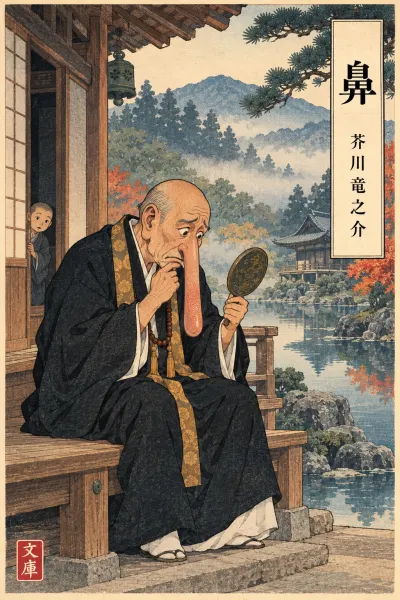
Nose is a short, darkly comic tale about vanity and the gap between how we see ourselves and how others see us. Zenchi Naigu, a respected Buddhist priest at Ike-no-o, has a nose so long it hangs below his chin. He pretends not to care, but secretly frets over it and scans every visitor's face for a nose like his. When a disciple brings back an odd cure from the capital, the Naigu gets the chance to change his face and finds out how other people really feel about it. Akutagawa drew the premise from an old Japanese tale and published the story in 1916; Natsume Sōseki's praise helped launch his career. The narrator is dry and ironic. He watches the Naigu's small self-deceptions closely and sometimes steps in to comment on human psychology. For learners, the story is short and has a clear plot and one memorable image. The challenge is the Taishō-era literary style: long sentences, formal written grammar, Buddhist vocabulary, and dialogue in archaic monk's speech. It is a good first step into modern literary prose.
Contents
Before you read
- Learn the Naigu's title and the story's key words first: 内供 (the priest's court rank, used almost like his name), 弟子 (disciple), 鼻, 茹でる (to boil), 踏む (to tread on), and 自尊心 (pride). They carry most of the plot.
- The text uses the older spelling 云う for 言う, especially in the pattern 〜と云えば (speaking of…) and in 〜と云う. Read it exactly as いう.
- Watch how the narrator explains the Naigu's motives with 〜からばかりではない… それよりむしろ〜からである ('not only because… but rather because…'). This pattern marks the gap between what the Naigu says and what he really feels, and that gap is the heart of the story.
- The dialogue is archaic. The disciple says ござる, 申した, じゃが and 痛うはござらぬ (= 痛くはありません), and the Naigu uses ぬ and なんだ for negatives (ぬ = ない, なんだ = なかった). Once you know these few substitutions, the lines are simple.
- Part 4 contains the narrator's short essay on 'the bystander's egoism' (傍観者の利己主義). Read it slowly, and more than once if needed. It uses 〜ば〜ほど and 〜とさえ思う, and it explains why the ending turns out as it does.
Words to know
The most useful words from the notes across the story.
| Word | Meaning | JLPT |
|---|---|---|
| 不承不承ふしょうぶしょう | reluctantly, grudginglyNote the rendaku in the second half: ぶしょう. | — |
| 依然としていぜんとして | still, as beforeWritten, formal adverb. | — |
| むず痒いむずがゆい | itchy, ticklyA crawling, irritating itch. Also used figuratively for feeling awkward or restless. | — |
| 勧めすすめる | to urge, recommenddictionary form: 勧める | N3 |
| 気の毒きのどく | pitiful, sorry for someone | N3 |
| 分ぶ | bu, an old unit of length (about 3 mm)One tenth of a 寸 (sun). 四分 is roughly 1.2 cm. | N3 |
| 機嫌きげん | mood, temper機嫌が悪い means 'in a bad mood'. | N3 |
| 茹でてゆでる | to boil (food)dictionary form: 茹でるIntransitive partner 茹だる appears in the disciple's line; the cooking word is part of the comedy. | N2 |
| 矛盾むじゅん | contradictionLiterally 'spear and shield', from a Chinese fable about a merchant selling both an unstoppable spear and an unbreakable shield. | N2 |
| すましているすます | to look unconcerned, to put on a composed airdictionary form: 澄ますOften in the form すました顔, a prim or innocent-looking face. | N1 |
| 自尊心じそんしん | pride, self-esteemThe key theme of the story. | N1 |
| 心細くこころぼそい | forlorn, lonely, uneasydictionary form: 心細いLiterally 'heart-thin': the feeling of being alone and unsupported. | N1 |
| 試みたこころみる | to try, attemptdictionary form: 試みるMore formal than やってみる. | N1 |
| 滑稽こっけい | comical, ridiculousA な-adjective. It can suggest something laughable in a slightly pitiful way. | N1 |
| 呟くつぶやく | to murmur, to mutterSpeaking quietly, often to oneself. | N1 |
Plot summary
Show the full summary (contains spoilers)
Zenchi Naigu, a high-ranking priest at Ike-no-o, has a nose five or six inches long that dangles below his chin. A disciple must hold it up with a board while he eats. Its inconvenience matters less to him than the wound to his pride. After scriptures and remedies fail, a disciple learns of a cure from a doctor in the capital: boil the nose, then tread on it. The Naigu feigns indifference until the disciple persuades him. After boiling, trampling and plucking, the nose shrinks to normal size. The Naigu is delighted, but people now laugh at him more openly than before. The narrator attributes this to 'the bystander's egoism': people pity a misfortune but feel let down when someone escapes it. The Naigu grows irritable. Then one cold autumn night the nose swells, and by morning it is long again. He feels relieved, sure that no one will laugh at him now.
About the author
Akutagawa Ryūnosuke (1892–1927) was one of the most important writers of modern Japanese short fiction. Born in Tokyo, he studied English literature at Tokyo Imperial University, and his early story 鼻 (The Nose) won praise from Natsume Sōseki. Many of his works retell older Japanese and Chinese tales with modern psychological insight, including 羅生門 (Rashōmon) and 藪の中 (In a Grove), which later inspired Kurosawa Akira's film Rashomon. He died by suicide at the age of 35. The Akutagawa Prize was named in his honour by his friend Kikuchi Kan.