Part 2 of 4 · JLPT N2
鼻 Hana, part 2: The Search for a Cure Begins
In this part
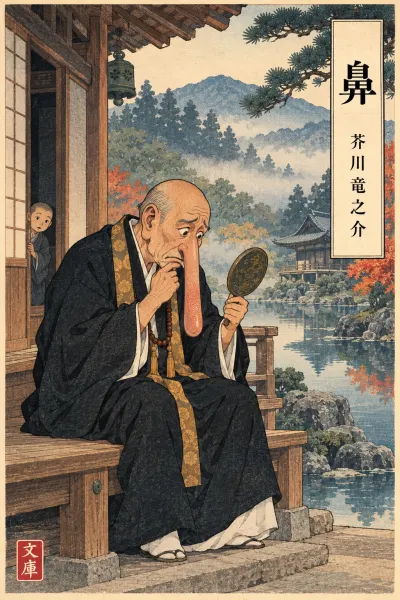
After finding no comfort in the scriptures and failing with folk remedies, the Naigu learns, through a disciple who has been to the capital, of a cure from a doctor there: boil the nose, then have someone tread on it. Pretending not to care, he waits for his disciple to talk him into trying it, and the disciple, who sees through the act, does exactly that. The nose is steeped in scalding water through a hole in a tray and then trodden on, while the Naigu lies on his side, unable even to shake his head.
AI translation · independently checked
最後に、内供は、内典外典の中に、自分と同じような鼻のある人物を見出して、せめても幾分の心やりにしようとさえ思った事がある。Finally, the Naigu had even thought of finding, somewhere in the Buddhist scriptures or the secular books, a person with a nose like his own, so as to gain at least some small measure of consolation.
けれども、目連や、舎利弗の鼻が長かったとは、どの経文にも書いてない。Yet no sutra anywhere says that the noses of Mokuren or Sharihotsu were long.
勿論竜樹や馬鳴も、人並の鼻を備えた菩薩である。And Ryūju and Memyō, of course, were Bodhisattvas furnished with perfectly ordinary noses.
内供は、震旦の話の序に蜀漢の劉玄徳の耳が長かったと云う事を聞いた時に、それが鼻だったら、どのくらい自分は心細くなくなるだろうと思った。When the Naigu heard, in the course of some tale about Shintan, that the ears of Ryū Gentoku of Shokukan had been long, he thought how much less forlorn he would feel if only it had been his nose.
内供がこう云う消極的な苦心をしながらも、一方ではまた、積極的に鼻の短くなる方法を試みた事は、わざわざここに云うまでもない。It hardly needs saying here that, while the Naigu went to these passive pains, he also tried, on the other hand, active methods of making his nose shorter.
内供はこの方面でもほとんど出来るだけの事をした。In this direction too he did very nearly everything that could be done.
烏瓜を煎じて飲んで見た事もある。He once boiled snake gourd and drank the brew.
鼠の尿を鼻へなすって見た事もある。He once rubbed rat's urine on his nose.
しかし何をどうしても、鼻は依然として、五六寸の長さをぶらりと唇の上にぶら下げているではないか。But whatever he did, and however he did it, was the nose not still dangling its five or six inches of length over his lips, just as before?
所がある年の秋、内供の用を兼ねて、京へ上った弟子の僧が、知己の医者から長い鼻を短くする法を教わって来た。Then one autumn, a disciple who had gone up to Kyō, partly on an errand for the Naigu, came back having learned from a doctor of his acquaintance a method for making a long nose short.
その医者と云うのは、もと震旦から渡って来た男で、当時は長楽寺の供僧になっていたのである。This doctor was a man who had originally come over from Shintan, and who at that time was serving as a priest at Chōrakuji.
内供は、いつものように、鼻などは気にかけないと云う風をして、わざとその法もすぐにやって見ようとは云わずにいた。The Naigu, as usual, put on an air of not caring in the least about such things as noses, and deliberately refrained from saying that he would try the method at once.
そうして一方では、気軽な口調で、食事の度毎に、弟子の手数をかけるのが、心苦しいと云うような事を云った。At the same time, in a light and casual tone, he said something to the effect that it pained him to put his disciple to such trouble at every meal.
内心では勿論弟子の僧が、自分を説伏せて、この法を試みさせるのを待っていたのである。Inwardly, of course, he was waiting for the disciple to talk him round and make him try the method.
弟子の僧にも、内供のこの策略がわからない筈はない。The disciple could hardly have failed to see through this stratagem of the Naigu's.
しかしそれに対する反感よりは、内供のそう云う策略をとる心もちの方が、より強くこの弟子の僧の同情を動かしたのであろう。But rather than resentment at it, it was probably the state of mind that drove the Naigu to such a stratagem that stirred the disciple's sympathy the more strongly.
弟子の僧は、内供の予期通り、口を極めて、この法を試みる事を勧め出した。Just as the Naigu had expected, the disciple began urging him in the most pressing terms to try the method.
そうして、内供自身もまた、その予期通り、結局この熱心な勧告に聴従する事になった。And the Naigu himself, just as he had expected, ended by yielding to this earnest advice.
その法と云うのは、ただ、湯で鼻を茹でて、その鼻を人に踏ませると云う、極めて簡単なものであった。The method was an extremely simple one: you merely boiled the nose in hot water and then had someone tread on it.
湯は寺の湯屋で、毎日沸かしている。Hot water was heated every day in the temple bathhouse.
そこで弟子の僧は、指も入れられないような熱い湯を、すぐに提に入れて、湯屋から汲んで来た。So the disciple straight away filled a pitcher with water too hot to put a finger in, and brought it back from the bathhouse.
しかしじかにこの提へ鼻を入れるとなると、湯気に吹かれて顔を火傷する惧がある。But if the Naigu were to put his nose directly into the pitcher, there was a danger that the steam would blow against his face and scald it.
そこで折敷へ穴をあけて、それを提の蓋にして、その穴から鼻を湯の中へ入れる事にした。So they bored a hole in a wooden tray, set it on the pitcher as a lid, and decided to put the nose into the hot water through that hole.
鼻だけはこの熱い湯の中へ浸しても、少しも熱くないのである。The nose alone, though steeped in this hot water, felt no heat at all.
しばらくすると弟子の僧が云った。After a while the disciple spoke.
――もう茹った時分でござろう。"I dare say it is boiled by now."
内供は苦笑した。The Naigu gave a wry smile.
これだけ聞いたのでは、誰も鼻の話とは気がつかないだろうと思ったからである。For he thought that anyone hearing only these words would never guess they were about a nose.
鼻は熱湯に蒸されて、蚤の食ったようにむず痒い。Steamed by the scalding water, the nose itched as if fleas had been biting it.
弟子の僧は、内供が折敷の穴から鼻をぬくと、そのまだ湯気の立っている鼻を、両足に力を入れながら、踏みはじめた。When the Naigu drew his nose out through the hole in the tray, the disciple began treading on it, still steaming, bearing down with the strength of both feet.
内供は横になって、鼻を床板の上へのばしながら、弟子の僧の足が上下に動くのを眼の前に見ているのである。The Naigu lay on his side with his nose stretched out on the floorboards, watching the disciple's feet move up and down before his eyes.
弟子の僧は、時々気の毒そうな顔をして、内供の禿げ頭を見下しながら、こんな事を云った。Now and then the disciple put on a pitying face and, looking down at the Naigu's bald head, said something like this:
――痛うはござらぬかな。"Does it not hurt, sir?
医師は責めて踏めと申したで。The physician did say I was to tread hard.
じゃが、痛うはござらぬかな。But does it not hurt, sir?"
内供は首を振って、痛くないと云う意味を示そうとした。The Naigu tried to shake his head to show that it did not hurt.
所が鼻を踏まれているので思うように首が動かない。But with his nose being trodden on, he could not move his head as he wished.
そこで、上眼を使って、弟子の僧の足に皹のきれているのを眺めながら、腹を立てたような声で、So, glancing upward and gazing at the chapped, cracked skin on the disciple's feet, he said in a voice that sounded almost angry:
Vocabulary
| Word | Meaning | JLPT |
|---|---|---|
| 心やりこころやり | consolation, something to ease one's feelingsOld-fashioned word from 心を遣る, 'to send one's heart away'. | — |
| 経文きょうもん | sutra text, Buddhist scripture経 is read きょう in Buddhist words (お経). | — |
| 人並ひとなみ | ordinary, like other peopledictionary form: 人並みLiterally 'in line with people'; 人並みの = average, normal. | — |
| 心細くこころぼそい | forlorn, lonely, uneasydictionary form: 心細いLiterally 'heart-thin': the feeling of being alone and unsupported. | N1 |
| 試みたこころみる | to try, attemptdictionary form: 試みるMore formal than やってみる. | N1 |
| 依然としていぜんとして | still, as beforeWritten, formal adverb. | — |
| 知己しるべ | acquaintanceUsually read ちき; しるべ is a literary gloss used by the author. | — |
| 策略さくりゃく | stratagem, scheme | — |
| 説伏せてときふせる | to talk someone round, persuadedictionary form: 説き伏せる説く (explain) + 伏せる (make yield). | — |
| 勧めすすめる | to urge, recommenddictionary form: 勧める | N3 |
| 茹でてゆでる | to boil (food)dictionary form: 茹でるIntransitive partner 茹だる appears in the disciple's line; the cooking word is part of the comedy. | N2 |
| 惧おそれ | danger, riskdictionary form: 惧れ〜おそれがある = 'there is a risk that…'; now usually written 恐れ. | — |
| 気の毒きのどく | pitiful, sorry for someone | N3 |
| 皹あかぎれ | chapped, cracked skin (from cold)皹がきれる = the skin cracks. | — |
Grammar
〜とさえ思う N3 even think of ~
さえ marks the thought as an extreme step: he went so far as to consider it. The volitional しよう + と思う gives 'thought of doing'.
せめても幾分の心やりにしようとさえ思った事がある
he had even thought of making it at least some small consolation
〜ではないか N3 is it not ~? (rhetorical)
The narrator turns a statement into a rhetorical question to stress, with irony, that nothing changed at all.
唇の上にぶら下げているではないか
was it not still dangling over his lips?
〜筈はない N3 there is no way that ~
With a negative before it (わからない筈はない), it becomes a strong positive: he surely understood.
内供のこの策略がわからない筈はない
could hardly have failed to see through this stratagem
Causative 〜せる/させる N4 have/let someone do
踏ませる is the causative of 踏む: the nose is to be trodden on by someone else at one's request.
その鼻を人に踏ませると云う
having someone tread on the nose
〜うはござらぬ N1 is not ~ (archaic polite)
痛く becomes 痛う (いとう) before ござる, an old polite form; ござらぬ is the negative of ござる. Together with かな it gives a courteous, old-fashioned question.
痛うはござらぬかな。
Does it not hurt, sir?
〜でござろう N1 it must be ~ (archaic polite conjecture)
ござろう is the old conjectural form of ござる, equivalent to modern でしょう, marking the monk's formal speech.
もう茹った時分でござろう。
I dare say it is boiled by now.