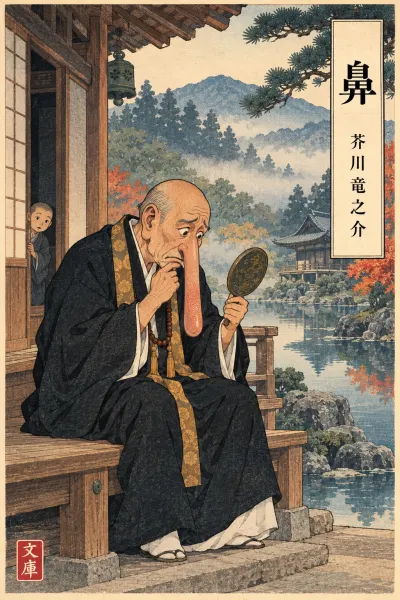
Part 3 of 4 · JLPT N2
鼻 Hana, part 3: A Short Nose and New Laughter
In this part
The disciple treads on the Naigu's boiled nose, plucks out the grease with tweezers, and boils it again, and the nose shrinks to an ordinary size. Delighted but anxious that it might grow long again, the Naigu keeps checking that it stays short. Within days, though, he notices that people laugh at him in a different manner than before, the samurai even more amusedly, and he senses there is more to it than the mere change in his looks.
AI translation · independently checked
――痛うはないて。"No, it does not hurt,"
と答えた。he answered.
実際鼻はむず痒い所を踏まれるので、痛いよりもかえって気もちのいいくらいだったのである。And in truth, since the nose was being trodden on just where it itched, it felt, if anything, more pleasant than painful.
しばらく踏んでいると、やがて、粟粒のようなものが、鼻へ出来はじめた。After the treading had gone on for a while, things like grains of millet at length began to appear on the nose.
云わば毛をむしった小鳥をそっくり丸炙にしたような形である。It looked, so to speak, like a little bird plucked of its feathers and roasted whole.
弟子の僧はこれを見ると、足を止めて独り言のようにこう云った。When the disciple saw this, he stopped his feet and said, as though talking to himself:
――これを鑷子でぬけと申す事でござった。"These, I was told, are to be drawn out with tweezers."
内供は、不足らしく頬をふくらせて、黙って弟子の僧のするなりに任せて置いた。The Naigu puffed out his cheeks in evident discontent and, saying nothing, left the disciple to do as he pleased.
勿論弟子の僧の親切がわからない訳ではない。It was not, of course, that he failed to understand the disciple's kindness.
それは分っても、自分の鼻をまるで物品のように取扱うのが、不愉快に思われたからである。He understood it well enough, but he found it disagreeable to have his own nose handled as though it were a mere object.
内供は、信用しない医者の手術をうける患者のような顔をして、不承不承に弟子の僧が、鼻の毛穴から鑷子で脂をとるのを眺めていた。With the face of a patient undergoing an operation by a doctor he does not trust, the Naigu watched, most unwillingly, as the disciple drew the grease from the pores of his nose with the tweezers.
脂は、鳥の羽の茎のような形をして、四分ばかりの長さにぬけるのである。The grease came out shaped like the quill of a bird's feather, in pieces about half an inch long.
やがてこれが一通りすむと、弟子の僧は、ほっと一息ついたような顔をして、Presently, when this was more or less finished, the disciple, looking like a man who has just let out a breath of relief,
――もう一度、これを茹でればようござる。"Now if we boil it once more, that will do,"
と云った。he said.
内供はやはり、八の字をよせたまま不服らしい顔をして、弟子の僧の云うなりになっていた。The Naigu, his brows still knitted and his face still sullen, went on doing just as the disciple told him.
さて二度目に茹でた鼻を出して見ると、成程、いつになく短くなっている。And when he took out the nose after its second boiling, sure enough, it had become shorter than usual.
これではあたりまえの鍵鼻と大した変りはない。Now it was scarcely different from an ordinary hooked nose.
内供はその短くなった鼻を撫でながら、弟子の僧の出してくれる鏡を、極りが悪るそうにおずおず覗いて見た。Stroking his shortened nose, the Naigu peered timidly and self-consciously into the mirror the disciple held out for him.
鼻は――あの顋の下まで下っていた鼻は、ほとんど嘘のように萎縮して、今は僅に上唇の上で意気地なく残喘を保っている。The nose—that nose which had once hung down below his chin—had shrunk almost beyond belief, and now clung feebly to its last breath just above his upper lip.
所々まだらに赤くなっているのは、恐らく踏まれた時の痕であろう。The red blotches here and there were no doubt the marks of its having been trodden on.
こうなれば、もう誰も哂うものはないにちがいない。Like this, surely no one would laugh at him any more.
――鏡の中にある内供の顔は、鏡の外にある内供の顔を見て、満足そうに眼をしばたたいた。The Naigu's face within the mirror looked at the Naigu's face outside the mirror and blinked contentedly.
しかし、その日はまだ一日、鼻がまた長くなりはしないかと云う不安があった。Yet for the whole of that day he still felt uneasy, fearing that the nose might grow long again.
そこで内供は誦経する時にも、食事をする時にも、暇さえあれば手を出して、そっと鼻の先にさわって見た。So whenever he had a moment to spare, whether chanting the sutras or taking his meals, the Naigu would put up a hand and gently touch the tip of his nose.
が、鼻は行儀よく唇の上に納まっているだけで、格別それより下へぶら下って来る景色もない。But the nose merely sat politely above his lip, and showed no particular sign of dangling down any further.
それから一晩寝てあくる日早く眼がさめると内供はまず、第一に、自分の鼻を撫でて見た。Then, after a night's sleep, when he woke early the next morning, the very first thing the Naigu did was to stroke his nose.
鼻は依然として短い。The nose was still short.
内供はそこで、幾年にもなく、法華経書写の功を積んだ時のような、のびのびした気分になった。At this the Naigu felt a lightness of heart he had not known in many years, much as he had felt when he earned merit by copying out the Lotus Sutra.
所が二三日たつ中に、内供は意外な事実を発見した。Within two or three days, however, the Naigu made an unexpected discovery.
それは折から、用事があって、池の尾の寺を訪れた侍が、前よりも一層可笑しそうな顔をして、話も碌々せずに、じろじろ内供の鼻ばかり眺めていた事である。A samurai who happened to call at the temple in Ike-no-o on some business wore a look even more amused than before, hardly said a word, and did nothing but stare and stare at the Naigu's nose.
それのみならず、かつて、内供の鼻を粥の中へ落した事のある中童子なぞは、講堂の外で内供と行きちがった時に、始めは、下を向いて可笑しさをこらえていたが、とうとうこらえ兼ねたと見えて、一度にふっと吹き出してしまった。Not only that, but the page who had once dropped the Naigu's nose into the gruel, on passing him outside the lecture hall, at first looked down and held back his laughter, but at last, apparently unable to hold it in any longer, burst out all at once.
用を云いつかった下法師たちが、面と向っている間だけは、慎んで聞いていても、内供が後さえ向けば、すぐにくすくす笑い出したのは、一度や二度の事ではない。Nor was it just once or twice that the lower monks, when given their orders, listened respectfully only while face to face with him, and then broke into giggles the moment the Naigu turned his back.
内供ははじめ、これを自分の顔がわりがしたせいだと解釈した。At first the Naigu put this down to the change in his appearance.
しかしどうもこの解釈だけでは十分に説明がつかないようである。But somehow this explanation alone did not seem to account for it fully.
――勿論、中童子や下法師が哂う原因は、そこにあるのにちがいない。Of course, the reason the pages and the lower monks laughed must lie there.
けれども同じ哂うにしても、鼻の長かった昔とは、哂うのにどことなく容子がちがう。And yet, though it was laughter all the same, there was something different in the way they laughed compared with the old days when his nose was long.
見慣れた長い鼻より、見慣れない短い鼻の方が滑稽に見えると云えば、それまでである。One might say that an unfamiliar short nose looks funnier than a familiar long one, and leave it at that.
が、そこにはまだ何かあるらしい。But there seemed to be something more to it.
Vocabulary
| Word | Meaning | JLPT |
|---|---|---|
| むず痒いむずがゆい | itchy, ticklyA crawling, irritating itch. Also used figuratively for feeling awkward or restless. | — |
| 粟粒あわつぶ | grain of milletUsed as an image for something tiny and round. Here it describes the beads of grease. | — |
| 鑷子けぬき | tweezersUsually written 毛抜き ('hair-puller'). The kanji 鑷子 are normally read せっし. | — |
| 不承不承ふしょうぶしょう | reluctantly, grudginglyThe second half takes rendaku: ぶしょう. | — |
| 分ぶ | bu, an old unit of length (about 3 mm)One tenth of a 寸 (sun). 四分 is roughly 1.2 cm. | N3 |
| 八の字をよせたはちのじをよせる | to knit one's brows, to frowndictionary form: 八の字を寄せるFrowning brows are compared to the shape of the character 八. | — |
| 極りが悪るきまりがわるい | embarrassed, awkwarddictionary form: 決まりが悪いModern spelling is 決まり(極まり)が悪い. The extra る is old-style okurigana. | — |
| 萎縮いしゅく | shrinking, witheringAlso used for people 'shrinking' from fear. | — |
| 残喘を保ってざんぜんをたもつ | to barely hang on to life, to linger ondictionary form: 残喘を保つA literary phrase, literally 'to keep one's remaining breaths'. Here it is used ironically of the nose. | — |
| 誦経ずぎょう | chanting of sutrasA Buddhist term. Also read ずきょう. | — |
| 依然としていぜんとして | still, as beforeA formal word stressing that something has not changed. | — |
| 碌々ろくろく | (not) properly, hardlyUsed with a negative, like ろくに. The modern spelling is usually kana. | — |
| 吹き出してふきだす | to burst out laughingdictionary form: 吹き出すLiterally 'to blow out'. Often used for laughter you cannot hold back. | — |
| 滑稽こっけい | comical, ridiculousA な-adjective. It can suggest something laughable in a slightly pitiful way. | N1 |
Grammar
〜うはない (old adjective form) N1 is not ~ (archaic negative of an い-adjective)
In older speech, the く of the adverbial form becomes う: 痛く → 痛う (いとう). This is the same sound change seen in ありがとう and おはよう. 痛うはない is the old form of 痛くはない.
痛うはないて。
No, it does not hurt.
〜なりに任せる / 〜なりになる N1 to go along with whatever someone does or says
なり after a verb means 'just as (someone) does'. With 任せる or になる, it shows the Naigu passively letting the disciple have his way.
黙って弟子の僧のするなりに任せて置いた
silently left the disciple to do as he pleased
〜はしないか N2 whether ~ might not happen (expressing worry)
The pattern Vます-stem + はしないか, followed by 不安 or 心配, expresses fear that something may happen. Here the Naigu worries that his nose may grow long again.
鼻がまた長くなりはしないかと云う不安があった
he felt uneasy that the nose might grow long again
〜かねる N2 cannot quite ~, unable to ~
Added to a verb stem, かねる means one is unable to do something even though one tries. こらえ兼ねた means the page could no longer hold back his laughter. 見えて adds 'apparently'.
とうとうこらえ兼ねたと見えて、一度にふっと吹き出してしまった
at last, apparently unable to hold it in, he burst out all at once
〜のみならず N1 not only ~ (but also)
A literary form of だけでなく. Here それのみならず adds a second, even more pointed example of people laughing.
それのみならず、かつて、内供の鼻を粥の中へ落した事のある中童子なぞは
Not only that, but the page who had once dropped the Naigu's nose into the gruel
〜と云えばそれまでだ N1 if you put it that way, there is nothing more to say
This pattern offers a simple explanation and then dismisses it as too easy. The narrator uses it to hint that the real reason lies deeper.
見慣れない短い鼻の方が滑稽に見えると云えば、それまでである
One might say that an unfamiliar short nose looks funnier, and leave it at that