Part 1 of 4 · JLPT N2
鼻 Hana, part 1: A Nose Too Long for Dignity
In this part
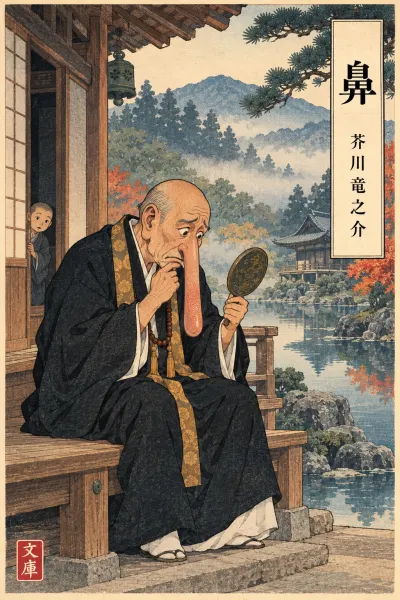
Zenchi Naigu, a priest of Ike-no-o who has risen to the post of naidōjō-gubu, has a nose known to everyone in Ike-no-o: five or six inches long, it dangles below his chin, and he even needs a disciple to hold it up with a board while he eats. What truly torments him is not the inconvenience but his wounded pride, so he secretly studies his face in the mirror and scans every visitor to the temple, hoping to find someone with a nose like his, and grows more miserable when he finds none.
AI translation · independently checked
禅智内供の鼻と云えば、池の尾で知らない者はない。When it came to the nose of Zenchi Naigu, there was no one in Ike-no-o who did not know of it.
長さは五六寸あって上唇の上から顋の下まで下っている。It was five or six inches long and hung down from above his upper lip to below his chin.
形は元も先も同じように太い。In shape it was equally thick at the root and at the tip.
云わば細長い腸詰めのような物が、ぶらりと顔のまん中からぶら下っているのである。It was, so to speak, a long, thin, sausage-like thing dangling loosely from the middle of his face.
五十歳を越えた内供は、沙弥の昔から、内道場供奉の職に陞った今日まで、内心では始終この鼻を苦に病んで来た。The Naigu, now past fifty, had inwardly suffered over this nose the whole time, from his old days as a novice right up to the present, when he had risen to the post of chaplain to the imperial palace sanctuary.
勿論表面では、今でもさほど気にならないような顔をしてすましている。Outwardly, of course, he even now kept a composed face, as though it scarcely troubled him.
これは専念に当来の浄土を渇仰すべき僧侶の身で、鼻の心配をするのが悪いと思ったからばかりではない。This was not merely because he thought it wrong for one in the position of a priest, who ought to devote himself single-mindedly to longing for the Pure Land to come, to be worrying about his nose.
それよりむしろ、自分で鼻を気にしていると云う事を、人に知られるのが嫌だったからである。It was rather because he hated the idea of others knowing that he himself was concerned about his nose.
内供は日常の談話の中に、鼻と云う語が出て来るのを何よりも惧れていた。More than anything, the Naigu dreaded the word "nose" coming up in everyday conversation.
内供が鼻を持てあました理由は二つある。There were two reasons why the Naigu found his nose such a burden.
――一つは実際的に、鼻の長いのが不便だったからである。One was practical: a long nose was simply inconvenient.
第一飯を食う時にも独りでは食えない。To begin with, he could not even eat his meals by himself.
独りで食えば、鼻の先が鋺の中の飯へとどいてしまう。If he ate by himself, the tip of his nose would reach down into the rice in his metal bowl.
そこで内供は弟子の一人を膳の向うへ坐らせて、飯を食う間中、広さ一寸長さ二尺ばかりの板で、鼻を持上げていて貰う事にした。So the Naigu had one of his disciples sit across the tray from him and, for the whole of the meal, hold his nose up with a board about an inch wide and two feet long.
しかしこうして飯を食うと云う事は、持上げている弟子にとっても、持上げられている内供にとっても、決して容易な事ではない。But eating a meal in this way was by no means easy, either for the disciple doing the lifting or for the Naigu being lifted.
一度この弟子の代りをした中童子が、嚏をした拍子に手がふるえて、鼻を粥の中へ落した話は、当時京都まで喧伝された。The story of how a temple boy, once taking this disciple's place, sneezed, and his hand shook so that the nose dropped into the rice gruel, was spread at the time as far as Kyōto.
――けれどもこれは内供にとって、決して鼻を苦に病んだ重な理由ではない。And yet, for the Naigu, this was by no means the main reason he suffered over his nose.
内供は実にこの鼻によって傷つけられる自尊心のために苦しんだのである。What the Naigu truly suffered from was the pride that this nose wounded.
池の尾の町の者は、こう云う鼻をしている禅智内供のために、内供の俗でない事を仕合せだと云った。The people of the town of Ike-no-o said that, for Zenchi Naigu with such a nose, it was a blessing he was not a layman.
あの鼻では誰も妻になる女があるまいと思ったからである。For they thought that with a nose like that, no woman would ever agree to become his wife.
中にはまた、あの鼻だから出家したのだろうと批評する者さえあった。Some even remarked that it was probably because of that nose that he had taken holy orders.
しかし内供は、自分が僧であるために、幾分でもこの鼻に煩される事が少くなったと思っていない。The Naigu, however, did not think that being a priest had made him even slightly less troubled by this nose.
内供の自尊心は、妻帯と云うような結果的な事実に左右されるためには、余りにデリケイトに出来ていたのである。The Naigu's pride was made far too delicate to be swayed by a mere incidental matter such as whether or not he had a wife.
そこで内供は、積極的にも消極的にも、この自尊心の毀損を恢復しようと試みた。So the Naigu tried, by both active and passive means, to repair the damage done to this pride.
第一に内供の考えたのは、この長い鼻を実際以上に短く見せる方法である。The first thing the Naigu thought of was a way to make this long nose look shorter than it really was.
これは人のいない時に、鏡へ向って、いろいろな角度から顔を映しながら、熱心に工夫を凝らして見た。This he tried when no one was about, facing the mirror, reflecting his face from every angle, and eagerly racking his brains.
どうかすると、顔の位置を換えるだけでは、安心が出来なくなって、頬杖をついたり頤の先へ指をあてがったりして、根気よく鏡を覗いて見る事もあった。Sometimes merely changing the position of his face was not enough to reassure him, and he would rest his cheek on his hand or put a finger to the tip of his chin, peering patiently into the mirror.
しかし自分でも満足するほど、鼻が短く見えた事は、これまでにただの一度もない。But never yet, not even once, had his nose looked short enough to satisfy even himself.
時によると、苦心すればするほど、かえって長く見えるような気さえした。At times it even seemed to him that the harder he tried, the longer it looked.
内供は、こう云う時には、鏡を箱へしまいながら、今更のようにため息をついて、不承不承にまた元の経机へ、観音経をよみに帰るのである。On such occasions the Naigu would put the mirror back in its box, sigh as though freshly struck by it all, and reluctantly return to his sutra desk to read the Kannon Sutra.
それからまた内供は、絶えず人の鼻を気にしていた。Beyond that, the Naigu was constantly concerned with other people's noses.
池の尾の寺は、僧供講説などのしばしば行われる寺である。The temple at Ike-no-o was one where offerings to monks and sermons were often held.
寺の内には、僧坊が隙なく建て続いて、湯屋では寺の僧が日毎に湯を沸かしている。Within the grounds, the monks' quarters stood one after another without a gap, and in the bathhouse the temple monks heated water every day.
従ってここへ出入する僧俗の類も甚だ多い。Accordingly, the monks and lay folk who came and went there were exceedingly numerous.
内供はこう云う人々の顔を根気よく物色した。The Naigu patiently scrutinised the faces of all these people.
一人でも自分のような鼻のある人間を見つけて、安心がしたかったからである。For he wanted to find even one person with a nose like his own and so set his mind at ease.
だから内供の眼には、紺の水干も白の帷子もはいらない。So the Naigu's eyes took in neither the dark-blue hunting robes nor the white summer kimonos.
まして柑子色の帽子や、椎鈍の法衣なぞは、見慣れているだけに、有れども無きが如くである。Still less the orange-coloured caps or the dark grey priestly robes, which, being so familiar to him, might as well not have been there at all.
内供は人を見ずに、ただ、鼻を見た。The Naigu did not look at people; he looked only at noses.
――しかし鍵鼻はあっても、内供のような鼻は一つも見当らない。But though there were hooked noses, not a single nose like the Naigu's was to be found.
その見当らない事が度重なるに従って、内供の心は次第にまた不快になった。As this failure to find one was repeated time and again, the Naigu's heart gradually grew sour once more.
内供が人と話しながら、思わずぶらりと下っている鼻の先をつまんで見て、年甲斐もなく顔を赤らめたのは、全くこの不快に動かされての所為である。That the Naigu, while talking with someone, would unthinkingly pinch the tip of his dangling nose and then blush in a way unbecoming to his years was entirely the work of this displeasure.
Vocabulary
| Word | Meaning | JLPT |
|---|---|---|
| 腸詰めちょうづめ | sausageLiterally 'stuffed intestine'; an old-fashioned word, now usually ソーセージ. | — |
| 苦に病んでくにやむ | to agonise over, to be troubled bydictionary form: 苦に病むA set phrase: to take something to heart as a source of suffering. | — |
| すましているすます | to look unconcerned, to put on a composed airdictionary form: 澄ますOften in the form すました顔, a prim or innocent-looking face. | N1 |
| 持てあましたもてあます | to find something too much to handle, to be at a loss withdictionary form: 持て余すUsually written 持て余す today. | — |
| 喧伝けんでん | spreading widely (of news or rumour)Formal written word; used as 喧伝される. | — |
| 自尊心じそんしん | pride, self-esteemThe key theme of the story. | N1 |
| 出家しゅっけ | taking holy orders, becoming a monkLiterally 'leaving home'; the opposite is 俗 (lay life). | — |
| 毀損きそん | damage, injury (to honour or reputation)Today mainly in 名誉毀損, defamation. | — |
| 工夫を凝らしてくふうをこらす | to think hard about a method, to devise carefullydictionary form: 工夫を凝らす凝らす means to concentrate or elaborate. | — |
| 不承不承ふしょうぶしょう | reluctantly, grudginglyNote the rendaku in the second half: ぶしょう. | — |
| 物色ぶっしょく | searching over, scrutinising (to find something)Nuance of looking through many things for a particular one. | — |
| 水干すいかん | suikan, a simple Heian-era robe worn by commoners and boysNo English equivalent; a plain starched robe of the hunting-garment type. | — |
| 年甲斐もなくとしがいもない | unbecoming to one's agedictionary form: 年甲斐もないUsed for behaviour that someone of that age ought to have outgrown. | — |
Grammar
〜と云えば N3 speaking of…, when it comes to…
Introduces a topic that immediately brings something to mind. Here it sets up the nose as a famous subject. 云う is an older spelling of 言う.
禅智内供の鼻と云えば、池の尾で知らない者はない。
When it came to the nose of Zenchi Naigu, there was no one in Ike-no-o who did not know of it.
〜からばかりではない / それよりむしろ〜からである N2 not only because… but rather because…
〜ばかりではない denies that the reason given is the whole story, and the next sentence with むしろ supplies the more important reason.
鼻の心配をするのが悪いと思ったからばかりではない。
It was not merely because he thought it wrong to be worrying about his nose.
〜て貰う事にした N4 arranged to have someone do something
〜てもらう shows the Naigu receiving the action of lifting, and 〜ことにした shows that this was his decision.
鼻を持上げていて貰う事にした
he arranged to have his nose held up
〜まい N2 probably not, surely will not
A written negative conjecture meaning roughly 〜ないだろう. Here it is the townspeople's guess that no woman would marry him.
あの鼻では誰も妻になる女があるまいと思ったからである。
For they thought that with a nose like that, no woman would ever become his wife.
〜ば〜ほど N3 the more…, the more…
The same verb is repeated in the ば-form and the dictionary form, followed by ほど, to show that one thing increases with another. かえって adds the ironic 'contrary to what he hoped'.
苦心すればするほど、かえって長く見えるような気さえした。
It even seemed to him that the harder he tried, the longer it looked.
有れども無きが如く N1 as though it were not there even though it is
A classical set phrase: ども means 'even though' and 〜が如く means 'just like'. It says the familiar clothing is effectively invisible to him.
見慣れているだけに、有れども無きが如くである。
Being so familiar to him, they might as well not have been there at all.