Part 4 of 4 · JLPT N2
鼻 Hana, part 4: The Long Nose Returns
In this part
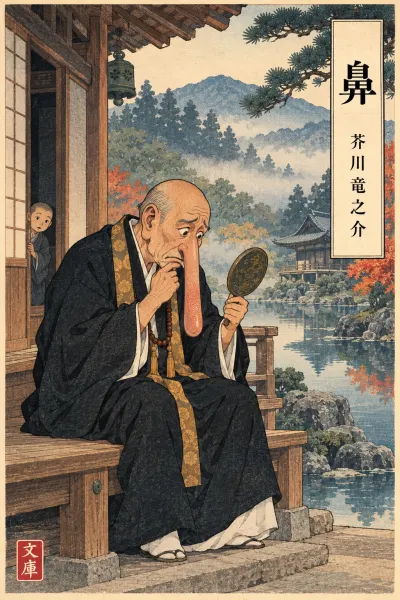
The Naigu feels that the people of Ike-no-o laugh at his shortened nose more openly than they did before, and the narrator explains this as the bystander's egoism: people sympathise with another's misfortune but feel let down when that person escapes it. Embittered, the Naigu grows short-tempered and even strikes the temple boy. One cold autumn night the nose swells and itches, and by morning it has grown back to its old length. He feels light-hearted, sure that no one will laugh at him now.
AI translation · independently checked
――前にはあのようにつけつけとは哂わなんだて。They never used to laugh at me so bluntly before.
内供は、誦しかけた経文をやめて、禿げ頭を傾けながら、時々こう呟く事があった。Now and then the Naigu would break off a sutra he had begun to chant, tilt his bald head, and murmur these words.
愛すべき内供は、そう云う時になると、必ずぼんやり、傍にかけた普賢の画像を眺めながら、鼻の長かった四五日前の事を憶い出して、「今はむげにいやしくなりさがれる人の、さかえたる昔をしのぶがごとく」ふさぎこんでしまうのである。At such times our lovable Naigu would always gaze vacantly at the picture of Fugen hanging beside him and recall the time, only four or five days earlier, when his nose had been long; and he would sink into gloom, "like one now fallen utterly low who pines for the glories of former days."
――内供には、遺憾ながらこの問に答を与える明が欠けていた。The Naigu, regrettably, lacked the insight to answer this question.
――人間の心には互に矛盾した二つの感情がある。In the human heart there are two feelings that contradict each other.
勿論、誰でも他人の不幸に同情しない者はない。Of course, there is no one who does not feel sympathy for another's misfortune.
所がその人がその不幸を、どうにかして切りぬける事が出来ると、今度はこっちで何となく物足りないような心もちがする。Yet once that person somehow manages to overcome the misfortune, we in our turn feel vaguely dissatisfied.
少し誇張して云えば、もう一度その人を、同じ不幸に陥れて見たいような気にさえなる。To put it with a little exaggeration, we even find ourselves wanting to see that person plunged into the same misfortune once more.
そうしていつの間にか、消極的ではあるが、ある敵意をその人に対して抱くような事になる。And before we know it, we come to harbour a certain hostility toward that person, passive though it may be.
――内供が、理由を知らないながらも、何となく不快に思ったのは、池の尾の僧俗の態度に、この傍観者の利己主義をそれとなく感づいたからにほかならない。The Naigu's vague displeasure, though he did not know the reason for it, came from nothing other than having dimly sensed this bystander's egoism in the attitude of the priests and lay people of Ike-no-o.
そこで内供は日毎に機嫌が悪くなった。And so the Naigu's temper grew worse by the day.
二言目には、誰でも意地悪く叱りつける。He would scold anyone spitefully at the slightest excuse.
しまいには鼻の療治をしたあの弟子の僧でさえ、「内供は法慳貪の罪を受けられるぞ」と陰口をきくほどになった。In the end even the disciple who had treated his nose began to mutter behind his back, "The Naigu will surely be punished for the sin of begrudging the Law."
殊に内供を怒らせたのは、例の悪戯な中童子である。The one who angered the Naigu most was that mischievous temple boy.
ある日、けたたましく犬の吠える声がするので、内供が何気なく外へ出て見ると、中童子は、二尺ばかりの木の片をふりまわして、毛の長い、痩せた尨犬を逐いまわしている。One day, hearing a dog barking shrilly, the Naigu idly stepped outside and saw the temple boy swinging a piece of wood about two feet long and chasing a thin, long-haired shaggy dog.
それもただ、逐いまわしているのではない。Nor was he simply chasing it.
「鼻を打たれまい。それ、鼻を打たれまい」と囃しながら、逐いまわしているのである。He was chasing it while chanting, "Mind your nose doesn't get hit! There now, mind your nose doesn't get hit!"
内供は、中童子の手からその木の片をひったくって、したたかその顔を打った。The Naigu snatched the piece of wood out of the boy's hand and struck him hard across the face with it.
木の片は以前の鼻持上げの木だったのである。The piece of wood was the very board that had once been used to lift his nose.
内供はなまじいに、鼻の短くなったのが、かえって恨めしくなった。The Naigu now came, if anything, to resent that he had needlessly had his nose shortened.
するとある夜の事である。Then one night it happened.
日が暮れてから急に風が出たと見えて、塔の風鐸の鳴る音が、うるさいほど枕に通って来た。It seemed a wind had suddenly risen after dark, for the ringing of the bells on the pagoda carried to his pillow so loudly it was a nuisance.
その上、寒さもめっきり加わったので、老年の内供は寝つこうとしても寝つかれない。What was more, the cold had grown noticeably sharper, and the aged Naigu could not fall asleep however he tried.
そこで床の中でまじまじしていると、ふと鼻がいつになく、むず痒いのに気がついた。So as he lay wide awake in bed, he suddenly noticed that his nose itched as it never had before.
手をあてて見ると少し水気が来たようにむくんでいる。When he put his hand to it, it felt somewhat puffy, as though it had filled with water.
どうやらそこだけ、熱さえもあるらしい。It seemed that there, and only there, it was even feverish.
――無理に短うしたで、病が起ったのかも知れぬ。"Perhaps some sickness has come of shortening it by force."
内供は、仏前に香花を供えるような恭しい手つきで、鼻を抑えながら、こう呟いた。So the Naigu murmured, holding his nose with hands as reverent as if he were offering incense and flowers before the Buddha.
翌朝、内供がいつものように早く眼をさまして見ると、寺内の銀杏や橡が一晩の中に葉を落したので、庭は黄金を敷いたように明るい。The next morning, when the Naigu woke early as usual, the ginkgo and horse-chestnut trees of the temple grounds had shed their leaves overnight, and the garden was as bright as if it had been spread with gold.
塔の屋根には霜が下りているせいであろう。Perhaps it was because frost had settled on the pagoda roof.
まだうすい朝日に、九輪がまばゆく光っている。In the still-faint morning sun, the nine rings of the spire were shining dazzlingly.
禅智内供は、蔀を上げた縁に立って、深く息をすいこんだ。Zenchi Naigu stood on the veranda, where the shutters had been raised, and drew a deep breath.
ほとんど、忘れようとしていたある感覚が、再び内供に帰って来たのはこの時である。It was at this moment that a certain sensation he had almost forgotten came back to him.
内供は慌てて鼻へ手をやった。The Naigu hastily put his hand to his nose.
手にさわるものは、昨夜の短い鼻ではない。What his hand touched was not the short nose of the night before.
上唇の上から顋の下まで、五六寸あまりもぶら下っている、昔の長い鼻である。It was the long nose of old, hanging down a good five or six inches from above his upper lip to below his chin.
内供は鼻が一夜の中に、また元の通り長くなったのを知った。The Naigu knew that in a single night his nose had grown long again, just as it used to be.
そうしてそれと同時に、鼻が短くなった時と同じような、はればれした心もちが、どこからともなく帰って来るのを感じた。And at the same time he felt a light-hearted feeling, just like the one he had felt when his nose became short, returning to him from somewhere.
――こうなれば、もう誰も哂うものはないにちがいない。"Now that it has come to this, surely no one will laugh anymore."
内供は心の中でこう自分に囁いた。So the Naigu whispered to himself in his heart.
長い鼻をあけ方の秋風にぶらつかせながら。All the while letting his long nose dangle in the autumn wind of dawn.
(大正五年一月)(January, Taishō 5 [1916])
Vocabulary
| Word | Meaning | JLPT |
|---|---|---|
| 呟くつぶやく | to murmur, to mutterSpeaking quietly, often to oneself. | N1 |
| 矛盾むじゅん | contradictionLiterally 'spear and shield', from a Chinese fable about a merchant selling both an unstoppable spear and an unbreakable shield. | N2 |
| 同情どうじょう | sympathy, compassionUsed as 〜に同情する, 'to sympathise with ~'. | N1 |
| 陥れておとしいれる | to plunge (someone) into; to entrapdictionary form: 陥れるTransitive. The intransitive 陥る means 'to fall into' a bad situation. | — |
| 敵意てきい | hostility, ill willUsually 敵意を抱く, 'to harbour hostility'. | — |
| 傍観者ぼうかんしゃ | bystander, onlooker傍 'side' + 観 'watch' + 者 'person': someone who watches from the side without taking part. | — |
| 利己主義りこしゅぎ | egoism, selfishness利己 'benefiting oneself' + 主義 '-ism'. The key idea of this passage. | — |
| 機嫌きげん | mood, temper機嫌が悪い means 'in a bad mood'. | N3 |
| 陰口かげぐち | backbiting, talk behind someone's backThe usual phrase is 陰口をたたく; 陰口をきく is an older variant. | — |
| 囃しはやす | to jeer, to taunt in a chanting voicedictionary form: 囃すAlso means to accompany music with rhythm or shouts. | — |
| 恨めしくうらめしい | resentful, bitter aboutdictionary form: 恨めしいResentment mixed with regret about one's own circumstances. | — |
| むず痒いむずがゆい | itchy, ticklyA crawling kind of itch. | — |
| むくんでむくむ | to swell, to become puffydictionary form: むくむUsed for swelling caused by fluid, e.g. むくんだ足 'swollen legs'. | — |
| はればれしたはればれする | to feel light-hearted and refresheddictionary form: 晴れ晴れするComes from 晴れる 'to clear up (of weather)'; a mind cleared of clouds. | — |
Grammar
〜なんだ N1 did not (archaic past negative)
An old and dialectal form equal to modern 〜なかった. 哂わなんだ means 哂わなかった; the final て is an old sentence-ending particle that adds a musing tone.
前にはあのようにつけつけとは哂わなんだて。
They never used to laugh so bluntly before, did they now.
〜べき N2 worthy of ~; ought to be ~
Verb (dictionary form) + べき placed before a noun describes it as deserving that action. 愛すべき内供 means 'the Naigu, who deserves to be loved', said with the narrator's gentle irony.
愛すべき内供は、そう云う時になると、必ずぼんやり
At such times our lovable Naigu would always vacantly…
〜ながらも N2 although, even while
Attached to a verb, adjective or noun, ながら(も) expresses concession rather than simultaneous action. Here it means 'although he did not know the reason'.
内供が、理由を知らないながらも、何となく不快に思ったのは
The Naigu's vague displeasure, though he did not know the reason for it,
〜にほかならない N2 is nothing other than ~
A formal, emphatic way to state that something is exactly and only X. With 〜からにほかならない it pinpoints the true cause.
この傍観者の利己主義をそれとなく感づいたからにほかならない。
came from nothing other than having dimly sensed this bystander's egoism.
〜まい N2 negative will or conjecture; here a teasing 'don't ~'
まい is the literary negative counterpart of う/よう. In the boy's chant 打たれまい works as a mocking warning: 'mind you don't get hit'.
「鼻を打たれまい。それ、鼻を打たれまい」と囃しながら
while chanting, "Mind your nose doesn't get hit! There now, mind your nose doesn't get hit!"
〜にちがいない N3 must be; surely
Expresses strong conviction on the speaker's part. The Naigu is certain that no one will laugh now, and the story leaves that certainty open to doubt.
こうなれば、もう誰も哂うものはないにちがいない。
Now that it has come to this, surely no one will laugh anymore.