Part 1 of 6 · JLPT N2
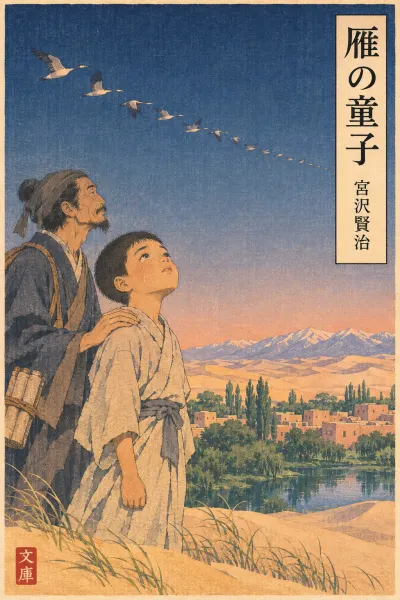
雁の童子 Kari no Dōji, part 1: A Shrine by the Desert Spring
In this part
Resting at a small spring south of the Moving Sands, a traveller notices a newly painted shrine and asks an old pilgrim about it. The pilgrim begins the tale of the Wild Goose Child, said to be a heavenly child who came down to that region. The story opens with Suriya Kei, an impoverished man of good family, urging his gun-carrying cousin to give up killing for sport; the cousin laughs off the advice and runs after a flight of wild geese.
AI translation · independently checked
流沙の南の、楊で囲まれた小さな泉で、私は、いった麦粉を水にといて、昼の食事をしておりました。At a small spring ringed with willows, south of the Moving Sands, I was having my midday meal of roasted barley flour stirred into water.
そのとき、一人の巡礼のおじいさんが、やっぱり食事のために、そこへやって来ました。Just then an old pilgrim came along to the same spot, he too to take his meal.
私たちはだまって軽く礼をしました。We exchanged a light, silent bow.
けれども、半日まるっきり人にも出会わないそんな旅でしたから、私は食事がすんでも、すぐに泉とその年老った巡礼とから、別れてしまいたくはありませんでした。Still, I had been travelling for half a day without meeting a single soul, so even after I had finished eating I did not want to leave the spring and the aged pilgrim straight away.
私はしばらくその老人の、高い咽喉仏のぎくぎく動くのを、見るともなしに見ていました。For a while I watched the old man's prominent Adam's apple bobbing up and down, half without meaning to.
何か話し掛けたいと思いましたが、どうもあんまり向うが寂かなので、私は少しきゅうくつにも思いました。I wanted to say something to him, but he was so very quiet that I felt rather awkward.
けれども、ふと私は泉のうしろに、小さな祠のあるのを見付けました。Then, all at once, I noticed a small shrine standing behind the spring.
それは大へん小さくて、地理学者や探険家ならばちょっと標本に持って行けそうなものではありましたがまだ全くあたらしく黄いろと赤のペンキさえ塗られていかにも異様に思われ、その前には、粗末ながら一本の幡も立っていました。It was very small, the sort of thing a geographer or an explorer might easily carry off as a specimen, yet it was still quite new and even painted in yellow and red, which made it look strange indeed; and in front of it, plain as it was, stood a single banner.
私は老人が、もう食事も終りそうなのを見てたずねました。Seeing that the old man had nearly finished his meal, I asked him.
「失礼ですがあのお堂はどなたをおまつりしたのですか。」"Excuse me, but to whom is that little shrine dedicated?"
その老人も、たしかに何か、私に話しかけたくていたのです。The old man, too, had surely been wanting to talk to me.
だまって二、三度うなずきながら、そのたべものをのみ下して、低く言いました。Nodding silently two or three times, he swallowed his food and said in a low voice:
「……童子のです。」"…It is the Child's."
「童子ってどう云う方ですか。」"The Child? What sort of person is that?"
「雁の童子と仰っしゃるのは。」老人は食器をしまい、屈んで泉の水をすくい、きれいに口をそそいでからまた云いました。"The one they call the Wild Goose Child…" The old man put away his eating bowl, bent down, scooped up water from the spring, rinsed his mouth carefully, and then spoke again.
「雁の童子と仰っしゃるのは、まるでこの頃あった昔ばなしのようなのです。この地方にこのごろ降りられました天童子だというのです。このお堂はこのごろ流沙の向う側にも、あちこち建っております。」"The tale of the Wild Goose Child is just like an old legend, except that it happened only recently. They say he was a heavenly child who came down to this region not long ago. These shrines have been going up here and there lately, even on the far side of the Moving Sands."
「天のこどもが、降りたのですか。罪があって天から流されたのですか。」"A child of Heaven came down? Was he banished from Heaven for some sin?"
「さあ、よくわかりませんが、よくこの辺でそう申します。多分そうでございましょう。」"Well, I cannot say for certain, but that is what people around here often say. Most likely it is so."
「いかがでしょう、聞かせて下さいませんか。お急ぎでさえなかったら。」"Would you be so kind as to tell me the story? That is, if you are not in a hurry."
「いいえ、急ぎはいたしません。私の聴いただけお話いたしましょう。"No, I am in no hurry. I shall tell you as much as I have heard.
沙車に、須利耶圭という人がございました。In Sasha there once lived a man named Suriya Kei.
名門ではございましたそうですが、おちぶれて奥さまと二人、ご自分は昔からの写経をなさり、奥さまは機を織って、しずかにくらしていられました。His was a distinguished family, so it is said, but it had fallen on hard times, and he lived quietly with his wife, the two of them alone: he copying the sutras as his family had done of old, and she weaving at her loom.
ある明方、須利耶さまが鉄砲をもったご自分の従弟のかたとご一緒に、野原を歩いていられました。One daybreak, Suriya was walking across the plain together with a cousin of his who carried a gun.
地面はごく麗わしい青い石で、空がぼうっと白く見え、雪もま近でございました。The ground was of a most beautiful blue stone, the sky looked hazy and white, and the snows were close at hand.
須利耶さまがお従弟さまに仰っしゃるには、お前もさような慰みの殺生を、もういい加減やめたらどうだと、斯うでございました。Suriya said to his cousin, so the tale goes, 'Isn't it high time you gave up this killing for mere amusement?'
ところが従弟の方が、まるですげなく、やめられないと、ご返事です。But the cousin answered him flatly, without the least concern, that he could not give it up.
(お前はずいぶんむごいやつだ、お前の傷めたり殺したりするものが、一体どんなものだかわかっているか、どんなものでもいのちは悲しいものなのだぞ。)と、須利耶さまは重ねておさとしになりました。'You are a cruel fellow,' Suriya admonished him once more. 'Do you even understand what kind of beings these are that you wound and kill? Every life, whatever it may be, is a sorrowful thing.'
(そうかもしれないよ。けれどもそうでないかもしれない。そうだとすればおれは一層おもしろいのだ、まあそんな下らない話はやめろ、そんなことは昔の坊主どもの言うこった、見ろ、向うを雁が行くだろう、おれは仕止めて見せる。)と従弟のかたは鉄砲を構えて、走って見えなくなりました。'Maybe so. But then again, maybe not. And if it is so, that makes it all the more fun for me. Come on, drop that silly talk; that is the sort of thing the old monks used to say. Look, there go some wild geese over there. Watch me bring one down.' And with that the cousin raised his gun and ran off until he was out of sight.
Vocabulary
| Word | Meaning | JLPT |
|---|---|---|
| 巡礼じゅんれい | pilgrim; pilgrimageHere it describes the old man: 巡礼のおじいさん = an old pilgrim. | — |
| 泉いずみ | spring (of water)Kanji tip: 白 (white) over 水 (water), clear water welling up. | N3 |
| きゅうくつきゅうくつ | awkward, ill at easedictionary form: 窮屈Literally 'cramped'; also used for feeling socially constrained. | N1 |
| 祠ほこら | small wayside shrineMuch smaller than a temple; often just a tiny house-shaped structure. | — |
| 異様いよう | strange, odd-lookingSuggests something out of place or unsettling. | — |
| 幡はた | (Buddhist) bannerA long hanging banner set up at temples and shrines; different kanji from 旗 (flag) and 機 (loom). | N3 |
| 天童子てんどうじ | heavenly child; divine youth童子 is a literary or Buddhist word for a boy, often a divine attendant. | — |
| 罪つみ | sin, crimeBeing 'cast down from Heaven for a sin' is a common motif in East Asian legends. | N3 |
| おちぶれておちぶれる | to come down in the world, fall into povertydictionary form: 落ちぶれる | — |
| 写経しゃきょう | copying Buddhist sutras by handDone as a religious practice or as a profession. | — |
| 殺生せっしょう | killing living thingsA Buddhist term; taking life is the first thing the precepts forbid. | — |
| 慰みなぐさみ | amusement, pastime慰みの殺生 = killing just for fun. | — |
| すげなくすげない | curtly, coldly, flatlydictionary form: すげないLiterary; describes a cold, unsympathetic manner. | — |
| おさとしになりましたさとす | to admonish, counseldictionary form: 諭すお〜になる is the honorific form, used here for Suriya. | — |
Grammar
〜ともなしに N1 without really meaning to ~
The same verb is repeated around ともなしに (見るともなしに見る) to show an action done idly, without real intention. Here the narrator is just absent-mindedly watching.
見るともなしに見ていました
I was watching, half without meaning to
Noun/Adjective + ながら (concessive) N2 although ~, though ~
Attached to a noun or adjective, ながら means 'though', not 'while'. 粗末ながら means 'though it was plain'.
粗末ながら一本の幡も立っていました
plain as it was, a single banner stood there too
〜でさえなかったら N2 as long as it isn't ~; if only ~ not
さえ combined with a conditional states the single condition that matters. The speaker is politely adding 'provided you are not in a hurry'.
お急ぎでさえなかったら。
That is, if you are not in a hurry.
〜が仰っしゃるには、…と N1 what ~ said was …
言う(には)introduces reported speech in a storytelling style, and the quotation is wrapped up with と. The storyteller rounds it off with 斯うでございました, 'so it was'.
須利耶さまがお従弟さまに仰っしゃるには、お前もさような慰みの殺生を、もういい加減やめたらどうだと、斯うでございました。
Suriya said to his cousin, so the tale goes, 'Isn't it high time you gave up this killing for mere amusement?'
〜たらどうだ N4 why don't you ~? (suggestion)
A plain, fairly blunt way to suggest an action. Its polite form is 〜たらどうですか.
もういい加減やめたらどうだ
Isn't it high time you gave it up?
〜て見せる N3 to do ~ (to show/prove one can)
Expresses determination to do something, often to prove a point to someone. The cousin boasts that he will bring a goose down.
おれは仕止めて見せる。
Watch me bring one down.