Part 5 of 6 · JLPT N2
雁の童子 Kari no Dōji, part 5: The Boy Who Wanted to Come Home
In this part
At twelve the Wild Goose Child is sent to a school in the capital, but one autumn day he suddenly comes home, saying he wants to work beside his mother instead of studying. His mother gently persuades him to go back and gives him a reed flute, and as he leaves a line of wild geese passes overhead, startling Suriya. In spring the ruins of the great temple of Sasha are dug out of the sand, and Suriya visits the capital to walk with his son, who says he never wants to be parted from his father.
AI translation · independently checked
須利耶さまは童子を十二のとき、少し離れた首都のある外道の塾にお入れなさいました。When the boy was twelve, Suriya enrolled him in a non-Buddhist school in the capital, which lay a little way off.
童子の母さまは、一生けん命機を織って、塾料や小遣いやらを拵らえてお送りなさいました。The boy's mother wove at her loom with all her might and sent him what was needed for his school fees and his pocket money.
冬が近くて、天山はもうまっ白になり、桑の葉が黄いろに枯れてカサカサ落ちました頃、ある日のこと、童子が俄かに帰っておいでです。Winter was near, the Tian Shan had already turned pure white, and the mulberry leaves had withered yellow and were falling with a dry rustle, when one day the boy suddenly came home.
母さまが窓から目敏く見付けて出て行かれました。His mother, quick to spot him from the window, went out to meet him.
須利耶さまは知らないふりで写経を続けておいでです。Suriya, pretending not to know, went on copying sutras.
(まあお前は今ごろどうしたのです。)"Why, whatever brings you here at this time?"
(私、もうお母さんと一緒に働らこうと思います。勉強している暇はないんです。)"I think I'll work together with you from now on, Mother. I have no time to be studying."
母さまは、須利耶さまのほうに気兼ねしながら申されました。His mother said, with an uneasy deference toward Suriya.
(お前はまたそんなおとなのようなことを云って、仕方ないではありませんか。早く帰って勉強して、立派になって、みんなの為にならないとなりません。)"There you go again, saying such grown-up things. That won't do, now. You must go back quickly and study, and become a fine person, and be of use to everyone."
(だっておっかさん。おっかさんの手はそんなにガサガサしているのでしょう。それだのに私の手はこんななんでしょう。)But Mother, your hands are so rough and chapped, aren't they? And yet my hands are like this, see?
(そんなことをお前が云わなくてもいいのです。誰でも年を老れば手は荒れます。そんなことより、早く帰って勉強をなさい。お前の立派になることばかり私には楽みなんだから。お父さんがお聞きになると叱られますよ。ね。さあ、おいで。)と斯う申されます。"You needn't say such things. Anyone's hands get rough as they grow old. Never mind that; hurry back and study. Seeing you become a fine person is my only pleasure. If your father hears of this, you'll be scolded, you know. Come now, come along." So she spoke.
童子はしょんぼり庭から出られました。Downcast, the boy went out of the garden.
それでも、また立ち停ってしまわれましたので、母さまも出て行かれてもっと向うまでお連れになりました。Even so, he stopped again, so his mother too went out and took him farther along.
そこは沼地でございました。That place was a stretch of marshland.
母さまは戻ろうとしてまた(さあ、おいで早く。)と仰っしゃったのでしたが童子はやっぱり停まったまま、家の方をぼんやり見ておられますので、母さまも仕方なくまた振り返って、蘆を一本抜いて小さな笛をつくり、それをお持たせになりました。His mother, about to turn back, said once more, "Come now, hurry along," but the boy still stood where he was, gazing vacantly toward the house; so his mother, having no other choice, turned round again, pulled up a reed, made a little flute from it, and put it in his hands.
童子はやっと歩き出されました。At last the boy began to walk.
そして、遥かに冷たい縞をつくる雲のこちらに、蘆がそよいで、やがて童子の姿が、小さく小さくなってしまわれました。And on this side of the clouds that drew cold stripes far away, the reeds swayed, and before long the boy's figure grew small, and smaller still, and was gone.
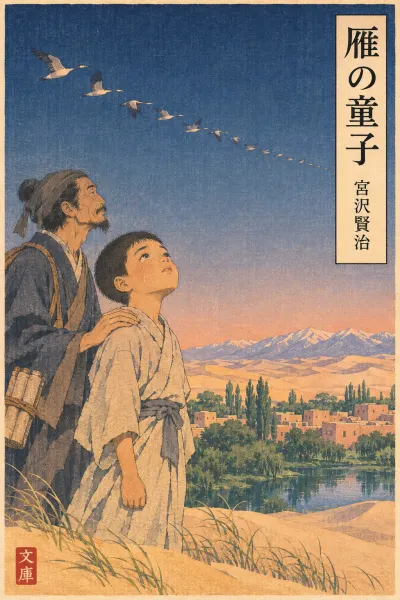
俄かに空を羽音がして、雁の一列が通りました時、須利耶さまは窓からそれを見て、思わずどきっとなされました。Suddenly there was a beating of wings in the sky, and as a line of wild geese passed by, Suriya, watching it from the window, felt his heart give an involuntary start.
そうして冬に入りましたのでございます。And so the winter set in.
その厳しい冬が過ぎますと、まず楊の芽が温和しく光り、沙漠には砂糖水のような陽炎が徘徊いたしまする。When that harsh winter is past, first the willow buds gleam softly, and over the desert the heat haze wanders like sugared water.
杏やすももの白い花が咲き、次では木立も草地もまっ青になり、もはや玉髄の雲の峯が、四方の空を繞る頃となりました。The white blossoms of apricot and plum came out, then the groves and meadows turned deep green, and at length the season came when peaks of chalcedony cloud encircled the sky on every side.
ちょうどそのころ沙車の町はずれの砂の中から、古い沙車大寺のあとが掘り出されたとのことでございました。It was just then, they say, that the remains of the old Sasha Daiji were dug up out of the sand at the edge of the town of Sasha.
一つの壁がまだそのままで見附けられ、そこには三人の天童子が描かれ、ことにその一人はまるで生きたようだとみんなが評判しましたそうです。One wall was found still standing as it had been, and on it were painted three heavenly children; everyone was talking, it is said, of how one of them in particular seemed truly alive.
或るよく晴れた日、須利耶さまは都に出られ、童子の師匠を訪ねて色々礼を述べ、また三巻の粗布を贈り、それから半日、童子を連れて歩きたいと申されました。One clear, fine day Suriya went to the capital, called on the boy's teacher, thanked him in many ways, presented him with three rolls of coarse cloth, and then asked whether he might walk with the boy for half a day.
お二人は雑沓の通りを過ぎて行かれました。The two of them made their way along the crowded streets.
須利耶さまが歩きながら、何気なく云われますには、As they walked, Suriya said, as if in passing:
(どうだ、今日の空の碧いことは、お前がたの年は、丁度今あのそらへ飛びあがろうとして羽をばたばた云わせているようなものだ。)"Look how blue the sky is today. Boys of your age are just like birds flapping their wings, about to fly up into that sky this very moment."
童子が大へんに沈んで答えられました。The boy answered, very subdued.
(お父さん。私はお父さんとはなれてどこへも行きたくありません。)"Father, I don't want to go anywhere away from you."
Vocabulary
| Word | Meaning | JLPT |
|---|---|---|
| 外道げどう | non-Buddhist (teaching or school)A Buddhist term for other religions or philosophies; in modern speech it is also an insult ('scoundrel'). | — |
| 塾じゅく | private school run by a teacherToday usually a cram school. | N1 |
| 機はた | loom機を織る = to weave at a loom. Read き in words like 機械. | N1 |
| 拵らえてこしらえる | to get together, to make or preparedictionary form: 拵えるUsually written 拵える or in kana today. | N2 |
| 俄かににわか | suddenly, unexpectedlydictionary form: 俄かLiterary; 俄か雨 = a sudden shower. | N2 |
| 目敏くめざとい | quick to notice, sharp-eyeddictionary form: 目敏い | — |
| 写経しゃきょう | copying sutras by handSuriya's work; also a devotional practice. | — |
| 気兼ねきがね | hesitation out of concern for someone; feeling constrainedOften 〜に気兼ねする: to hold back for fear of bothering someone. | N1 |
| しょんぼりしょんぼり | dejectedly, downcastMimetic word for drooping, lonely sadness. | — |
| 沼地ぬまち | marshland, swamp | — |
| 蘆あし | reedAlso written 葦 or 芦. | N1 |
| 羽音はおと | the sound of wings beating | — |
| 陽炎かげろう | heat haze, shimmering air | — |
| 雑沓ざっとう | crowd, bustleNow usually written 雑踏. | — |
Grammar
お〜なさる N3 honorific form of a verb
The verb stem is placed between お and なさる to show respect for the subject. The narrator uses it throughout for Suriya, his wife and the boy.
外道の塾にお入れなさいました
placed him in a school outside the Buddhist faith
〜ておいでです N2 honorific 'is doing'
おいでになる is an honorific of いる, so 〜ておいでです is a respectful version of 〜ています. It describes an ongoing action by someone the speaker respects.
須利耶さまは知らないふりで写経を続けておいでです。
Suriya, pretending not to know, went on copying sutras.
〜ないとなりません N4 must, have to
A form of 'if you don't..., it won't do', meaning obligation. It is close to the more common 〜なければなりません.
みんなの為にならないとなりません。
You must be of use to everyone.
〜たまま N4 remaining in a state
Attached to the past form of a verb, まま shows that a state continues unchanged. Here the boy stays standing still instead of walking on.
童子はやっぱり停まったまま、家の方をぼんやり見ておられます
the boy still stood where he was, gazing vacantly toward the house
〜とのことでございました N2 it was said that, so the story goes
〜とのことだ reports information heard from others. でございました makes it very polite, matching the storyteller's style.
古い沙車大寺のあとが掘り出されたとのことでございました。
the remains of the old Sasha Daiji were dug up, they say.
〜ようなものだ N3 it is like, it is just as if
Makes a comparison by saying one thing is essentially the same as another. Suriya compares the boy's age to birds about to take flight.
羽をばたばた云わせているようなものだ。
it's just like flapping your wings.