Upper intermediate · JLPT N2
雁の童子Kari no Dōji — The Child Who Came with the Wild Geese
- JLPT N2
- 7,989 characters
- 6 parts
- about 67 minutes
- 3 easier versions
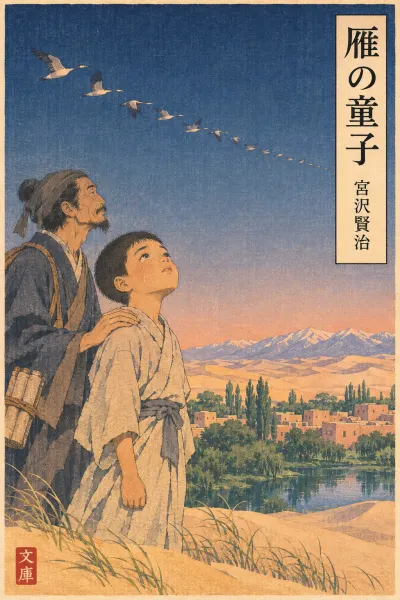
This is a framed legend set in a Central Asian desert region south of the Moving Sands. A traveller resting at a small spring notices a newly painted shrine. An old pilgrim explains it by telling the tale of the Wild Goose Child, a boy said to have come down from heaven. Suriya Kei, a poor man of good family who copies sutras, takes in a child who survives when a flight of wild geese is shot from the sky. In the oasis town of Sasha the boy grows up gentle and strangely knowing. He weeps at things others barely notice, and his adoptive father comes to feel a quiet awe toward him. The tone is hushed and sorrowful, with Buddhist ideas of compassion and past lives running underneath. For a learner, the main challenge is the pilgrim's narration, which is very honorific and slightly archaic, full of でございます and respectful verb forms. The reward is that the characters' dialogue is plain and natural. The six parts are short, so each sitting covers one clear episode.
Contents
Easier versions
This story is also retold in simpler Japanese. Reading an easier version first makes the original much more approachable.
Before you read
- Separate the three voices. The traveller narrates in ordinary です/ます. The pilgrim's tale uses heavy honorifics: でございます, 申します/申しまする, 申し伝えます, and お〜なさる or 〜れる/〜られる for Suriya and the boy. The characters speak in plain form. When a sentence suddenly becomes simple, it is usually dialogue.
- Read 〜れる/〜られる on Suriya's or the boy's actions as honorific, not passive or potential. Similarly, 〜が仰っしゃるには、…と introduces reported speech: "According to what X said, ..."
- Watch for concessive ながら after nouns and adjectives, as in 貧しいながら ("though poor"). Also learn 〜ともなしに ("without really meaning to") and 〜でさえなかったら ("if only it weren't ..."). Each recurs at emotionally important moments.
- Learn a small core vocabulary first: 雁(かり, wild goose), 童子(どうじ, divine child or boy), お経 or 経(sutra), 写す(to copy), 流沙(the Moving Sands), 鉄砲(gun), 壁(wall). Learn the place names in the glossary too, since they appear without explanation.
- 見る見る ("before one's eyes, rapidly") and 〜たまま ("while still ...") carry many of the vivid images, such as the burning geese and the boy's collapse. Slow down when you see them.
Words to know
The most useful words from the notes across the story.
| Word | Meaning | JLPT |
|---|---|---|
| 俄かににわか | suddenly, all at oncedictionary form: 俄かLiterary; everyday speech uses 急に. | N2 |
| 写経しゃきょう | copying Buddhist sutras by handDone as a religious practice or as a profession. | — |
| 遁げにげる | to flee, escapedictionary form: 遁げるOlder kanji for 逃げる. | N4 |
| 郊外こうがい | outskirts, edge of town | N4 |
| 泉いずみ | spring (of water)Kanji tip: 白 (white) over 水 (water), clear water welling up. | N3 |
| 幡はた | (Buddhist) bannerA long hanging banner set up at temples and shrines; different kanji from 旗 (flag) and 機 (loom). | N3 |
| 罪つみ | sin, crimeBeing 'cast down from Heaven for a sin' is a common motif in East Asian legends. | N3 |
| 眺めてながめる | to gaze at, look out overdictionary form: 眺めるSuggests looking steadily at something at a distance. | N3 |
| 随いましたしたがう | to follow, go along withdictionary form: 随うUsually written 従う today; in 随いて the same kanji is read つ(いて). | N3 |
| 囲みましたかこむ | to surround, to encircledictionary form: 囲む | N3 |
| 赦してゆるす | to forgivedictionary form: 赦す赦 is used for forgiving a wrong; 許す is the everyday spelling. | N3 |
| 気の毒きのどく | pitiful; feeling sorry for someoneExpresses sympathy for another's misfortune. | N3 |
| 堪らなくたまらない | unbearable, unable to stand itdictionary form: 堪らないAlso used positively: 'irresistible'. | N3 |
| 拝むおがむ | to pray to with palms pressed together; to beg humbly | N2 |
| 這ってはう | to creep, to crawldictionary form: 這うUsed poetically here for light spreading slowly. | N2 |
Plot summary
Show the full summary (contains spoilers)
A traveller asks an old pilgrim about a newly painted shrine, and the pilgrim tells a legend. Suriya Kei urges his cousin to stop hunting. Soon afterwards, bullets strike a line of wild geese, which burst into flame and turn into heavenly beings. A dying old man among them begs Suriya to raise his unharmed grandson. Suriya takes the boy home, and Sasha calls him the Wild Goose Child. The boy is gentle, smiling when a stone hits him and weeping over a cooked fish and a foal separated from its mother. At twelve he studies in the capital, though he longs to stay home. In spring, ancient temple ruins are dug from the sand. In a deep pit, father and son find a wall painting of heavenly children, one resembling the boy. The boy collapses, says his grandfather has called him, and reveals that Suriya painted this wall in a past life. Then he dies. The pilgrim finishes, and the two men bow and part across the desert.
About the author
Miyazawa Kenji was a poet and writer of children's stories from Hanamaki in Iwate Prefecture. He studied agricultural science in Morioka and later taught at an agricultural school. He devoted much of his life to helping local farmers improve their methods and their cultural lives. He was a devout Buddhist, and his faith, love of nature and interest in science run through his writing. His fame came after his death, with works such as 銀河鉄道の夜, 風の又三郎 and the poem 雨ニモマケズ.