Part 6 of 6 · JLPT N2
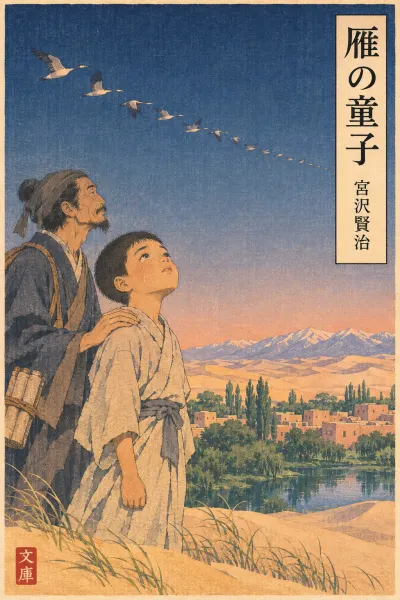
雁の童子 Kari no Dōji, part 6: The Painted Wall and the Parting
In this part
Walking outside town, Suriya and the boy climb down into a deep pit dug in the sand, where an old wall shows three heavenly children, one of whom looks like the boy. The boy collapses, says his grandfather has sent for him, and before dying tells how in a past life Suriya painted that very wall. The old pilgrim ends his tale, and he and the narrator bow to each other and walk off in opposite directions across the desert.
AI translation · independently checked
須利耶さまはお笑いになりました。Suriya-sama laughed.
(勿論だ。この人の大きな旅では、自分だけひとり遠い光の空へ飛び去ることはいけないのだ。)(Of course. On this person's great journey, it would never do to fly off alone to that distant sky of light.)
(いいえ、お父さん。私はどこへも行きたくありません。そして誰もどこへも行かないでいいのでしょうか。)とこう云う不思議なお尋ねでございます。("No, Father. I don't want to go anywhere. And is it all right for no one to go anywhere?") Such was the strange question he asked.
(誰もどこへも行かないでいいかってどう云うことだ。)("What do you mean, is it all right for no one to go anywhere?")
(誰もね、ひとりで離れてどこへも行かないでいいのでしょうか。)("I mean, is it all right for no one to go off alone, apart from the others, anywhere at all?")
(うん。それは行かないでいいだろう。)と須利耶さまは何の気もなくぼんやりと斯うお答えでした。("Yes. I suppose it's all right not to go.") So Suriya-sama answered, absently and without a second thought.
そしてお二人は町の広場を通り抜けて、だんだん郊外に来られました。And the two of them passed through the town square and gradually came out to the outskirts.
沙がずうっとひろがっておりました。The sand stretched away on and on.
その砂が一ところ深く掘られて、沢山の人がその中に立ってございました。In one place that sand had been dug out deep, and a great many people were standing down inside the pit.
お二人も下りて行かれたのです。The two of them went down as well.
そこに古い一つの壁がありました。There stood a single old wall.
色はあせてはいましたが、三人の天の童子たちがかいてございました。Its colours had faded, but three heavenly children were painted on it.
須利耶さまは思わずどきっとなりました。Suriya-sama's heart gave a sudden jolt in spite of himself.
何か大きい重いものが、遠くの空からばったりかぶさったように思われましたのです。It seemed to him that something huge and heavy had come down from the far-off sky and fallen right over him.
それでも何気なく申されますには、Even so, he spoke as if nothing were the matter:
(なるほど立派なもんだ。あまりよく出来てなんだか恐いようだ。この天童はどこかお前に肖ているよ。)("Well, it really is a fine piece of work. It's so well done that it's almost frightening. This heavenly child looks a little like you.")
須利耶さまは童子をふりかえりました。Suriya-sama turned to look back at the boy.
そしたら童子はなんだかわらったまま、倒れかかっていられました。And there was the boy, still smiling somehow, beginning to fall.
須利耶さまは愕ろいて急いで抱き留められました。Suriya-sama was startled and quickly caught him in his arms.
童子はお父さんの腕の中で夢のようにつぶやかれました。In his father's arms the boy murmured as if in a dream:
(おじいさんがお迎いをよこしたのです。)("Grandfather has sent someone to fetch me.")
須利耶さまは急いで叫ばれました。Suriya-sama cried out in haste:
(お前どうしたのだ。どこへも行ってはいけないよ。)("What's the matter with you? You mustn't go anywhere!")
童子が微かに云われました。The boy spoke faintly:
(お父さん。お許し下さい。私はあなたの子です。この壁は前にお父さんが書いたのです。そのとき私は王の……だったのですがこの絵ができてから王さまは殺されわたくしどもはいっしょに出家したのでしたが敵王がきて寺を焼くとき二日ほど俗服を着てかくれているうちわたくしは恋人があってこのまま出家にかえるのをやめようかと思ったのです。)("Father, please forgive me. I am your child. You painted this wall long ago, Father. At that time I was the king's……, but after this picture was made the king was killed and we became monks together, and when the enemy king came and burned the temple, while we were hiding for about two days in ordinary clothes, I had someone I loved, and I thought I might give up going back to the monk's life.")
人々が集って口々に叫びました。People gathered round and cried out all at once:
(雁の童子だ。雁の童子だ。)("It's the Wild Goose Child! It's the Wild Goose Child!")
童子はも一度、少し唇をうごかして、何かつぶやいたようでございましたが、須利耶さまはもうそれをお聞きとりなさらなかったと申します。The boy seemed to move his lips a little once more and murmur something, but they say Suriya-sama could no longer make it out.
私の知っておりますのはただこれだけでございます。」That is all that I know."
老人はもう行かなければならないようでした。It seemed the old man had to be on his way now.
私はほんとうに名残り惜しく思い、まっすぐに立って合掌して申しました。I felt truly sorry to part from him, and standing up straight, I put my palms together and said:
「尊いお物語をありがとうございました。まことにお互い、ちょっと沙漠のへりの泉で、お眼にかかって、ただ一時を、一緒に過ごしただけではございますが、これもかりそめのことではないと存じます。"Thank you for that precious tale. Truly, we have only met briefly at a spring on the edge of the desert and spent a single short while together, yet I believe this too is no passing chance.
ほんの通りかかりの二人の旅人とは見えますが、実はお互がどんなものかもよくわからないのでございます。We may look like nothing more than two travellers who happened to pass by, but in truth we do not really know what either of us is.
いずれはもろともに、善逝の示された光の道を進み、かの無上菩提に至ることでございます。Someday, together, we shall surely walk the path of light that the Well-Gone One has shown, and reach that supreme enlightenment.
それではお別れいたします。さようなら。」And so I will take my leave. Farewell."
老人は、黙って礼を返しました。The old man silently returned my bow.
何か云いたいようでしたが黙って俄かに向うを向き、今まで私の来た方の荒地にとぼとぼ歩き出しました。He seemed to want to say something, but in silence he suddenly turned away and began to plod off into the wasteland I had come from.
私もまた、丁度その反対の方の、さびしい石原を合掌したまま進みました。And I, for my part, with my palms still pressed together, went on across the lonely stony plain in exactly the opposite direction.
Vocabulary
| Word | Meaning | JLPT |
|---|---|---|
| 郊外こうがい | outskirts, edge of town | N4 |
| あせてあせる | to fade (of colour)dictionary form: 褪せるDifferent from 焦る (to be in a hurry), which has the same reading. | — |
| 天童てんどう | heavenly child, celestial boyBuddhist term for a divine being in the form of a child; the same as 天の童子. | — |
| 肖ているにる | to resemble, look likedictionary form: 肖るOld-fashioned kanji; today written 似る. | — |
| 倒れかかってたおれかかる | to start to fall, be about to collapsedictionary form: 倒れかかる | — |
| 抱き留められましただきとめる | to catch and hold in one's armsdictionary form: 抱き留める | — |
| つぶやかれましたつぶやく | to murmur, mutterdictionary form: 呟く | N1 |
| お迎いおむかえ | someone sent to fetch a persondictionary form: お迎えお迎えが来る is a euphemism for death; お迎い is an older form. | — |
| 出家しゅっけ | becoming a monk; the monk's lifeLiterally 'leaving the household'. | — |
| 俗服ぞくふく | ordinary lay clothes (not monk's robes) | — |
| 名残り惜しくなごりおしい | sorry to part, reluctant to say goodbyedictionary form: 名残惜しい | — |
| 合掌がっしょう | pressing one's palms together in prayer or greeting | — |
| かりそめかりそめ | passing, temporary, trivialdictionary form: 仮初めLiterary; かりそめのことではない means 'no mere chance'. | — |
| とぼとぼとぼとぼ | (walking) wearily, plodding | — |
Grammar
〜ないでいい N4 it is all right not to …; there is no need to …
Negative て-form plus いい gives permission not to do something. The boy asks whether everyone may stay and not leave the others.
誰もね、ひとりで離れてどこへも行かないでいいのでしょうか。
I mean, is it all right for no one to go off alone, apart from the others, anywhere at all?
〜てございます N1 humble/polite form of 〜てある / 〜ている
ござる replaces ある or いる to make the narration very polite. The storyteller uses it for states, such as pictures painted on a wall or people standing in a pit.
三人の天の童子たちがかいてございました。
three heavenly children were painted on it.
〜ように思われる N3 it seemed as if …
The spontaneous passive 思われる expresses a feeling that comes over someone by itself. ように marks the comparison 'as if'.
遠くの空からばったりかぶさったように思われましたのです。
It seemed to him that something had come down from the far-off sky and fallen right over him.
〜たまま N4 while still …, remaining in the state of …
た-form plus まま means one state continues while something else happens. Here the boy keeps smiling even as he collapses.
童子はなんだかわらったまま、倒れかかっていられました。
The boy, still smiling somehow, was beginning to fall.
〜ているうち(に) N3 while …, in the course of …
This marks a period of time during which something else develops. While he was hiding in lay clothes, he came to have someone he loved.
二日ほど俗服を着てかくれているうちわたくしは恋人があって
while we were hiding for about two days in ordinary clothes, I had someone I loved
Honorific passive 〜れる/〜られる N3 respectful form of a verb
The passive form is used here to show respect, not passive meaning. The narrator uses it for actions by Suriya and the boy, such as 抱き留められました and つぶやかれました.
須利耶さまは愕ろいて急いで抱き留められました。
Suriya-sama was startled and quickly caught him in his arms.