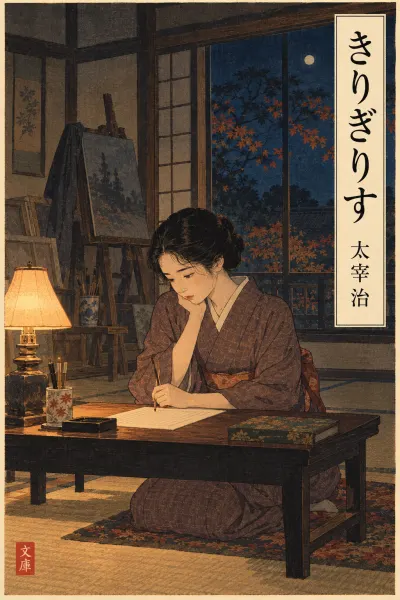
 N4 · easy
Simplified retelling · JLPT N4
きりぎりす Kirigirisu in easy Japanese (N4)
This is our own simplified retelling of A Small Cricket, written for N4 learners and checked word by word against the N4 vocabulary list. A few story words and grammar patterns go beyond N4; the notes below give each one's level. It keeps the characters, events and ending of the original. When it feels easy, move on to the original text.
The story in brief
A twenty-four-year-old wife writes to her painter husband to say she is leaving him. She married him against her parents' wishes because his paintings moved her, and their first poor years together were happy, but sudden success turned him vain, money-minded and two-faced. One night, listening to a cricket chirping in the dark, she resolves to live by that small, quiet voice.
AI translation · independently checked
あなたと別れます。I am leaving you.
私は、もう二十四さいです。I am already twenty-four years old.
私のどこが悪いのか、私にはわかりません。I do not understand what it is about me that is wrong.
でも、もう、あなたといっしょに生きることは出来ません。But I can no longer go on living with you.
五年前の春、私は十九さいでした。Five years ago, in the spring, I was nineteen.
お父さんもお母さんも、あなたとのけっこんに、はんたいしました。Both Father and Mother were against my marrying you.
ほかにも、いい人の話が二つありました。There had been two other proposals as well, from good men.
でも、私はその人たちとけっこんしたいと思いませんでした。But I did not feel that I wanted to marry either of them.
私でなければだめな人のところへ、行きたかったのです。I wanted to go to someone who would be lost without me.
あなたの話を持って来たのは、たじまさんでした。It was Mr. Tajima who brought me the proposal about you.
たじまさんは、えの店の人です。Mr. Tajima is a man from a picture shop.
お父さんの会社に、あなたのえを持って来ました。He brought one of your paintings to Father's office.
あるさむい日、私は一人で、お父さんの会社へそのえを見に行きました。One cold day I went alone to Father's office to see that painting.
小さいにわと、えんがわのえでした。It was a painting of a small garden and a veranda.
えんがわには、白いざぶとんが一つだけありました。On the veranda there was just a single white floor cushion.
青と、きいろと、白だけのえでした。It was a painting of nothing but blue, yellow and white.
見ていると、私のからだはふるえました。As I looked at it, my body began to tremble.
このえは、私にしかわからないと思いました。I thought that no one but I could understand this painting.
私はお母さんにたのみました。I pleaded with Mother.
たじまさんにも、じぶんでへんじをしました。I gave Mr. Tajima my answer myself, too.
ひと月がんばって、私はとうとう、あなたのところへ行きました。After holding firm for a month, I at last came to you.
それからの二年は、本当に楽しかったです。The two years after that were truly happy ones.
私たちは小さいアパートに住んでいました。We lived in a small apartment.
お金はほとんどありませんでした。We had almost no money.
でも、あなたはすきなえだけをかいていました。But you painted only what you loved to paint.
私は毎日、安い物で新しい料理を作りました。Every day I made new dishes out of cheap things.
私は、それがうれしかったのです。That made me happy.
ときどき、たじまさんが来て、あなたのえを持って行きました。Now and then Mr. Tajima would come and take your paintings away.
そして、私に白いふうとうを渡しました。And he would hand me a white envelope.
中にはお金が入っていました。Inside, there was money.
私は一度も、あなたに「お金がほしい」「有名になって」と、たのんだことはありません。Not once did I ask you, "I want money," or "Please become famous."
二年目の秋、たじまさんが、あなたのえを見せる会を開きました。In the autumn of our second year, Mr. Tajima held an exhibition of your paintings.
その前に、あなたは、はいしゃに通い始めました。Before it, you started going to the dentist.
前は少しも気にしなかったのに。Though before, you had never cared about such things in the least.
会はとてもよかったです。The exhibition went very well.
新聞は、あなたのえをほめました。The newspapers praised your paintings.
えは、ぜんぶ人に買われました。Every one of the paintings was bought.
私はこわくなりました。I grew frightened.
いいことが、早く来すぎたと思いました。I thought the good things had come too soon.
私たちは急にお金持ちになりました。All at once we became rich.
あなたは、アパートをはずかしいと思うようになりました。You began to feel ashamed of the apartment.
私たちは、この大きい家にひっこしました。We moved into this big house.
あなたはデパートで、高い物をたくさん買いました。At the department store you bought a great many expensive things.
私はかなしくなりました。I grew sad.
きゃくも、たくさん来るようになりました。Visitors, too, began to come in great numbers.
前はしずかな人だったのに、あなたはよく話すようになりました。You used to be a quiet man, yet now you talked a great deal.
でも、あなたの話は、ほかの人から聞いたことばかりです。But all your talk is nothing but things you heard from other people.
私が話したことも、じぶんの意見のように話します。Even things I have said, you repeat as if they were your own opinions.
それに、いつもお金のことを話します。And besides, you always talk about money.
私はお金はいりません。I do not need money.
しずかに生きたいのです。I want to live quietly.
にわに、へちまのたなを作ってほしいと、何度もたのみました。Again and again I asked you to build a trellis for loofah vines in the garden.
でも、あなたは「来年な」と答えるだけでした。But all you ever answered was, "Next year."
ことしのお正月、あなたは私を、おかい先生の家へつれて行きました。This New Year, you took me to Master Okai's house.
先生はとても有名な画家ですが、小さい家に住んでいました。The Master is a very famous painter, yet he lived in a small house.
本当にりっぱな人だと思いました。I thought him a truly fine man.
でも、先生の家を出ると、あなたは先生の悪口を話しました。But as soon as we had left his house, you began speaking ill of him.
さっきまで、先生にとてもていねいに話していたのに。And only moments before, you had been speaking to him so very politely.
その日、私はあなたと別れようと思いました。That was the day I decided to leave you.
このあいだ、あなたはラジオで話しました。The other day, you spoke on the radio.
あなたのこえは、知らない人のこえのようでした。Your voice sounded like the voice of a stranger.
きたないこえだと思いました。I thought it an ugly voice.
私はラジオをけしました。I turned off the radio.
その夜、私は早くねました。That night I went to bed early.
電気をけして、一人でねていると、虫がないていました。When I had put out the light and was lying alone, an insect was chirping.
ちょうど、私のせなかの近くでした。It was just near my back.
私のせなかの中で、小さいきりぎりすがないているような気がしました。I felt as though a little cricket were chirping inside my own back.
私は、この小さいこえをずっとわすれないで、生きて行こうと思いました。I decided that I would go on living without ever forgetting this small voice.
この世界では、あなたが正しいのかもしれません。In this world, perhaps it is you who are right.
でも、私には、じぶんのどこが正しくないのか、どうしてもわかりません。But I simply cannot understand where it is that I am not right.
Vocabulary
| Word | Meaning | JLPT |
|---|---|---|
| 別れますわかれる | to part from, to separate, to leave (a partner)dictionary form: 別れるUsed with と: あなたと別れる = to leave you / break up with you. | N4 |
| はんたいしましたはんたいする | to oppose, to be againstdictionary form: 反対するThe thing opposed takes に: けっこんにはんたいする. | — |
| えんがわえんがわ | veranda; a narrow wooden walkway along the garden side of a Japanese housedictionary form: 縁側 | N1 |
| ざぶとんざぶとん | floor cushion for sitting ondictionary form: 座布団 | N2 |
| ふるえましたふるえる | to tremble, to shakedictionary form: 震える | N3 |
| とうとうとうとう | at last, finally (after a long effort) | N4 |
| ふうとうふうとう | envelopedictionary form: 封筒 | N5 |
| はいしゃはいしゃ | dentistdictionary form: 歯医者歯 (tooth) + 医者 (doctor). | N4 |
| ほめましたほめる | to praisedictionary form: 褒める | N4 |
| ひっこしましたひっこす | to move (house)dictionary form: 引っ越す | N4 |
| へちまへちま | loofah (a climbing gourd plant)Grown on a trellis (たな) for shade in summer; here a symbol of a simple, quiet life. | — |
| 悪口わるぐち | bad-mouthing, speaking ill of someoneUsually 悪口を言う; here 悪口を話す. | N3 |
| ていねいていねい | polite, courteousdictionary form: 丁寧A な-adjective; ていねいに = politely. | N4 |
| きりぎりすきりぎりす | cricket (a chirping insect; strictly, a kind of katydid)The title of the story. | — |
Grammar
〜でなければだめ N4 it must be ~; nothing but ~ will do
でなければ is the negative conditional of です ("if it is not"), and だめ means "no good". Together, 私でなければだめな人 describes a person for whom only she will do.
私でなければだめな人のところへ、行きたかったのです。
I wanted to go to someone who would be lost without me.
〜のに N4 even though, despite the fact that
のに joins two facts where the second is surprising or disappointing. Placed at the end of a sentence, as here, it carries the speaker's complaint or regret.
前は少しも気にしなかったのに。
Though before, you had never cared about such things in the least.
〜ようになる N4 to come to (do), to start (doing)
Attached to the dictionary form of a verb, it shows a gradual change in habit or attitude. Here it marks how the husband changed after becoming rich.
あなたは、アパートをはずかしいと思うようになりました。
You began to feel ashamed of the apartment.
〜てほしい N4 to want someone to do something
The て-form of a verb plus ほしい expresses a wish for someone else to act. With たのむ, it reports a request.
にわに、へちまのたなを作ってほしいと、何度もたのみました。
Again and again I asked you to build a trellis for loofah vines in the garden.
〜ような気がする N3 to feel as if, to have a feeling that
ような ("like, as if") plus 気がする ("to have a feeling") describes an impression that is not literally true. Here she feels the cricket is inside her own back.
私のせなかの中で、小さいきりぎりすがないているような気がしました。
I felt as though a little cricket were chirping inside my own back.
〜かもしれない N4 might, may, perhaps
かもしれない after a plain form shows possibility without certainty. Here the polite form かもしれません lets her concede a point while still doubting it.
この世界では、あなたが正しいのかもしれません。
In this world, perhaps it is you who are right.