Intermediate · JLPT N3
きりぎりすKirigirisu — A Small Cricket
- JLPT N3
- 12,635 characters
- 6 parts
- about 105 minutes
- 2 easier versions
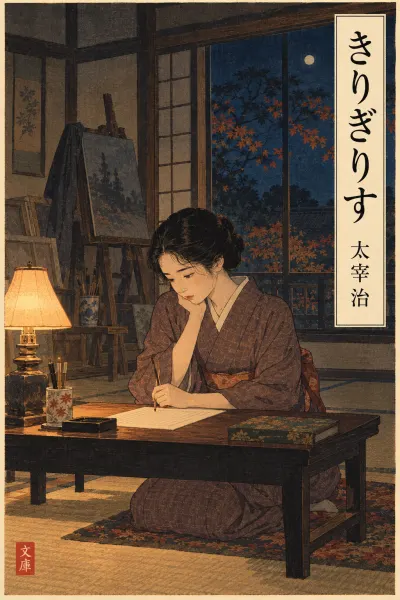
きりぎりす is a short story told entirely in the voice of a twenty-four-year-old wife writing to her painter husband to say she is leaving him. Five years earlier she turned down safer suitors and married an unknown, poor artist because one of his paintings moved her. Now he is successful, and she tries to explain, point by point, why that success has made her unable to stay. The piece is less a plot than a confession: Dazai uses this female first-person monologue to examine vanity, flattery, money, and what it means to keep one's integrity. The tone moves from restrained and courteous to hurt, ironic, and finally quietly resolute. For a learner, the single narrator and the letter form are a help, because there is no dialogue to follow between many speakers and the sentences stay close to everyday life. The challenge is register. She writes in formal feminine keigo with older spellings, slips into intimate casual speech when her feelings break through, and quotes her husband's rough masculine lines. Following those shifts is a large part of understanding her.
Contents
Easier versions
This story is also retold in simpler Japanese. Reading an easier version first makes the original much more approachable.
Before you read
- Learn the narrator's formal letter vocabulary before you start: ~でございます, 申し上げます, 居ります (= おります), and verbs written with older kanji such as 怺える (こらえる, to bear or endure). They appear throughout, and recognising them quickly frees your attention for the content.
- Watch for register shifts as signals of emotion. When she drops from ~でございます into casual feminine endings like ~の, ~わ, ~ね, or ~ですもの, she is usually at her most hurt or most honest. Her husband's quoted lines (~やがる, 来やがった) are deliberately coarse by contrast.
- Much of her argument is built from patterns of change and degree, such as ~につれて, ~一方だ, and ~ば~ほど. Expect to meet ~てならない (can't help feeling) and ~のかも知れません when she hedges her own judgements.
- Keep track of where scenes take place. Yodobashi stands for the poor, happy years and Mitaka for the prosperous, unhappy present, so a place name often tells you which period she is describing.
- Notice how often she reports his words and then comments on them, for example when he repeats her opinion of Maupassant as his own. Phrases like ~というじゃありませんか mark her disbelief, and reading these passages slowly shows how her criticism works.
Words to know
The most useful words from the notes across the story.
| Word | Meaning | JLPT |
|---|---|---|
| 大家たいか | great master, leading authorityRead おおや it means a landlord. | N3 |
| 躓かつまずく | to stumble; to faildictionary form: 躓くUsually written in kana today. | N2 |
| 見合いみあい | formal meeting of prospective marriage partnersThe first step of an arranged marriage, usually set up by a go-between. | N1 |
| 出世しゅっせ | rise in the world, success in one's careerOften used of social or career advancement; 御 makes it polite here. | N1 |
| 張り合いはりあい | something worth doing; a sense of purpose張り合いが無い = pointless, unrewarding. | — |
| 陰口かげぐち | backbiting, speaking ill of someone behind their backUsed with たたく: 陰口をたたく. | — |
| 清貧せいひん | honest poverty, being poor but pure-minded | — |
| 孤高ここう | lofty isolation, standing proudly alone | — |
| 覚悟かくご | being prepared for (something bad), resolve覚悟している = to be ready to face something unpleasant. | N3 |
| 評判ひょうばん | reputation; public reception非常な評判 means 'a great sensation, very well received'. | N3 |
| 怺えるこらえる | to bear, to endure, to hold backdictionary form: 堪える怺 is an old kanji spelling; today it is written 堪える. | N2 |
| 勿体なくてもったいない | too good (for one); wastefuldictionary form: 勿体ないUsually written in kana today. | N2 |
| 承りましたうけたまわる | to hear (humble)dictionary form: 承るA humble verb meaning 'hear', 'receive' or 'accept'. | N2 |
| 縁談えんだん | marriage proposal, offer of marriage縁 'tie, fate' + 談 'talk'. | N1 |
| 縁側えんがわ | veranda, the wooden walkway along the garden side of a Japanese house | N1 |
Plot summary
Show the full summary (contains spoilers)
A young wife writes a farewell letter to her husband, a painter. She recalls rejecting two respectable suitors and choosing him after seeing his painting, overcoming her parents' objections with the help of the art dealer Tajima. Their two poor years in a Yodobashi apartment were her happiest. After his first solo exhibition becomes a sensation, he changes. He joins the Nika-kai, moves into a large house in Mitaka, gossips about other painters, repeats others' opinions as his own, watches money closely, and lies to a friend in need. She hopes some misfortune will humble him, but his success only grows. After he flatters the great painter Okai and then sneers at him on the way home, she resolves to leave. That night, after switching off his pompous radio talk, she lies listening to a cricket under the floor and vows to keep its faint voice within her always.
About the author
Dazai Osamu (太宰治) was the pen name of Tsushima Shūji, born into a wealthy landowning family in Aomori Prefecture in northern Japan. He studied French literature at Tokyo Imperial University but did not graduate, devoting himself instead to writing. He is best known for the novels The Setting Sun (斜陽) and No Longer Human (人間失格), which draw heavily on his own troubled life. Much of his work is dark and confessional. Keep Running, Melos shows a brighter, more straightforwardly heroic side of his writing. He died by suicide in 1948.