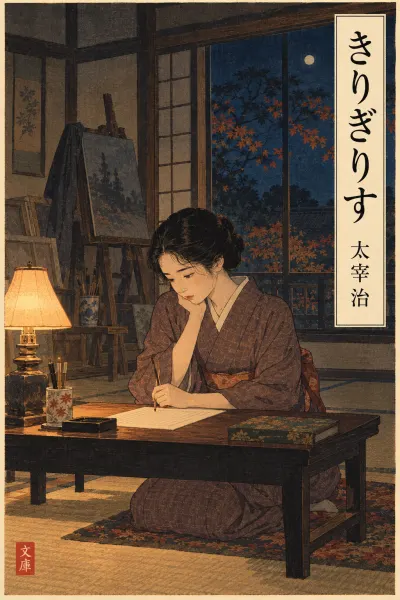
 N5 · easy
Simplified retelling · JLPT N5
きりぎりす Kirigirisu in easy Japanese (N5)
This is our own simplified retelling of A Small Cricket, written for N5 learners and checked word by word against the N5 vocabulary list. A few story words and grammar patterns go beyond N5; the notes below give each one's level. It keeps the characters, events and ending of the original. When it feels easy, move on to the N4 version or the original text.
The story in brief
A twenty-four-year-old wife tells her painter husband she is leaving him. She recalls how she was moved by his painting and how happy their poor early years were, but after he became famous he turned to money, borrowed other people's words and lied, and bowed to a respected teacher only to disparage him once outside. After hearing his voice on the radio sound like a stranger's, she turns it off, goes to bed, hears a small cricket, and resolves to live on with its voice.
AI translation · independently checked
あなたと、わかれます。I am leaving you.
あなたは、いつもうそをいいました。You always told lies.
わたしにも、わるいところがあるかもしれません。Perhaps there is something wrong with me as well.
でも、どこがわるいのか、わかりません。But I don't know where I am at fault.
わたしは、もう二十四さいです。I am already twenty-four years old.
五年前のはる、わたしは十九さいでした。Five years ago, in the spring, I was nineteen.
たじまさんという人が、あなたのえを、お父さんのかいしゃに売りに来ました。A man called Mr. Tajima came to my father's company to sell your paintings.
そして、「この人のおくさんになりませんか」といいました。And he said, "Won't you become this man's wife?"
お父さんもお母さんも、この話がきらいでした。Both Father and Mother disliked this proposal.
わたしは一人で、かいしゃへそのえを見に行きました。I went to the company by myself to see the painting.
とてもさむいへやでした。It was a very cold room.
小さいにわのえでした。It was a painting of a small garden.
青ときいろと白だけのえでした。It was a painting in nothing but blue, yellow and white.
わたしのからだは、ふるえました。My whole body trembled.
「このえは、わたしでなければ、わからない」とおもいました。I thought, "No one but me could understand this painting."
わたしは、あなたとけっこんしました。I married you.
小さいアパートに、二年すみました。We lived in a small apartment for two years.
わたしたちは、びんぼうでした。We were poor.
でも、毎日がとてもたのしかったです。But every day was such a joy.
お金がなくても、おいしいりょうりをつくりました。Even without money, I made delicious meals.
あなたは、すきなえだけをかきました。You painted only the pictures you wanted to paint.
あなたは、ずっとびんぼうで、だれにもあたまを下げない人だと、おもっていました。I believed you were a man who would stay poor all his life and never bow his head to anyone.
でも、たじまさんが、あなたのえを、たくさんの人に見せました。But Mr. Tajima showed your paintings to a great many people.
えは、みんなかわれました。Every one of the paintings was bought.
しんぶんも、あなたをほめました。The newspapers praised you, too.
あなたは、きゅうにゆうめいになりました。All at once, you became famous.
わたしたちは、大きいいえをかりて、そこにすみました。We rented a big house and went to live there.
あなたは、デパートでたかい物をたくさんかいました。You bought a great many expensive things at the department store.
わたしは、それがいやでした。I hated that.
いえには、毎日たくさんの人が来ました。Every day, a great many people came to the house.
あなたは、よく話す人になりました。You became a man who talked a great deal.
でも、ほかの人のことばを、あなたのことばにして話しました。But you took other people's words and spoke them as if they were your own.
あなたは、いつもお金の話をしました。You were always talking about money.
わたしのさいふの中も見ました。You even looked inside my purse.
わたしは、お金はいりません。I have no need of money.
あなたの友だちが、こまって来ました。A friend of yours came to us in trouble.
あなたは、「わたしたちも、お金がない」といって、すこしだけお金をかしました。You said, "We haven't got any money either," and lent him only a little.
それも、うそです。That was a lie, too.
あなたは毎あさ、大きいこえで、うたをうたいます。Every morning you sing songs in a loud voice.
今年のはじめ、ゆうめいなおかい先生のいえへ行きました。At the beginning of this year, we went to the house of the famous Master Okai.
先生は、小さいいえにすんでいました。The master lived in a small house.
ほんとうにりっぱな人でした。He was truly a fine man.
あなたは先生の前で、なんどもあたまを下げました。In front of the master, you bowed your head again and again.
でも、いえを出て、すぐに「あの先生は、だめだ」といいました。But as soon as we left the house, you said, "That master's no good."
わたしは、あなたとわかれようとおもいました。I thought that I would leave you.
でも、あなたは、ずっとゆうめいで、お金もたくさんありました。But you went on being famous, and you had plenty of money, too.
せんしゅう、あなたはラジオで話しました。Last week, you spoke on the radio.
知らない人のこえでした。It was the voice of a stranger.
きたないこえでした。It was an ugly voice.
わたしは、ラジオをけしました。I turned off the radio.
そのよる、わたしははやくねました。That night, I went to bed early.
へやは、くらくて、しずかでした。The room was dark and quiet.
下で、小さいきりぎりすがないていました。Down below, a small cricket was chirping.
わたしのせなかの中で、ないているようでした。It seemed to be chirping from inside my back.
わたしは、この小さいこえを、ずっとわすれません。I shall never forget this small voice.
このこえといっしょに生きていきます。I shall go on living with this voice beside me.
あなたがよくて、わたしがわるいのかもしれません。Perhaps you are right, and I am the one who is wrong.
でも、わたしのどこがわるいのか、わかりません。But I cannot tell what it is in me that is wrong.
Vocabulary
| Word | Meaning | JLPT |
|---|---|---|
| わかれますわかれる | to separate, to leave someone, to partdictionary form: わかれる(別れる)Use と for the person: あなたとわかれる = to leave you. | — |
| うそうそ | a liedictionary form: うそ(嘘)To tell a lie is うそをいう or うそをつく. | — |
| ふるえましたふるえる | to tremble, to shakedictionary form: ふるえる(震える)Here from strong emotion, not from the cold. | — |
| けっこんしましたけっこんする | to marrydictionary form: けっこんする(結婚する)The partner takes と: あなたとけっこんする. | — |
| びんぼうびんぼう | poor, povertydictionary form: びんぼう(貧乏)A な-adjective: びんぼうな人, びんぼうでした. | — |
| ほめましたほめる | to praisedictionary form: ほめる(褒める) | — |
| ゆうめいゆうめい | famousdictionary form: ゆうめい(有名)な-adjective; ゆうめいになる = to become famous. | — |
| かりてかりる | to rent, to borrowdictionary form: かりる(借りる)Opposite of かす (to lend). | — |
| こまってこまる | to be in trouble, to be in difficultydictionary form: こまる(困る)Often means short of money, as here. | — |
| かしましたかす | to lenddictionary form: かす(貸す)The giver uses かす; the receiver uses かりる. | — |
| りっぱりっぱ | fine, admirable, worthy of respectdictionary form: りっぱ(立派) | — |
| あたまを下げましたあたまをさげる | to bow one's head; to humble oneself before someonedictionary form: あたまを下げる(頭を下げる)Can be a polite greeting or, as here, flattery of a powerful person. | — |
| きたないきたない | dirty; (of a voice) ugly, unpleasantdictionary form: きたない(汚い) | — |
| きりぎりすきりぎりす | a cricket (a chirping insect, strictly a katydid)The title of the story. Insects 'cry' in Japanese: きりぎりすがなく. | — |
Grammar
〜かもしれません N4 maybe, perhaps
Added to the plain form of a verb or adjective to show something is possible but not certain. Here the wife admits she might also be at fault.
わたしにも、わるいところがあるかもしれません。
Perhaps there is something wrong with me as well.
verb stem + に来る/行く N5 to come / go in order to do
The ます-stem of a verb plus に shows the purpose of coming or going. 売りに来ました means he came for the purpose of selling.
たじまさんという人が、あなたのえを、お父さんのかいしゃに売りに来ました。
A man called Mr. Tajima came to my father's company to sell your paintings.
〜でなければ N3 if it is not ~ / unless it is ~
The negative conditional of the copula (だ/です → でなければ). With a negative main clause it means 'unless it is ~, not...', i.e. 'only ~ can'. わたしでなければ、わからない means no one but her could understand.
このえは、わたしでなければ、わからない
No one but me could understand this painting.
〜なくても N4 even if not / even without
The ない-form changed to なくても means 'even if (something) isn't so'. Here, even though they had no money, she still cooked good meals.
お金がなくても、おいしいりょうりをつくりました。
Even without money, I made delicious meals.
volitional + とおもう N4 to think of doing, to intend to do
The volitional form (わかれよう) plus とおもう expresses an intention or decision forming in the speaker's mind.
わたしは、あなたとわかれようとおもいました。
I thought that I would leave you.
〜ようでした N4 it seemed as if
Plain form + ようだ describes how something seems or feels, often as a comparison. The cricket's voice felt as if it came from inside her own body.
わたしのせなかの中で、ないているようでした。
It seemed to be chirping from inside my back.