Part 4 of 5 · JLPT N3
狐 Kitsune, part 4: A Bedtime Question About Foxes
In this part
Bunroku gets home and quietly starts to worry that a fox really has possessed him. At bedtime his mother asks about the festival, but he asks her instead whether putting on new clogs at night makes a fox possess you, and what she would do if he turned into a fox. She laughs, then teases him with a very serious face: she and his father would give up being human and become foxes too.
AI translation · independently checked
文六ちゃんの屋敷の外囲いになっている槙の生垣のところに来ました。He came to the hedge of maki trees that ran around the outside of Bunroku's house and yard.
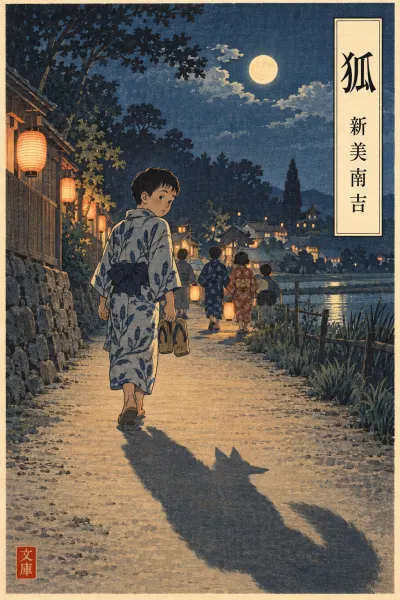
背戸口の方の小さい木戸をあけて中にはいりながら、文六ちゃんは、じぶんの小さい影法師を見てふと、ある心配を感じました。As he opened the little wicket gate by the back door and went in, Bunroku caught sight of his own small shadow, and all at once he felt a certain worry.
――ひょっとすると、じぶんはほんとうに狐につかれているかもしれない、ということでした。It was this: perhaps a fox really had got into him.
そうすると、お父さんやお母さんはじぶんをどうするだろうということでした。And if that were so, what would his father and mother do with him?
六Six
お父さんが樽屋さんの組合へいつて、今晩はまだ帰らないので、文六ちゃんとお母さんはさきに寝むことになりました。His father had gone to the barrel-makers' guild and had not yet come home that evening, so Bunroku and his mother went to bed first.
文六ちゃんは初等科三年生なのにまだお母さんといっしょに寝るのです。Bunroku was in his third year of primary school, yet he still slept with his mother.
ひとり子ですからしかたないのです。He was an only child, so it could not be helped.
「さあ、お祭の話を、母ちゃんにきかしておくれ」"Now then, tell Mama all about the festival."
とお母さんは、文六ちゃんのねまきのえりを合わせてやりながらいいました。said his mother, as she straightened the collar of Bunroku's nightclothes.
文六ちゃんは、学校から帰れば学校のことを、町にゆけば町のことを、映画を見てくれば映画のことをお母さんにきかれるのです。Whenever Bunroku came home from school, his mother asked him about school; whenever he went into town, she asked him about the town; and whenever he had seen a film, she asked him about the film.
文六ちゃんは話が下手ですから、ちぎれちぎれに話をします。Bunroku was not good at telling things, so he told them in bits and pieces.
それでもお母さんは、とても面白がって、よろこんで文六ちゃんの話をきいてくれるのでした。Even so, his mother always found it great fun and listened happily to everything he told her.
「神子さんね、あれよく見たら、お多福湯のトネ子だったよ」"You know the shrine maiden? When I looked real close, it was Toneko from the Otafuku-yu."
と文六ちゃんは話しました。Bunroku told her.
お母さんは、そうかい、といって、面白そうに笑って、His mother said, "Is that so?" and laughed as if she found it very funny,
「それから、もう誰が出たかわからなかったかい」"And after that, couldn't you tell who else came on?"
とききました。she asked.
文六ちゃんはおもいだそうとするように、眼を大きく見ひらいて、じっとしていましたが、やがて、祭の話はやめて、こんなことをいいだしました。Bunroku opened his eyes wide and lay very still, as though trying to remember, but after a while he dropped the subject of the festival and began to say something like this.
「母ちゃん、夜、新しい下駄おろすと、狐につかれる?」"Mama, if you put on new clogs at night, does a fox get into you?"
お母さんは、文六ちゃんが何をいい出したかと思って、しばらく、あっけにとられて文六ちゃんの顔を見ていましたが、今晩、文六ちゃんの身の上に、おおよそどんなことが起ったか、けんとうがつきました。His mother wondered what on earth Bunroku was talking about, and for a little while she simply stared at his face in astonishment; but then she had a fair idea of what must have happened to him that evening.
「誰がそんなことをいった?」"Who told you a thing like that?"
文六ちゃんはむきになって、じぶんのさきの問いをくりかえしました。Bunroku, very much in earnest, asked his question over again.
「ほんと?」"Is it true?"
「嘘だよ、そんなこと。昔の人がそんなことをいっただけだよ」"No, that's not true. It's just something people used to say in the old days."
「嘘だね?」"It's not true?"
「嘘だとも」"Of course it isn't."
「きっとだね」"For sure?"
「きっと」"For sure."
しばらく文六ちゃんは黙っていました。For a while Bunroku said nothing.
黙っている間に、大きい眼玉が二度ぐるりぐるりとまわりました。While he was silent, his big eyes rolled round and round, twice.
それからいいました。Then he said,
「もし、ほんとだったらどうする?」"But if it was true, what would you do?"
「どうするって、何を?」"What would I do? About what?"
とお母さんがききかえしました。his mother asked back.
「もし、僕が、ほんとに狐になっちゃったらどうする?」"If I really did turn into a fox, what would you do?"
お母さんは、しんからおかしいように笑いだしました。His mother burst out laughing, as if she found it truly funny.
「ね、ね、ね」"Tell me, tell me, tell me!"
と文六ちゃんは、ちょっとてれくさいような顔をして、お母さんの胸を両手でぐんぐん押しました。said Bunroku, looking a little embarrassed, and he pushed hard against his mother's chest with both hands.
「そうさね」と、お母さんはちょっと考えていてからいいました。"Well now," said his mother, after thinking for a moment.
「そしたら、もう、家におくわけにゃいかないね」"Then I suppose we couldn't keep you in the house any more."
文六ちゃんは、それをきくと、さびしい顔つきをしました。When Bunroku heard this, a lonely look came over his face.
「そしたら、どこへゆく?」"Then where would I go?"
「鴉根山の方にゆけば、今でも狐がいるそうだから、そっちへゆくさ」"They say there are still foxes over Karasune-yama way, so you'd go there, I expect."
「母ちゃんや父ちゃんはどうする?」"And what would you and Papa do?"
するとお母さんは、大人が子供をからかうときにするように、たいへんまじめな顔で、しかつべらしく、Then his mother, the way grown-ups do when they are teasing children, put on a very serious face and said solemnly,
「父ちゃんと母ちゃんは相談をしてね、かあいい文六が、狐になってしまったから、わしたちもこの世に何のたのしみもなくなってしまったで、人間をやめて、狐になることにきめますよ」"Papa and Mama would talk it over, and we'd say: our darling Bunroku has turned into a fox, so there's nothing left in this world to make us happy; we'll stop being people and become foxes too. That's what we'd decide."
Vocabulary
| Word | Meaning | JLPT |
|---|---|---|
| 生垣いけがき | hedge (a fence of living plants)生 'living' + 垣 'fence'. 槙 (maki) is a podocarpus, often used for hedges. | — |
| 背戸口せどぐち | back door, back entranceOld-fashioned; 背戸 is the back of a house. | — |
| 影法師かげぼうし | (a person's) shadow, silhouetteLiterary word for a shadow cast by a person. | — |
| つかれているつかれる | to be possessed (by a spirit or animal)dictionary form: 憑かれる狐につかれる = to be bewitched by a fox, a common folk belief. Different from 疲れる 'to be tired'. | — |
| 組合くみあい | guild, association, union | N3 |
| ひとり子ひとりご | only childdictionary form: 一人子Today ひとりっ子 is more common. | — |
| ちぎれちぎれちぎれちぎれ | in bits and pieces, disjointedlyFrom ちぎれる 'to be torn off'. | — |
| 神子みこ | shrine maiden (dancer at a shrine)Usually written 巫女. | — |
| おろすおろす | to use (something new) for the first timedictionary form: 下ろす新しい下駄をおろす = to wear new clogs for the first time. | N3 |
| あっけにとられてあっけにとられる | to be taken aback, dumbfoundeddictionary form: 呆気に取られる | — |
| けんとうがつきましたけんとうがつく | to have a rough idea, to guessdictionary form: 見当がつく | — |
| むきになってむきになる | to get very earnest or worked up (about something)dictionary form: 向きになる | — |
| てれくさいてれくさい | embarrassed, self-consciousdictionary form: 照れくさい | — |
| しかつべらしくしかつべらしい | solemnly, with a straight facedictionary form: しかつべらしいOld-fashioned; the modern form is しかつめらしい. | — |
Grammar
ひょっとすると〜かもしれない N3 perhaps, possibly
ひょっとすると introduces a guess and かもしれない ends it, so together they express a nagging possibility. Here it shows Bunroku's half-formed fear.
ひょっとすると、じぶんはほんとうに狐につかれているかもしれない
perhaps a fox really had got into him
〜ことになる N4 it is arranged / it turns out that
〜ことになる describes an outcome decided by circumstances rather than by one person's choice. Because the father is out, going to bed first is simply how things work out.
文六ちゃんとお母さんはさきに寝むことになりました
Bunroku and his mother went to bed first
〜ば〜を (repeated) N4 whenever X, then Y
The conditional ば is repeated in a list to show a habit: each time Bunroku does something, his mother asks about it.
学校から帰れば学校のことを、町にゆけば町のことを
whenever he came home from school, about school; whenever he went into town, about the town
〜とも N2 of course, certainly
Sentence-final とも after a plain form gives a strong, reassuring agreement. The mother uses it to comfort Bunroku firmly.
嘘だとも
Of course it isn't.
〜わけにゃいかない (= わけにはいかない) N3 cannot (for social or moral reasons)
わけにはいかない means something is not possible because of circumstances, not ability. にゃ is a casual contraction of には.
もう、家におくわけにゃいかないね
I suppose we couldn't keep you in the house any more.
〜で (dialect = から) N3 because, so
In this regional speech, で after a plain form gives a reason, like standard から. It links the loss of all joy to the decision to become foxes.
わしたちもこの世に何のたのしみもなくなってしまったで
there's nothing left in this world to make us happy, so