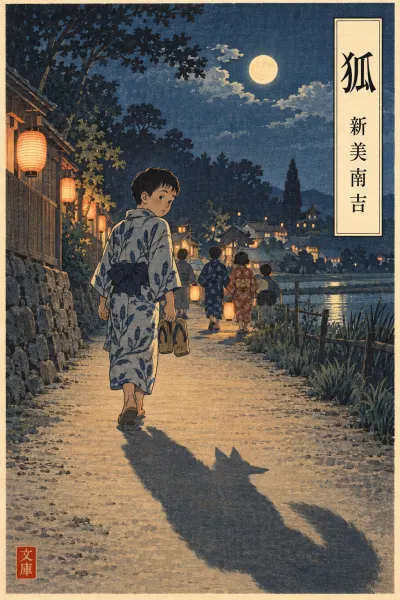
Part 2 of 5 · JLPT N3
狐 Kitsune, part 2: An Eerie Puppet and a Quiet Walk Home
In this part
At the festival, the children watch the dancers and the puppet on the float. The puppet blinks and suddenly sticks out its bright red tongue, and in the shadowy lantern light it frightens them. They remember Bunroku's new clogs and the old woman's warning about foxes. On the long moonlit walk home, they secretly whisper to one another that the clog-shop lady only pretended to perform the protective charm, and they begin to wonder whether Bunroku is already possessed.
AI translation · independently checked
「あれ、トネ子だよ、ふふ」"Look, that's Toneko, hee hee!"
とささやきあったりしました。and they whispered things like that to one another.
稚児さんを見てるのに飽くと、くらいところにいって、鼠花火をはじかせたり、かんしゃく玉を石垣にぶつけたりしました。When they grew tired of watching the festival children, they went off into the dark and set off ground-spinner fireworks, or threw snappers against the stone walls.
舞台を照らすあかるい電燈には、虫がいっぱい来て、そのまわりをめぐっていました。Swarms of insects had come to the bright electric lights that lit the stage, and they were circling round and round them.
見ると、舞台の正面のひさしのすぐ下に、大きな、あか土色の蛾がぴったりはりついていました。When they looked, there was a big moth, the colour of red earth, clinging flat just under the eaves at the front of the stage.
山車の鼻先のせまいところで、人形の三番叟が踊りはじめる頃は、すこし、お宮の境内の人も少くなったようでした。By the time the Sanbasō puppet began to dance on the narrow ledge at the front of the festival float, the crowd in the shrine grounds seemed to have thinned a little.
花火や、ゴム風船の音もへったようでした。The bangs of fireworks and the squeaks of rubber balloons seemed to have died down, too.
子供たちは山車の鼻の下にならんで、仰向いて、人形の顔を見ていました。The children lined up beneath the front of the float, tipped their heads back, and gazed up at the puppet's face.
人形は大人とも子供ともつかぬ顔をしています。The puppet had a face that belonged neither to a grown-up nor to a child.
その黒い眼は生きているとしか思えません。You could only believe that its black eyes were alive.
ときどき、またたきするのは、人形を踊らす人がうしろで糸をひくのです。When it blinked now and then, that was the puppeteer behind it pulling on a string.
子供たちはそんなことはよく知っています。The children knew all about that.
しかし、人形がまたたきすると、子供たちは、何だか、ものがなしいような、ぶきみなような気がします。Yet whenever the puppet blinked, the children somehow felt a little sad, and a little uneasy.
するととつぜん、パクッと人形が口をあきペロッと舌を出し、あっというまに、もとのように口をとじてしまいました。Then all of a sudden the puppet's mouth snapped open, out flicked its tongue, and in the blink of an eye it had shut its mouth again, just as before.
まっかな口の中でした。The inside of its mouth was bright red.
これも、うしろで糸をひく人がやったことです。That, too, was the work of the man pulling the strings behind it.
子供たちはよく知っているのです。The children knew that very well.
ひるまなら、子供たちは面白がって、ゲラゲラ笑うのです。In the daytime, the children would have found it funny and roared with laughter.
けれど子供たちは、いまは笑いませんでした。But now the children did not laugh.
提灯の光の中で、――影の多い光の中で、まるで生きている人間のように、まばたきしたり、ペロッと舌を出したりする人形……何というぶきみなものでしょう。In the lantern light, in light full of shadows, a puppet that blinked and flicked out its tongue just like a living person... what an eerie thing it was!
――子供たちは思い出しました、文六ちゃんの新しい下駄のことを。The children remembered Bunroku's new clogs.
晩げに新しい下駄をおろすものは狐につかれるといったあの婆さんのことを。And they remembered that old woman who had said that anyone who wears new clogs for the first time in the evening will be possessed by a fox.
子供たちは、じぶんたちが、ながく遊びすぎたことにも気がつきました。The children realised, too, that they had stayed out playing far too long.
じぶんたちにはこれから帰ってゆかねばならない、半里の、野中の道があったことにも気がつきました。And they realised that they still had half a ri of road through the fields to walk before they were home.
四Four
かえりも月夜でありました。The way home was moonlit, too.
しかし、かえりの月夜は、なんとなくつまらないものです。Yet a moonlit walk home is somehow a dreary thing.
子供たちは、だまって――ちょうど一人一人が、じぶんのこころの中をのぞいてでもいるように、だまって歩いていました。The children walked on in silence, as silently as if each one of them were peering into his own heart.
切通し坂の上に来たとき、一人の子が、もう一人の子の耳に口を寄せて何かささやきました。When they reached the top of the slope through the cutting, one child put his mouth to another child's ear and whispered something.
するとささやかれた子は別の子のそばにいって何かささやきました。Then the child who had been whispered to went over to someone else and whispered something.
その子はまた別の子にささやきました。That child in turn whispered to yet another.
――こうして、文六ちゃんのほか、子供たちは何か一つのことを、耳から耳へいいつたえました。In this way, one single thing passed from ear to ear among all the children except Bunroku.
それはこういうことだったのです。This is what it was:
「下駄屋さんの小母さんは文六ちゃんの下駄に、ほんとうにマッチをすっておまじないをしやしんだった。まねごとをしただけだった」"The lady at the clog shop didn't really strike a match on Bunroku's clogs for the charm. She only pretended to."
それから子供たちはまたひっそりして歩いてゆきました。After that the children walked on quietly again.
ひっそりしているとき子供たちは考えておりました。And as they walked quietly along, the children were thinking.
――狐につかれるというのはどんなことかしらん。What does it mean, being possessed by a fox, I wonder?
文六ちゃんの中に狐がはいることだろうか。Does a fox get inside Bunroku?
文六ちゃんの姿や形はそのままでいて、心は狐になってしまうことだろうか。Does Bunroku stay looking just the same on the outside while his heart turns into a fox?
そうすると、いまもう、文六ちゃんは狐につかれているかもしれないわけだ。If that's so, Bunroku might already be possessed by a fox right now.
文六ちゃんは黙っているからわからないが、心の中はもう狐になってしまっているかもしれないわけだ。Bunroku's keeping quiet, so you can't tell, but inside he might already have turned into a fox.
Vocabulary
| Word | Meaning | JLPT |
|---|---|---|
| 稚児ちご | children in festival costume who dance or ride in a shrine processionUsually said with さん, as here. Toneko is one of these dancers. | — |
| 飽くあく | to grow tired of, to have had enough ofOld-fashioned form of 飽きる. Here 〜のに飽くと means 'when they got bored of…'. | — |
| 鼠花火ねずみはなび | ground-spinner fireworkLiterally 'mouse firework', because it whizzes along the ground like a mouse. | — |
| 山車だし | festival floatA special reading: neither 山 nor 車 is normally read this way. | — |
| 三番叟さんばそう | Sanbasō, a celebratory ritual dance, here performed by a puppetComes from Noh and Kyōgen and is danced to wish for good harvests and fortune. English has no equivalent, so the name is kept. | — |
| 境内けいだい | the grounds of a shrine or temple | — |
| 仰向いてあおむく | to look up, to tilt one's head backdictionary form: 仰向くThe related 仰向け means 'lying on one's back'. | — |
| ものがなしいものがなしい | vaguely sad, melancholydictionary form: 物悲しいThe prefix もの adds a sense of 'somehow, without a clear reason'. | — |
| ぶきみぶきみ | eerie, creepy, uncannydictionary form: 不気味 | — |
| おろすおろす | to use or wear something new for the first timedictionary form: 下ろすThis is a special sense of the verb. Compare 新しい靴をおろす, 'to break in new shoes'. | N3 |
| 狐につかれるきつねにつかれる | to be possessed by a foxdictionary form: 狐に憑かれるIn folk belief, a fox spirit could enter a person and control their mind. 憑く is used for spirits taking hold of someone. | — |
| 半里はんり | half a ri, about 2 kmOne ri is an old unit of distance of about 3.9 km. | — |
| 切通し坂きりどおしざか | a slope where the road passes through a cutting in a hill切通し is a road cut through a hill. Note the rendaku in 坂 → ざか. | — |
| おまじないおまじない | a charm, a little protective spelldictionary form: お呪いHere it is the ritual of striking a match on new clogs to ward off the fox. | — |
Grammar
〜とも〜ともつかぬ N1 that cannot be called either … or …
つかぬ is the literary negative of つく, 'to be decided'. The pattern describes something that falls in between two categories. Here the puppet's face is somewhere between an adult's and a child's.
人形は大人とも子供ともつかぬ顔をしています。
The puppet had a face that belonged neither to a grown-up nor to a child.
〜としか思えない N2 can only think that …; it seems nothing but …
しか together with a negative verb means 'only'. The phrase stresses that no other interpretation seems possible, even though the children know the eyes are not really alive.
その黒い眼は生きているとしか思えません。
You could only believe that its black eyes were alive.
〜ねばならない N2 must, have to
This is a more literary form of 〜なければならない. 帰ってゆかねばならない means 'must go home'.
じぶんたちにはこれから帰ってゆかねばならない、半里の、野中の道があった
they still had half a ri of road through the fields to walk home
〜しやしんだった (dialect) N1 didn't (really) do
This is a dialect form of しはしなかった. やし comes from は + し, and 〜ん is the regional negative. It gives the children's rumour a strong 'she didn't actually do it' tone.
ほんとうにマッチをすっておまじないをしやしんだった。
She didn't really strike a match for the charm.
〜かもしれないわけだ N3 so it follows that … might be the case
かもしれない means 'might', and わけだ presents this as a logical conclusion. It shows the children reasoning their way, step by step, to a frightening idea.
いまもう、文六ちゃんは狐につかれているかもしれないわけだ。
Bunroku might already be possessed by a fox right now.
〜かしらん N3 I wonder …
This is an old-fashioned variant of かしら. It marks an inner question the speaker asks themselves.
狐につかれるというのはどんなことかしらん。
What does it mean, being possessed by a fox, I wonder?