Part 3 of 5 · JLPT N3
狐 Kitsune, part 3: A Cough, and a Lonely Walk Home
In this part
On the way home from the festival, Bunroku gives a small cough that sounds like 'kon', and the frightened children decide he has turned into a fox. When they reach the water mill, nobody walks him to his isolated house as they usually do, not even kind Yoshinori. Bunroku goes down the moonlit path alone, hurt because he understands exactly why they have turned away from him.
AI translation · independently checked
おなじ月夜で、おなじ野中の道では、誰でもおなじようなことを考えるものです。On the same moonlit night, on the same road through the fields, everyone tends to think much the same thing.
そこでみんなの足はしぜんにはやくなりました。And so, without anyone meaning to, everyone's feet began to hurry.
ぐるりを低い桃の木でとりまかれた池のそばへ、道が来たときでした。It happened just as the road came beside a pond ringed all round by low peach trees.
子供たちの中で誰かが、Someone among the children went
「コン」"Kon,"
と小さい咳をしました。with a small cough.
ひっそりして歩いているときなので、みんなは、その小さい音でさえ、聞きおとすわけにはゆきませんでした。They were walking along in hushed silence, so not one of them could fail to hear even so small a sound.
そこで子供たちは、今の咳は誰がしたか、こっそり調べました。So the children quietly tried to find out who had just coughed.
すると――文六ちゃんがしたということがわかりました。And then they discovered that it had been Bunroku.
文六ちゃんがコンと咳をした!Bunroku had coughed "kon"!
それなら、この咳にはとくべつの意味があるのではないかと子供たちは考えました。In that case, the children thought, perhaps this cough had some special meaning.
よく考えて見るとそれは咳ではなかったようでした。When they thought it over carefully, it did not really seem to have been a cough at all.
狐の鳴声のようでした。It seemed more like the cry of a fox.
「コン」"Kon,"
とまた文六ちゃんがいいました。went Bunroku again.
文六ちゃんは狐になってしまったと子供たちは思いました。The children thought that Bunroku had turned into a fox.
わたしたちの中には狐が一匹はいっていると、みんなは恐ろしく思いました。"There's a fox in among us," they all thought, full of dread.
五Five
樽屋の文六ちゃんの家は、みんなの家とは少しはなれたところにありました。The home of Bunroku, the barrel-maker's boy, stood a little apart from everyone else's houses.
ひろい、蜜柑畑になっている屋敷にかこわれて、一軒きり、谷地にぽつんと立っていました。It was surrounded by wide grounds planted with mandarin orange groves, and it stood all on its own down in a low, damp hollow.
子供たちはいつも、水車のところから少し廻りみちして、文六ちゃんを、その家の門口まで送ってやることにしていました。The children always made a point of going a little out of their way from the water mill to see Bunroku home as far as his gate.
なぜなら、文六ちゃんは樽屋の清六さんの一人きりの大事な坊ちゃんで、甘えん坊だからです。That was because Bunroku was the precious only son of Seiroku the barrel-maker, and a boy who was used to being babied.
文六ちゃんのお母さんが、よく、蜜柑やお菓子をみんなにくれて、文六ちゃんと遊んでやってくれとたのみに来るからです。It was also because Bunroku's mother often gave them all mandarins and sweets, and came to ask them to play with Bunroku.
今晩も、お祭にゆくときには、その門口まで、文六ちゃんを迎えに行ってやったのでした。Tonight too, when they set off for the festival, they had gone all the way to that gate to fetch Bunroku.
さてみんなは、とうとう、水車のところに来ました。Now, at last, they all came to the water mill.
水車の横から細い道がわかれて草の中を下へおりてゆきます。Beside the water mill a narrow path branched off and wound down through the grass.
それが文六ちゃんの家にゆく道です。That was the path to Bunroku's house.
ところが、今夜は誰も、文六ちゃんのことを忘れてしまったかのように、送ってゆこうとするものがありません。But tonight nobody offered to walk him home, as if they had all forgotten about Bunroku.
忘れたどころではありません、文六ちゃんがこわいのです。Far from forgetting him, they were afraid of Bunroku.
甘えん坊の文六ちゃんは、それでも、いつも親切な義則君だけは、こちらへ来てくれるだろうと思って、うしろをむきむき、水車のかげになってゆきました。Still, Bunroku, who was used to being babied, thought that Yoshinori, at least, who was always so kind, would come along with him, and he kept looking back over his shoulder as he passed into the shadow of the water mill.
とうとう、だれも文六ちゃんといっしょにゆきませんでした。In the end, nobody went with Bunroku.
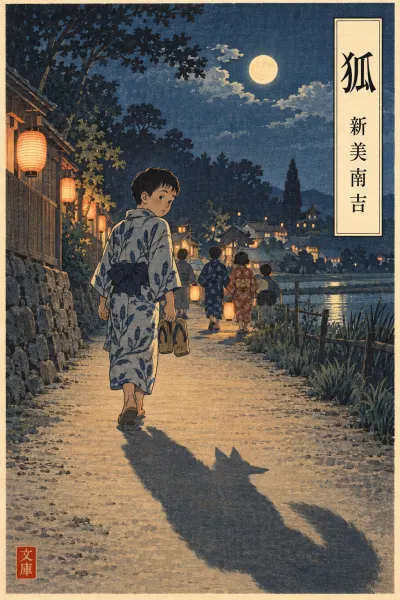
さて文六ちゃんは、ひとりで、月にあかるい谷地へおりてゆく細道をくだりはじめました。And so Bunroku began, all by himself, to go down the narrow path into the moonlit hollow.
どこかで、蛙がくくみ声で鳴いていました。Somewhere a frog was croaking in a muffled voice.
文六ちゃんは、ここから、じぶんの家までは、もうじきだから、誰も送ってくれなくても、困るわけではないのです。From here it was only a short way to Bunroku's own house, so he would come to no harm even if nobody walked him home.
だが、いつもは送ってくれたのです、今夜にかぎっておくってくれないのです。But they had always walked him home before, and tonight of all nights they would not.
文六ちゃんは、ぼけんとしているようでも、もうちゃんと知っているのです、みんなが、じぶんの下駄のことで何といいかわしたか、また、じぶんが咳をしたためにどういうことになったかを。Bunroku might look as if he were in a daze, but he already knew perfectly well what the others had said to one another about his clogs, and what had come of his coughing.
祭にゆくまでは、あんなに、じぶんに親切にしてくれたみんなが、じぶんが、夜新しい下駄をはいて狐にとりつかれたかしれないために、もう誰一人かえりみてくれない、それが文六ちゃんにはなさけないのでした。Before the festival they had all been so kind to him, yet now, because he had put on new clogs at night and might have been possessed by a fox, not a single one of them would so much as look back at him, and that was what made Bunroku so miserable.
義則君なんか文六ちゃんより四年級も上だけれど親切な子で、いつもなら、文六ちゃんが寒そうにしていると、洋服の上に着ている羽織をぬいでかしてくれたものでした(田舎の少年は寒い時、洋服の上に羽織を着ています)。Yoshinori, for one, was four years above Bunroku at school, but he was a kind boy, and at other times, whenever Bunroku looked cold, he would take off the haori he wore over his Western clothes and lend it to him. (In the countryside, boys wear a haori over their Western clothes when it is cold.)
それだのに、今夜は、文六ちゃんが、いくら咳をしていても羽織を貸してやろうとはいいませんでした。And yet tonight, however much Bunroku coughed, Yoshinori never once offered to lend him his haori.
Vocabulary
| Word | Meaning | JLPT |
|---|---|---|
| 月夜つきよ | moonlit night月 (moon) + 夜 (night); 夜 is read よ in compounds like this. | — |
| とりまかれたとりまく | to surround, to ringdictionary form: 取り巻くPassive here: the pond is 'surrounded' by peach trees. | N1 |
| ひっそりひっそり | quietly, in hushed silenceDescribes a still, silent atmosphere; ひっそりする = to be hushed. | — |
| 聞きおとすききおとす | to fail to hear, to miss (a sound)dictionary form: 聞き落とす聞く + 落とす (drop): a sound 'dropped' by the ear. | — |
| 樽屋たるや | barrel-maker, cooper〜屋 marks a trade or shop, and also the person or family who runs it. | — |
| 谷地やち | low, damp hollow; marshy low groundRegional word for wet low-lying land between hills. | — |
| 水車すいしゃ | water mill, waterwheel | — |
| 門口かどぐち | gate, front entrance of a house門 is read かど here, with rendaku on 口 (ぐち). | — |
| 甘えん坊あまえんぼう | a child who is used to being babied or coddledFrom 甘える (to act spoiled, to depend on others' indulgence). | — |
| ぼけんとぼけんと | vacantly, in a dazeColloquial variant of ぼけっと / ぼんやり. | — |
| とりつかれたとりつく | (of a spirit or fox) to possess someonedictionary form: 取り憑くIn Japanese folklore foxes were believed to possess people, often through the passive とりつかれる. | — |
| かえりみてかえりみる | to look back at; to pay attention to, care aboutdictionary form: 顧みるLiterary; here both literally looking back and showing concern. | N1 |
| なさけないなさけない | miserable, pitiful, wretcheddictionary form: 情けないExpresses the hurt and shame of being treated badly. | — |
| 羽織はおり | haori, a short kimono-style jacket worn over other clothesThere is no English equivalent. Here it is worn over Western-style school clothes for warmth. | — |
Grammar
〜ものです N3 it is natural that…; people tend to…
After a plain verb, ものだ states a general truth or natural tendency. The narrator says that anyone would think the same thing in that situation.
誰でもおなじようなことを考えるものです。
everyone tends to think much the same thing.
〜わけにはゆかない N3 cannot (possibly) do…
ゆく is an older form of いく. The pattern says something is impossible because of the circumstances, not because of ability. In the hushed silence, nobody could miss the sound.
その小さい音でさえ、聞きおとすわけにはゆきませんでした。
they could not fail to hear even so small a sound.
〜かのように N2 as if…
Attached to a plain-form clause, it describes behaviour that looks as though something were true when it is not. The children act as if they had forgotten Bunroku.
文六ちゃんのことを忘れてしまったかのように
as if they had forgotten all about Bunroku
〜どころではない N2 far from…; it's not a matter of…
This rejects the first idea as far too mild and points to something stronger. The children had not simply forgotten Bunroku; they were actually afraid of him.
忘れたどころではありません、文六ちゃんがこわいのです。
Far from forgetting him, they were afraid of Bunroku.
〜にかぎって N2 (only) on this occasion, of all times
After a noun, にかぎって singles out one case where the usual thing does not happen, often with a sense of unfairness.
今夜にかぎっておくってくれないのです。
tonight of all nights they would not walk him home.
〜たものでした N3 used to…, would (habitually)…
The past form plus ものだった describes a repeated action in the past, often with a nostalgic tone. It contrasts Yoshinori's usual kindness with how he behaves tonight.
羽織をぬいでかしてくれたものでした
he would take off his haori and lend it to him