Part 1 of 4 · JLPT N3
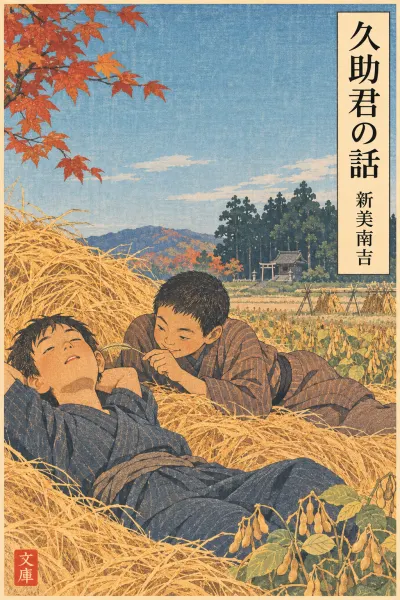
久助君の話 Kyūsukekun no Hanashi, part 1: An Empty Autumn Afternoon, and Hyōtarō
In this part
After Kyūsuke wins a school prize, his father makes him study for an hour every day after school, so by the time he goes out his friends are usually nowhere to be found. One bright autumn afternoon he listens for them, then searches the storehouse yard and the temple and finds no one. On his way to Tokuichi's house he bumps into Hyōtarō, a lovable boy known for his tall tales, tone-deaf singing and odd habits.
AI translation · independently checked
久助君は、四年から五年になるとき、学術優等品行方正のほうびをもらってきた。When Kyūsuke moved up from the fourth grade to the fifth, he came home with a prize for excellence in his studies and good conduct.
はじめて久助君がほうびをもらったので、電気会社の集金人であるおとうさんは、ひじょうにいきごんで、それからは、久助君が学校から帰ったらすぐ、一時間勉強することに規則をきめてしまった。Because it was the first prize Kyūsuke had ever won, his father, a bill collector for the electric company, was terribly keen, and from then on he laid down a rule that Kyūsuke must study for one hour as soon as he got home from school.
久助君は、この規則を喜ばなかった。Kyūsuke was not happy about this rule.
一時間たって、家の外に出てみても、近所に友だちが遊んでいないことが多いので、そのたびに、友だちをさがして歩かねばならなかったからである。When the hour was up and he went outside, there were often no friends playing anywhere nearby, and each time he had to walk around looking for them.
秋のからりと晴れた午後のこと、久助君は柱時計が三時半をしめすと、「ああできた」と、算術の教科書をパタッととじ、つくえの前を立ちあがった。One afternoon in autumn, when the sky was crisp and clear, the wall clock pointed to half past three, and Kyūsuke said, "Ah, done!" He snapped his arithmetic textbook shut and stood up from his desk.
外に出るとまばゆいように明るい。Outside it was dazzlingly bright.
だが、やれやれ、きょうもなかまたちの声は聞こえない。But, oh dear, there was no sound of his pals' voices today either.
久助君は、お宮の森の方へ耳をすました。Kyūsuke listened carefully toward the wood around the shrine.
森は、久助君のところから三町ははなれていたが、久助君は、そこに友だちが遊んでいるかどうかを、耳で知ることができるのだった。The wood was a good three hundred yards from Kyūsuke's house, but he could tell just by listening whether his friends were playing there or not.
だが、きょうは、森はしんとしていて、うまい返事をしない。But today the wood was hushed and gave no helpful answer.
つぎに久助君は、反対の方の、夜学校のあたりにむかって耳をすました。Next Kyūsuke turned the other way and listened toward the night school.
夜学校も三町ばかりへだたっている。The night school was also about three hundred yards away.
だが、これもよいあいずをおくらない。But it, too, sent no good signal.
しかたがないので久助君は、かれらの集まっていそうな場所をさがしてまわることにした。There was nothing else for it, so Kyūsuke decided to go around searching the places where they were likely to have gathered.
もうこんなことが、なんどあったかしれない。Who knew how many times this had happened by now.
こんなことはほんとにいやだ。He really hated this sort of thing.
最初、久助君は、宝蔵倉の前にいってみた、多分の期待をもって。First, Kyūsuke went to look in front of the treasure storehouse, full of hope.
そこで、よくみんなはキャッチボールをするから。The others often played catch there.
しかしきてみると、だれもいない。But when he got there, nobody was around.
そのはずだ、豆が庭いっぱいにほしてある。No wonder: the whole yard was covered with beans spread out to dry.
これじゃ、なにもして遊べない。Nobody could play anything there like this.
そのつぎに久助君は、北のお寺へいった。Next Kyūsuke went to the temple to the north.
ほんとうはあまり気がすすまなかったのだ。To tell the truth, he did not much feel like going.
というのは、そこは、べつの通学団の遊び場所だったから。That was because it was where a different group of schoolchildren played, the ones who walked to school together.
しかし、こんなよい天気の日にひとりで遊ぶよりはましだったので、いったのである。But it was better than playing by himself on such a fine day, so he went.
が、そこにも、たけの高いはげいとうが五、六本、かっと秋日にはえて、鐘撞堂の下に立っているばかりで、犬の子一ぴきいなかった。Yet there too, five or six tall amaranths stood under the bell tower, blazing in the autumn sun, and there was nothing else, not so much as a puppy.
まさか医者の家へなんか集まっていることもあるまいが、ともかくのぞいてみようと思って、黄色い葉のまじった豆畑のあいだを、徳一君の家の方へやっていった。Surely they would not have gathered at the doctor's house, of all places, but he thought he would take a peek anyway, and made his way toward Tokuichi's house between the bean fields, which were dotted with yellow leaves.
そのとちゅう、ほし草の積みあげてあるそばで、兵太郎君にひょっくり出あったのである。On the way, beside a heap of stacked hay, he suddenly ran into Hyōtarō.
兵太郎君は、みんなからほら兵とあだ名をつけられていたが、まったくそうだった。Everyone had given Hyōtarō the nickname Horahyō, and it suited him perfectly.
こんなうなぎをつかんだといって、両方の手の指で、てんびんぼうほどの太さをして見せるので、ほんとうかと思っていってみると、筆ぐらいのめそきんが、井戸ばたの黒いかめの底にしずんでいるというふうである。He would say he had caught an eel this big, and show with the fingers of both hands something as thick as a carrying pole. Then, when you went to see, thinking it might be true, you would find a little baby eel no bigger than a writing brush lying at the bottom of a black jar by the well. That was how he was.
また、兵太郎君はおんちで、君が代もろくろくうたえなかったが、いっこうそんなことは気にせず、みんなが声をそろえてうたっていると、すぐ唱和するので、みんなは調子がへんになって、やめてしまうのであった。Hyōtarō was also tone-deaf and could hardly sing even the national anthem, but he did not care one bit. Whenever everyone was singing together, he would join right in, and the others would lose the tune and end up stopping.
だが、わる気はないので、みんなにきらわれてはいない。But he never meant any harm, so nobody disliked him.
ときどき鼻をすこし右にまげるようにして、キュッと音をたててすいあげるのと、わらうとき、ゆかの上だろうが道の上だろうが、ところきらわず下にころがるくせがあった。He had a habit of now and then bending his nose a little to the right and sniffing up with a squeak, and a habit of rolling about on the ground when he laughed, whether he was on a floor or out in the road.
体操のとき、久助君のすぐ前なので、久助君は、かれの頭のうしろがわに、いくつ、どんな形のはげがあるかをよく知っている。In gym class he stood right in front of Kyūsuke, so Kyūsuke knew very well how many bald patches there were on the back of his head, and what shapes they were.
Vocabulary
| Word | Meaning | JLPT |
|---|---|---|
| ほうびほうび | reward, prizedictionary form: 褒美Often used with もらう for a prize given by a school or a superior. | N1 |
| いきごんでいきごむ | to be eager, to be fired updictionary form: 意気込むLiterally 'to push one's spirit in'. Shows strong enthusiasm for doing something. | N1 |
| 耳をすましたみみをすます | to listen carefully, to strain one's earsdictionary form: 耳を澄ます澄ます means 'to make clear'. A set phrase. | — |
| しんとしんと | hushed, completely silentA mimetic word for deep stillness, often followed by して or する. | — |
| へだたっているへだたる | to be distant, to be apartdictionary form: 隔たるA written-style word for distance in space or time. | N1 |
| あいずあいず | signal, signdictionary form: 合図Used with 送る 'to send' or する. | N3 |
| ましまし | better (of two poor choices), the lesser evilImplies that neither option is really good. | N1 |
| はげいとうはげいとう | amaranth (a tall plant with bright red leaves)dictionary form: 葉鶏頭A typical autumn plant in Japanese gardens and temple grounds. | — |
| ひょっくりひょっくり | unexpectedly, by chanceAn older variant of ひょっこり, used for chance meetings. | — |
| あだ名あだな | nicknameあだ名をつける means 'to give someone a nickname'. | — |
| めそきんめそきん | tiny young eelA dialect word related to めそ / めそっこ, a small eel. | — |
| おんちおんち | tone-deaf; a person who can't carry a tunedictionary form: 音痴Also used jokingly for other weaknesses, e.g. 方向音痴 'no sense of direction'. | — |
| 唱和しょうわ | joining in with others in singing or chantingFormal word; 唱 means 'chant' and 和 means 'in harmony'. | — |
| くせくせ | habit, quirkdictionary form: 癖Usually for personal mannerisms, often slightly odd ones. | N3 |
Grammar
〜ねばならない N2 must, have to
ねば is a written, older form of なければ, so 歩かねばならなかった means the same as 歩かなければならなかった. It is common in narration and formal writing.
友だちをさがして歩かねばならなかったからである
because he had to walk around looking for his friends
〜かどうか N4 whether or not
A plain-form clause plus かどうか turns a yes/no question into a noun phrase, here the object of 知る. Kyūsuke could tell whether his friends were playing there or not.
そこに友だちが遊んでいるかどうかを、耳で知ることができるのだった
he could tell by ear whether his friends were playing there or not
〜かしれない N2 who knows how (many/much)…
With a question word such as なんど, the clause plus かしれない stresses that the number is too large to count. It expresses the narrator's sense of frustration.
もうこんなことが、なんどあったかしれない。
Who knew how many times this had happened by now.
まさか〜まい N2 surely … not
まい is a literary negative guess, like ないだろう. With まさか it means 'surely they wouldn't…', and the following が introduces what he decides to do anyway.
まさか医者の家へなんか集まっていることもあるまいが
Surely they would not have gathered at the doctor's house, of all places, but
〜だろうが〜だろうが N1 whether A or B
Repeating だろうが after two nouns means 'it makes no difference whether it is A or B'. Here it goes with ところきらわず, 'no matter where'.
ゆかの上だろうが道の上だろうが、ところきらわず下にころがるくせがあった
he had a habit of rolling about, whether he was on a floor or in the road