Part 4 of 4 · JLPT N3
久助君の話 Kyūsukekun no Hanashi, part 4: A Stranger in a Friend's Face
In this part
As their long bout of rough play ends, Kyūsuke lets go and stands, and Hyōtarō gets up and gazes at the horizon with a lonely look. Kyūsuke is suddenly struck by the feeling that he has spent half the day romping with a boy he doesn't know, but then sees that it was his familiar friend Hyōtarō after all. They part awkwardly at dusk, and Kyūsuke is left with a new sadness: even people we know well can sometimes become strangers.
AI translation · independently checked
久助君はちょっと手をゆるめてみた。Kyūsuke loosened his grip a little, to see what would happen.
だが相手はもう、その虚に乗じてはこない。But his opponent no longer tried to take advantage of the opening.
久助君は手をはなしてしまった。Kyūsuke let go of him completely.
それでも相手は立ちなおろうとしない。Even so, his opponent made no attempt to get back up.
そこで久助君は、ついに立ちあがった。So at last Kyūsuke stood up.
すると、兵太郎君もむっくりと起きあがった。Then Hyōtarō, too, slowly got up.
兵太郎君は久助君のすぐ前に立つと、なにもいわないで、地平線のあたりをややしばらくながめていた。Hyōtarō stood right in front of Kyūsuke and, without saying a word, gazed for quite a while toward the horizon.
なんともいえないさびしそうなまなざしで。With an indescribably lonely look in his eyes.
久助君はびっくりした。Kyūsuke was startled.
久助君の前に立っているのは、兵太郎君ではない、見たこともない、さびしい顔つきの少年である。The boy standing in front of Kyūsuke was not Hyōtarō. He was a boy Kyūsuke had never seen before, a boy with a lonely face.
なんということか、兵太郎君だと思いこんで、こんな知らない少年と、じぶんは半日くるっていたのである。How could it be? Believing he was Hyōtarō, Kyūsuke had spent half the day romping wildly with this boy he didn't even know.
久助君は世界がうら返しになったように感じた。Kyūsuke felt as if the world had been turned inside out.
そして、ぼけんとしていた。And he just stood there in a daze.
いったい、これはだれだろう。Who on earth could this be?
じぶんが半日くるっていたこの見知らぬ少年は……。This unknown boy he had spent half the day romping with…
なんだ、やはり兵太郎君じゃないか。Why, it was Hyōtarō after all!
やっぱり相手は、日ごろのなかまの兵太郎君だった。Sure enough, his opponent was Hyōtarō, his everyday companion.
そうわかって、久助君はほっとした。Realizing this, Kyūsuke felt relieved.
あたりはもう、うす暗くなっていた。It was already growing dark all around.
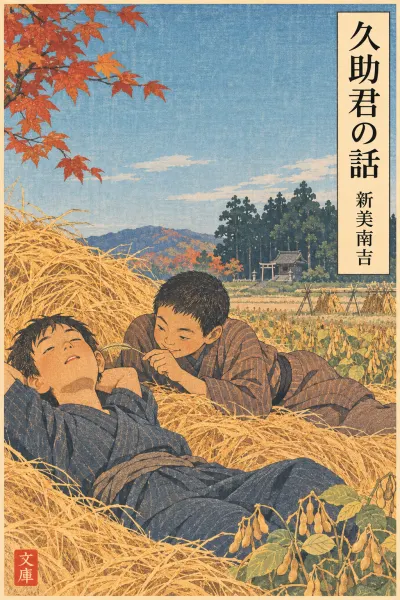
着物から草のごみをはらい、おびをしめなおすと、てれくさい気持ちで、久助君は兵太郎君にわかれた。Kyūsuke brushed the bits of grass off his kimono, retied his sash, and, feeling a little embarrassed, parted from Hyōtarō.
しっけ、ともいわないで。Without even saying "See ya."
だがそれからの久助君は、こう思うようになった。But from then on, Kyūsuke came to think this way:
――わたしがよく知っている人間でも、ときには、まるで知らない人間になってしまうことがあるものだと。—that even a person I know well can sometimes turn into someone I don't know at all; such things do happen.
そして、わたしがよく知っているのがほんとうのその人なのか、わたしの知らないのがほんとうのその人なのか、わかったもんじゃないと。And there's no telling whether the person I know well is the real one, or whether the one I don't know is the real one.
そしてこれは、久助君にとって、ひとつの新しい悲しみであった。And for Kyūsuke, this was a new kind of sadness.
Vocabulary
| Word | Meaning | JLPT |
|---|---|---|
| ゆるめてゆるめる | to loosen, to relax (a grip)dictionary form: 緩めるTransitive. The intransitive partner is 緩む (to become loose). | N1 |
| 虚に乗じてきょにじょうじる | to take advantage of an opening or unguarded momentdictionary form: 虚に乗じるLiterary set phrase. 虚 means 'emptiness' or 'an unguarded gap'. | — |
| 立ちなおろうたちなおる | to get back up, to recoverdictionary form: 立ち直るAlso used figuratively for recovering from a setback. | — |
| むっくりむっくり | (rising) slowly and heavily, all of a sudden from lying downMimetic word, often followed by 起きあがる. | — |
| 地平線ちへいせん | the horizon (over land)The horizon over the sea is 水平線. | N3 |
| ややしばらくややしばらく | for quite a whiledictionary form: やや暫くSomewhat literary. やや (rather) strengthens しばらく (a while). | — |
| まなざしまなざし | look, gaze, expression in one's eyesdictionary form: 眼差し | — |
| 顔つきかおつき | facial expression, look on one's face〜つき means 'appearance', as in 目つき (the look in someone's eyes). | N1 |
| 思いこんでおもいこむ | to be convinced of, to assume (often wrongly)dictionary form: 思い込む | N2 |
| くるっていたくるう | to frolic wildly, to romp and roughhousedictionary form: 狂うUsually means 'to go mad' or 'to go wrong'. Here it means playing wildly. | N3 |
| うら返しうらがえし | inside out, turned overdictionary form: 裏返し | N1 |
| 見知らぬみしらぬ | unfamiliar, never seen beforeA fixed form using the old negative 〜ぬ, the written equivalent of 見知らない. | — |
| 日ごろひごろ | everyday, usualdictionary form: 日頃 | N1 |
| てれくさいてれくさい | embarrassed, awkward, bashfuldictionary form: 照れくさい | — |
| しっけしっけい | 'so long', a casual goodbye (clipped colloquial form of 失敬)dictionary form: 失敬A shortened, dialectal form of 失敬, an old-fashioned casual parting word used by boys. | — |
Grammar
〜ようとしない N3 won't (try to) do; makes no attempt to
The volitional form plus とする means 'try to do'. In the negative, it shows that someone shows no sign of doing something, even when expected to.
それでも相手は立ちなおろうとしない。
Even so, his opponent made no attempt to get back up.
〜ないで N4 without doing
The plain negative plus で describes the manner of the following action: Hyōtarō gazes at the horizon without saying anything.
なにもいわないで、地平線のあたりをややしばらくながめていた
without saying a word, he gazed for quite a while toward the horizon
〜ようになる N4 come to (do/think)
A dictionary-form verb plus ようになる expresses coming to do something, a change in state or habit. Here: from then on, Kyūsuke came to think this way.
だがそれからの久助君は、こう思うようになった。
But from then on, Kyūsuke came to think this way:
〜ことがあるものだ N2 it can happen that…; things like that do happen
ことがある means 'there are times when'. Adding ものだ turns it into a general truth that the speaker has come to recognize.
まるで知らない人間になってしまうことがあるものだと
can sometimes become someone I don't know at all
〜か〜か、わかったもんじゃない N2 there's no telling whether A or B
Two embedded questions ending in のか are set side by side. わかったもんじゃない (colloquial for わかったものではない) strongly denies that anyone could ever know.
わたしの知らないのがほんとうのその人なのか、わかったもんじゃないと
or whether the one I don't know is the real one, there's no telling
〜にとって N3 for, to (from someone's point of view)
Marks the person whose viewpoint or experience is being described. The discovery is a sadness specifically for Kyūsuke.
そしてこれは、久助君にとって、ひとつの新しい悲しみであった。
And for Kyūsuke, this was a new kind of sadness.