Part 3 of 4 · JLPT N3
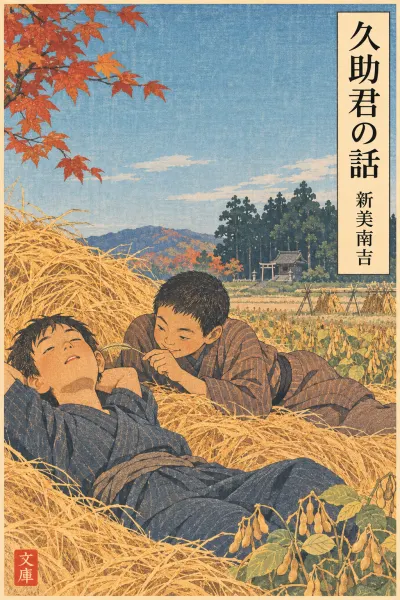
久助君の話 Kyūsukekun no Hanashi, part 3: A Wrestling Match in the Hay
In this part
Kyūsuke and Hyōtarō roll and wrestle in the hay until evening, and Kyūsuke keeps changing his mind about whether his friend is joking or fighting for real. When Hyōtarō finally stops resisting, the sound of a distant cart reminds Kyūsuke that dusk has come, and a sudden loneliness comes over him. Still pinning his friend down, he realises he has not looked at Hyōtarō's face once, and he wonders anxiously what the other boy is thinking.
AI translation · independently checked
そこでふたりは、おたがいが、ねこの子のようなものになってしまったことを感じた。Then the two of them felt that they had both turned into something like kittens.
それからふたりは、ほし草にくるまりながら、上になり下になりしてくるいはじめた。After that, wrapped up in the hay, they began to romp wildly, one on top and then the other underneath.
しばらくのあいだ、久助君は、じょうだんのつもりで、くるっていた。For a while Kyūsuke went on romping, meaning it all as a joke.
相手もそのつもりでやっていることだと思っていた。He believed that the other boy was doing it in the same spirit.
ところが、そのうちに、久助君はひとつの疑問にとらわれだした。Before long, however, Kyūsuke found himself caught by a doubt.
どうも相手は、本気になってやっているらしい。It seemed somehow that the other boy was doing it in earnest.
久助君を下からはねのけるときに、久助君の胸をついたが、どうも、じょうだん半分のあらそいの場合の力の入れかたとはちがっている。When he pushed Kyūsuke off from underneath, he shoved him in the chest, and the force behind it somehow felt different from the way you push in a half-joking scuffle.
また、久助君を上からおさえつけるときの、相手のやせた腕が、ぶるぶるとふるえている。And when he held Kyūsuke down from above, his thin arms were trembling.
じょうだん半分なら、そんなことはないはずである。If he were only half joking, that surely would not happen.
相手がしんけんなら、こちらもしんけんにならなきゃいけない、と久助君はそのつもりになって、一生けんめいにやりだしたが、そうするうちに、まもなくまた、つぎの疑問がわいてきた。If the other boy was serious, then he had to be serious too, Kyūsuke thought, and he made up his mind to it and began to struggle with all his might; but as he did so, another doubt soon welled up.
やはり、兵太郎君は、じょうだん半分と心得てくるっているらしい。It seemed that Hyōtarō was romping about as a half-joke after all.
久助君の手が、あやまって相手のわきのしたから、熱っぽいふところにもぐりこんだとき、兵太郎君はクックッとわらったからである。For when Kyūsuke's hand slipped by accident under the other boy's arm and into the feverish warmth inside his kimono, Hyōtarō giggled, "Heh-heh."
相手がじょうだんでやっているのなら、こちらだけしんけんでやっているのは、男らしくないことなので、こちらもそのつもりになろうと思っていると、まもなくまた、まえの疑問があたまをもたげる。If the other boy was only fooling around, it would be unmanly to be the only one taking it seriously, so Kyūsuke was thinking he would treat it as a game too, when soon the first doubt raised its head again.
ふたつの疑問が交互にあらわれたり消えたりしたが、ふたりはともかくくるいつづけた。The two doubts kept appearing and vanishing in turn, but the two boys went on romping all the same.
久助君は顔をほし草におしつけられて、ほし草をくわえたり、ほし草があるつもりでひっくり返ったところにほし草がなくて、頭をじかに地べたにぶつけ、じーんと頭じゅうが鳴りわたって、あついなみだがうかんだりした。Kyūsuke had his face pressed into the hay and got mouthfuls of it; or he would tumble backwards thinking there was hay there, find there was none, and bang his head straight on the bare ground, so that his whole head rang and hot tears welled up in his eyes.
また、しっかりと、複雑に、手足を相手の手足にからませているときは、じぶんと相手の足の区別など、はっきりつかないので、相手の足をおさえつけたつもりで、じぶんのもう一方の足をおさえつけたりしていることもあった。And when their arms and legs were tightly and intricately tangled together, he couldn't clearly tell his own legs from the other boy's, so there were times when he meant to pin down the other boy's leg and found he was pinning down his own other leg instead.
とっくみあいは、夕方までつづいた。The wrestling went on until evening.
おびはゆるみ、着物はだらしなくなってしまい、じっとりあせばんだ。Their sashes came loose, their kimonos were in a mess, and they were damp with sweat.
なんどめかに、久助君が上になって兵太郎君をおさえつけたら、もう兵太郎君は、ていこうしなかった。After who knows how many rounds, Kyūsuke came out on top and held Hyōtarō down, and this time Hyōtarō didn't resist any more.
ふたりは、しいんとなってしまった。The two of them fell completely silent.
二町ばかりはなれた道を通るらしい車の輪の音が、カラカラときこえてきた。They heard the rattle of cart wheels, apparently passing along a road about two hundred metres away.
それが、はじめて聞いたこの世の物音のように感じられた。It felt like the first sound of this world he had ever heard.
その音は、もう夕方になったということを久助君に知らせた。That sound told Kyūsuke that evening had already come.
久助君は、ふいとさびしくなった。All of a sudden Kyūsuke felt lonely.
くるいすぎたあとに、いつも感じるさびしさである。It was the loneliness he always felt after romping too much.
もうやめようと思った。He thought he would stop now.
だがもし、これで立ちあがって兵太郎君がベソをかいていたら、どんなにやりきれぬだろうということを、久助君は痛切に感じた。But Kyūsuke felt keenly how unbearable it would be if he stood up now and found Hyōtarō on the verge of tears.
おかしいことに、とっくみあいのあいだじゅう、久助君は、一ぺんも相手の顔を見なかった。Strangely enough, the whole time they were wrestling, Kyūsuke had not looked at the other boy's face even once.
今こうして相手をおさえていながらも、じぶんの顔は相手の胸の横にすりつけて下をむいているので、やはり、相手の顔は見ていないのである。Even now, as he held the other boy down like this, his own face was pressed against the side of the other boy's chest and turned downwards, so he still was not looking at the other boy's face.
兵太郎君は身動きもせず、じっとしている。Hyōtarō lay perfectly still, without moving a muscle.
かなりはやい呼吸が、久助君の顔につたわってくる。Kyūsuke could feel the other boy's rather quick breathing on his face.
兵太郎君は、いったいなにを考えているのだろう。What on earth could Hyōtarō be thinking?
Vocabulary
| Word | Meaning | JLPT |
|---|---|---|
| くるいはじめたくるう | to romp wildly, play roughlydictionary form: 狂うUsually means 'to go mad', but of children it means to frolic and roughhouse without restraint. | N3 |
| 疑問ぎもん | doubt, question疑 = doubt, 問 = ask. | N3 |
| とらわれだしたとらわれる | to be seized by, caught up in (a thought)dictionary form: 囚われる | — |
| 本気ほんき | seriousness, in earnestContrasts with じょうだん (joke) throughout the passage; しんけん (真剣) is a near-synonym. | N1 |
| はねのけるはねのける | to push off, throw offdictionary form: 撥ね除ける | — |
| おさえつけるおさえつける | to hold down, pin downdictionary form: 押さえ付ける | — |
| 心得てこころえる | to regard as, understand (something) to bedictionary form: 心得るSomewhat literary; AとBと心得る = 'take A to be B'. | N2 |
| ふところふところ | the inside front of a kimono, against the chestdictionary form: 懐Where people kept things close to the body; also used figuratively for 'one's finances'. | — |
| 交互こうご | alternately, by turns | N1 |
| 地べたじべた | the bare groundColloquial word for the ground's surface. | — |
| とっくみあいとっくみあい | a grappling match, wrestling, scuffledictionary form: 取っ組み合い | — |
| あせばんだあせばむ | to become damp with sweatdictionary form: 汗ばむ〜ばむ means 'to take on a slight quality of'. | — |
| 町ちょう | chō, an old unit of distance (about 109 m)Read ちょう as a counter, not まち. | N5 |
| ベソをかいていたらべそをかく | to pull a crying face, be close to tearsdictionary form: べそをかくSaid of children. | — |
| 痛切つうせつ | keenly, acutely | N1 |
Grammar
〜になり〜になりして N2 now ~, now ~ (alternating states)
Repeating the stem form of なる with two opposite states shows them alternating back and forth. Here the boys keep changing places, one on top and then the other.
上になり下になりしてくるいはじめた
began to romp wildly, one on top and then the other underneath
〜つもりで N4 intending as, with the idea that
Nounのつもりで means doing something with that intention or in that spirit. The passage also uses 〜たつもりで for 'believing one had done', as in 相手の足をおさえつけたつもりで.
久助君は、じょうだんのつもりで、くるっていた
Kyūsuke went on romping, meaning it all as a joke
〜はずである N4 should, surely (logical expectation)
はず expresses what the speaker reasons ought to be the case. In the negative, ないはずである means 'that surely would not happen'. である is the written-style form of だ.
じょうだん半分なら、そんなことはないはずである。
If he were only half joking, that surely would not happen.
〜なきゃいけない N4 have to, must
なきゃ is the casual contraction of なければ. With いけない it means something must be done, here reported as Kyūsuke's thought.
こちらもしんけんにならなきゃいけない
he had to be serious too
〜ぬ N1 not (classical negative)
ぬ is an old-fashioned negative ending equal to ない. やりきれぬ means the same as やりきれない, 'unbearable'.
どんなにやりきれぬだろう
how unbearable it would be